From the free course AP Human Geography on Lykke
2.8 Women and Demographic Change
Key concepts: Women’s social and economic roles · Education and employment of women · Fertility and birth rates · Demographic Transition Model stages 3 and 4 · Population growth and decline · Rate of Natural Increase (RNI) · Doubling time · Age of marriage · Infant mortality and fertility · Economic effects of demographic change
When women gain greater access to education and paid employment, fertility usually declines because marriage and childbearing are often delayed, the opportunity cost of raising children increases, and families gain more control over reproductive decisions.
2.8 Women and Demographic Change
When women gain greater access to education and paid employment, fertility usually declines because marriage and childbearing are often delayed, the opportunity cost of raising children increases, and families gain more control over reproductive decisions. This relationship helps explain why population growth commonly slows as countries move from stage 3 to stage 4 of the Demographic Transition Model.
Women’s social and economic roles
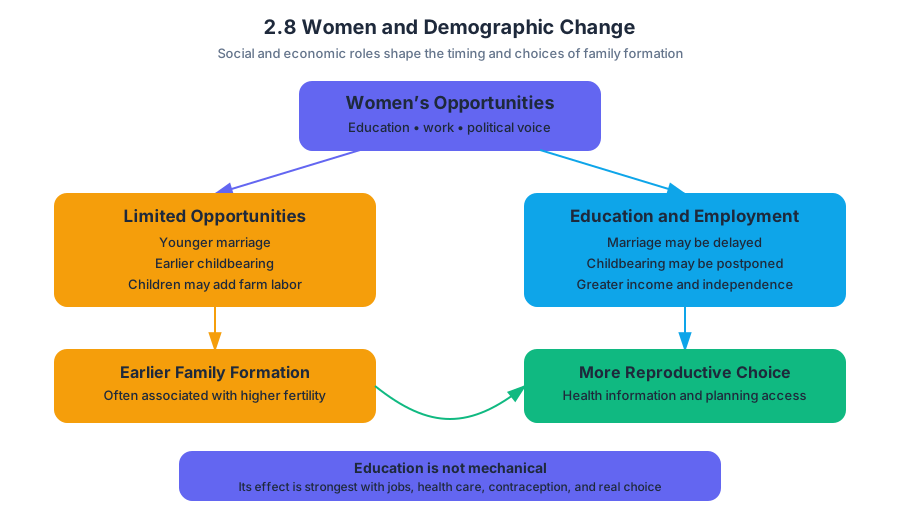
A society’s expectations for women shape demographic behavior. In places where women have limited educational, occupational, and political opportunities, marriage may occur at younger ages and childbearing may begin earlier. Children may also be viewed as economic assets, especially in highly agricultural societies where they can contribute labor to farming or household production.
By contrast, education and paid employment can delay both marriage and childbearing. A student who remains in school longer or an adult pursuing a career may postpone having children. Employment can also increase women’s independence, household income, and access to health information, contraception, and family-planning services.
The relationship is not mechanical: education alone does not automatically produce low fertility. Its demographic effect is strongest when education is paired with employment opportunities, accessible health care, contraception, and social conditions that allow women to make meaningful reproductive choices.
Education, employment, and fertility
Fertility refers to the actual reproductive behavior of a population, often measured with the total fertility rate (TFR), the average number of children born to a woman during her lifetime. The crude birth rate (CBR) measures live births per $1{,}000$ people in a year, while fertility focuses more directly on childbearing patterns.
Consider two countries with similar populations. In Country A, most women marry at age $19$, work primarily in subsistence agriculture, and have limited access to contraception. In Country B, women commonly complete secondary or higher education, enter paid employment, marry later, and have reliable access to family planning. Country A will generally have higher fertility and faster population growth than Country B.
A second factor is infant mortality. When many infants die, families may have more children because they cannot be certain that all children will survive to adulthood. As infant mortality falls through improved health care, sanitation, and nutrition, families often choose fewer births while maintaining the desired number of surviving children.
Key relationship: Expanded education and employment for women are associated with lower fertility; limited social roles, early marriage, agricultural child labor, and high infant mortality are associated with higher fertility.
Stages 3 and 4 of the Demographic Transition Model
The Demographic Transition Model (DTM) connects changing birth and death rates to economic and social development. In stage 3, the death rate is already low, but the birth rate declines as urbanization, education, contraception, and changing family expectations spread. In stage 4, both birth and death rates are low, so population growth is slow, zero, or sometimes negative.
The movement from stage 3 to stage 4 often reflects changes in women’s lives. Increased education and employment can raise the age of marriage, reduce the number of years available for childbearing, and make large families less economically practical. These changes lower the birth rate even when life expectancy remains high.
Misconception check — “Stage 4 means the population immediately shrinks.” Not necessarily. A stage-4 country may continue growing because of population momentum: a large number of people may still be entering childbearing ages. Negative growth occurs only when deaths exceed live births, producing a negative Rate of Natural Increase.
Rate of Natural Increase and doubling time
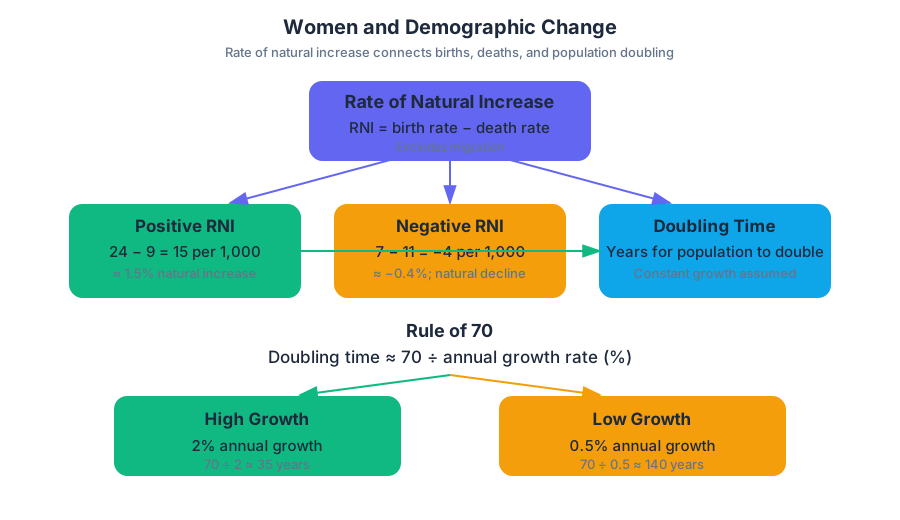
The Rate of Natural Increase (RNI) measures population change from births and deaths, excluding migration. It is calculated as:
$$ \text{RNI} = \text{crude birth rate} - \text{crude death rate} $$
If a country has a crude birth rate of $24$ per $1{,}000$ people and a crude death rate of $9$ per $1{,}000$, its difference is $15$ per $1{,}000$, or approximately $1.5%$ natural increase. If births are $7$ per $1{,}000$ and deaths are $11$ per $1{,}000$, the RNI is $-4$ per $1{,}000$, or approximately $-0.4%$; the population is declining naturally.
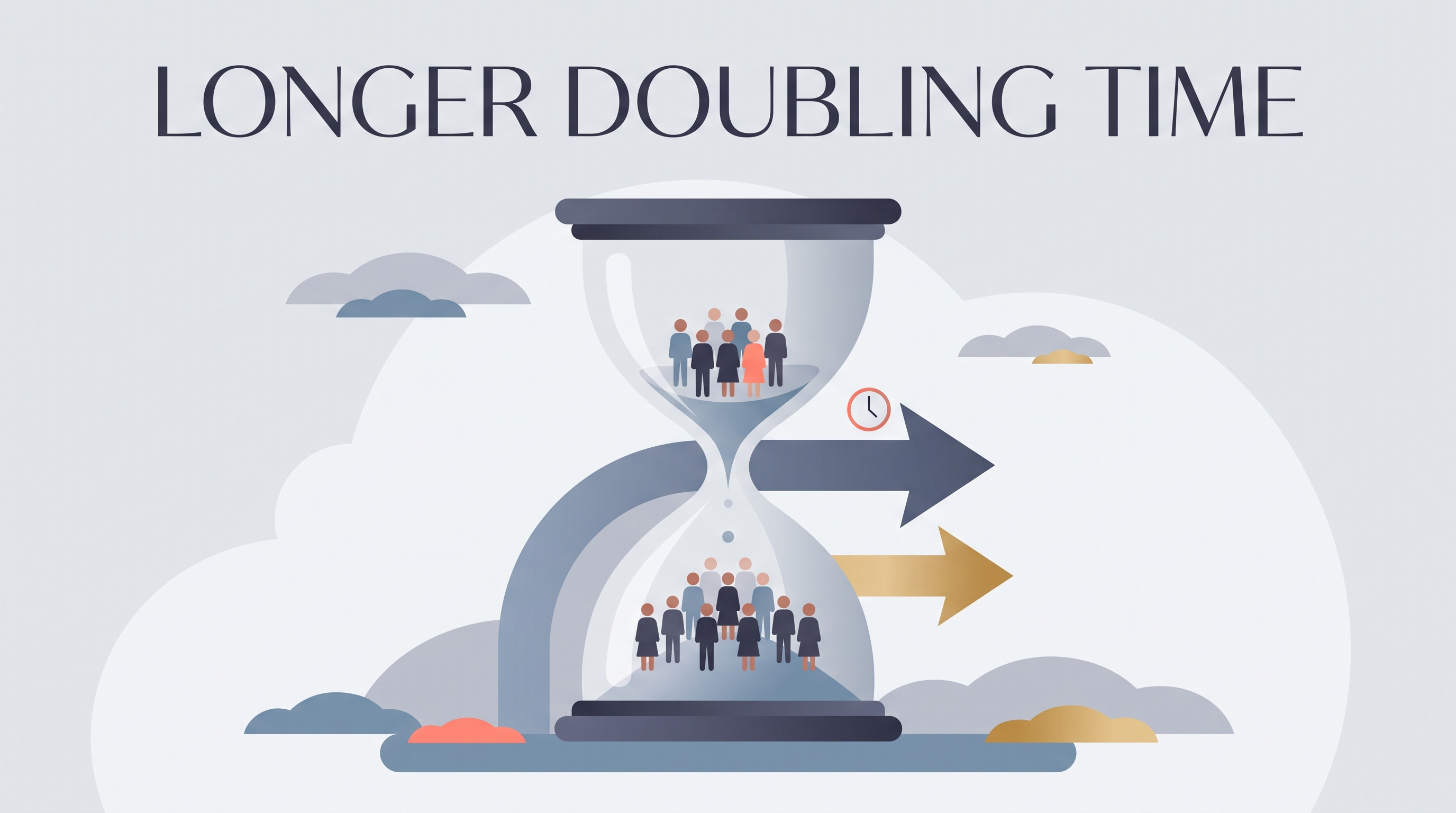
A high RNI generally produces a short doubling time, the time required for a population to double if its growth rate remains constant. A low RNI produces a long doubling time. The “rule of $70$” gives an estimate:
$$ \text{Doubling time} \approx \frac{70}{\text{annual growth rate in percent}} $$
For an annual growth rate of $2%$, doubling time is approximately $\frac{70}{2}=35$ years. At $0.5%$, it is approximately $140$ years.
Population change and economic effects
Population change creates short- and long-term economic consequences. Rapid growth can expand the labor force and consumer market, but it can also strain schools, housing, health care, food systems, and infrastructure. Negative growth can reduce the available workforce and increase government spending on pensions, health care, and other support for older residents.
Skill connections: Topic 2.8 draws especially on Skill 2.C: Spatial Relationships, when explaining how demographic conditions vary between places; Skill 3.B: Data Analysis, when describing population patterns and trends; Skill 3.D: Data Analysis, when comparing demographic data; and Skill 3.F: Data Analysis, when identifying limitations in demographic data. The topic’s required content includes IMP-2.B.1, which connects women’s social and economic roles to population change.
Retrieval check
A country’s birth rate falls from $30$ to $15$ per $1{,}000$, while its death rate remains $8$ per $1{,}000$. What happens to its RNI and doubling time? The RNI falls from $22$ to $7$ per $1{,}000$; natural growth continues, but doubling time becomes longer because population growth has slowed.
Source Materials
- AP Human Geography Course and Exam Description
- AP Human Geography Course and Exam Description Clarifications and Corrections
- AP Human Geography Course Overview
- AP Human Geography Course at a Glance
- AP Human Geography Course at a Glance Poster
- AP Human Geography
- AP Human Geography
- AP Human Geography Sample Syllabus 1