From the free course AP Human Geography on Lykke
7.6 Trade and the World Economy
Key concepts: Neoliberal policies · Free trade agreements · International trade organizations · Spatial connections and trade relationships · Economic interdependence · Deindustrialization · Complementarity · Comparative advantage · Trade agreements and national sovereignty · Free-trade, special economic, and export-processing zones
A soybean shipment from Paraguay can feed Argentina’s food system, support Paraguayan farmers, and connect both economies to global prices and trade rules. International trade is the exchange of goods and services across places; it grows when economies have different resources, skills, technologies, or production…
7.6 Trade and the World Economy
A soybean shipment from Paraguay can feed Argentina’s food system, support Paraguayan farmers, and connect both economies to global prices and trade rules. International trade is the exchange of goods and services across places; it grows when economies have different resources, skills, technologies, or production costs.
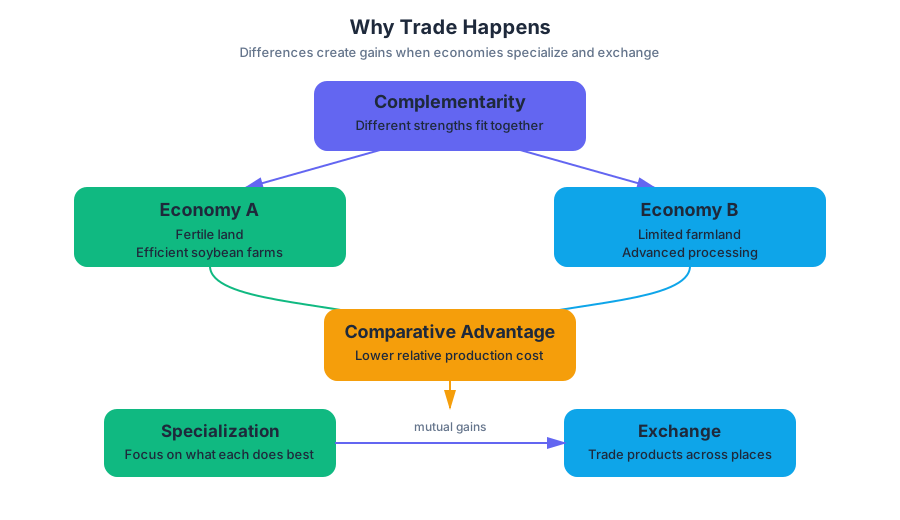
PSO-7.A.1 — Complementarity and comparative advantage establish the basis for trade. Complementarity exists when places have different supplies or needs, so each can provide something the other wants. Comparative advantage means specializing in the activity a place can perform at a lower opportunity cost relative to other activities.
Why trade happens
Imagine two neighboring economies. Economy A has fertile land and efficient soybean farms, while Economy B has limited farmland but advanced food-processing facilities. Even if B could grow some soybeans, both places may gain when A specializes in soybeans and B specializes in processing, then exchanges the products. Their differences create complementarity; their relative production costs create comparative advantage.
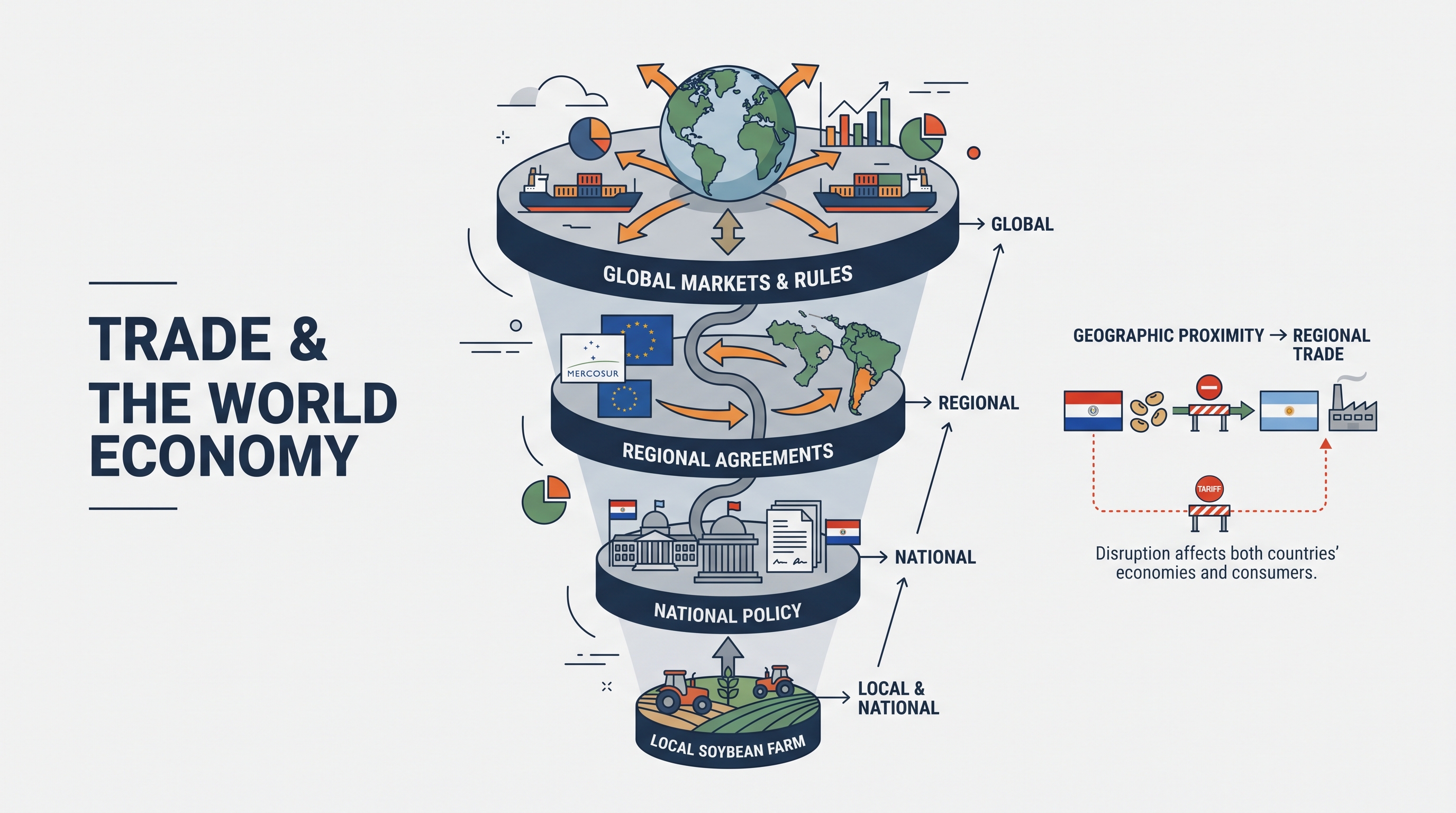
In 2021, Argentina imported $2.34 billion in soybeans from Paraguay, and 95% of Argentina’s total soybean imports came from Paraguay. The relationship illustrates more than a simple flow of goods: Paraguay’s agricultural production complements Argentina’s demand, while transportation networks, prices, contracts, and trade policies connect the two places spatially.
Neoliberal policies and trade organizations
Neoliberal policies generally favor reduced government barriers to economic exchange, including lower tariffs, fewer restrictions on imports and exports, privatization, and expanded participation in global markets. Free trade agreements are formal arrangements in which participating states reduce trade barriers and establish shared rules.
PSO-7.A.2 — Neoliberal policies, including free trade agreements, have created new organizations, spatial connections, and trade relationships, such as the EU, World Trade Organization (WTO), Mercosur, and OPEC, that foster greater globalization.
These organizations do not all perform the same function. The European Union (EU) is a regional political and economic bloc whose members coordinate many policies and facilitate trade. The World Trade Organization (WTO) provides a global framework for trade rules and dispute settlement. Mercosur is a South American regional trade bloc that links member economies. OPEC, by contrast, is primarily an organization of oil-producing countries that coordinates petroleum policy; it should not be treated as equivalent to a general free-trade organization.
Trade agreements can reduce tariffs, standardize regulations, protect investment, and create procedures for resolving disputes. They can also align states that share economic interests, geographic proximity, or exposure to the same transnational problems. However, cooperation may challenge sovereignty when a member state must change domestic laws, open borders to trade, or follow jointly negotiated rules.
Interdependence across scales
Economic interdependence is mutual dependence among economies created by trade, investment, supply chains, financial systems, and shared policies. A country may rely on another for raw materials, components, energy, markets, loans, or transportation services.
A disruption in one economy can therefore travel through the network:
$$ \text{factory shutdown} \rightarrow \text{fewer exports} \rightarrow \text{input shortage} \rightarrow \text{higher prices} \rightarrow \text{job and consumption changes} $$
For example, if a major soybean supplier experiences drought, importing firms may pay more, food processors may face higher costs, consumers may encounter rising prices, and workers in connected industries may experience changing employment. The same process can operate in reverse: a tariff, financial crisis, or policy change can alter production and consumption far beyond the government that adopted it.
PSO-7.A.3 — Government initiatives at all scales may affect economic development, including tariffs. A tariff is a tax placed on an imported good. It may protect domestic producers, but it can also raise consumer prices, reduce imports, provoke retaliation, and reshape trade relationships.
Global financial institutions add another layer of connection. Debt crises, international lending agencies such as the International Monetary Fund (IMF), and development strategies such as microlending demonstrate how economies can become closely connected—even interdependent—through credit and financial policy (PSO-7.A.4).
Trade’s uneven consequences
Free trade can expand markets, lower prices, and create economies of scale, in which producing at a larger volume lowers the average cost per unit. It can also encourage investment in new manufacturing zones, free-trade zones, special economic zones, and export-processing zones, where governments often offer tax advantages, simplified regulations, or improved infrastructure to attract globally oriented firms.
At the same time, international trade can change the economic sectors of national economies. Deindustrialization is the decline of manufacturing employment or output in a place, often associated with automation, international competition, relocation of factories, or a shift toward service-sector work. A country may gain export revenue overall while particular industrial regions lose factories, wages, and population.
Named misconception check — “Free trade benefits every place equally.” Trade can produce national or global growth while distributing gains and losses unevenly. Exporting regions, consumers, investors, and highly skilled workers may benefit, while import-competing industries and former manufacturing communities experience job loss or economic decline.
Skill in action: Scale Analysis (5.B)
5.B — Scale Analysis: “Explain spatial relationships across various geographic scales using geographic concepts, processes, models, or theories.” Apply it by tracing one trade relationship from the local soybean farm, to national agricultural policy, to regional organizations such as Mercosur, and finally to global markets and financial rules. A strong explanation connects the scales rather than merely naming them.
Retrieval check: Argentina receives most of its imported soybeans from Paraguay. Identify the geographic concept that explains why the two economies trade, then name one way a tariff or supply disruption could affect consumers and producers in both countries.
Source Materials
- AP Human Geography Course and Exam Description
- AP Human Geography Course and Exam Description Clarifications and Corrections
- AP Human Geography Course Overview
- AP Human Geography Course at a Glance
- AP Human Geography Course at a Glance Poster
- AP Human Geography
- AP Human Geography
- AP Human Geography Sample Syllabus 1