From the free course AP Human Geography on Lykke
3.3 Cultural Patterns
Key concepts: Cultural convergence · Cultural divergence · Migration and cultural diffusion · Global agricultural patterns · Cultural, economic, and environmental influences on agriculture · Communication technology and cultural change · Indigenous language loss and preservation · Language replacement by dominant languages such as English · Religion expressed through regional architecture · Visual-source analysis of cultural patterns
Cultural patterns are never random: they reveal how people, places, environments, economies, and technologies shape one another. A language map, a religious building, or an agricultural map can therefore be read as evidence of cultural processes—not merely as a collection of locations.
3.3 Cultural Patterns
Cultural patterns are never random: they reveal how people, places, environments, economies, and technologies shape one another. A language map, a religious building, or an agricultural map can therefore be read as evidence of cultural processes—not merely as a collection of locations.
Learning Objective 3.3: Explain the regional distribution of cultural traits and cultural identity.
Essential Knowledge SPS-3.A: Contemporary cultural patterns and processes reflect interactions among migration, globalization, communication technology, and local cultural practices.
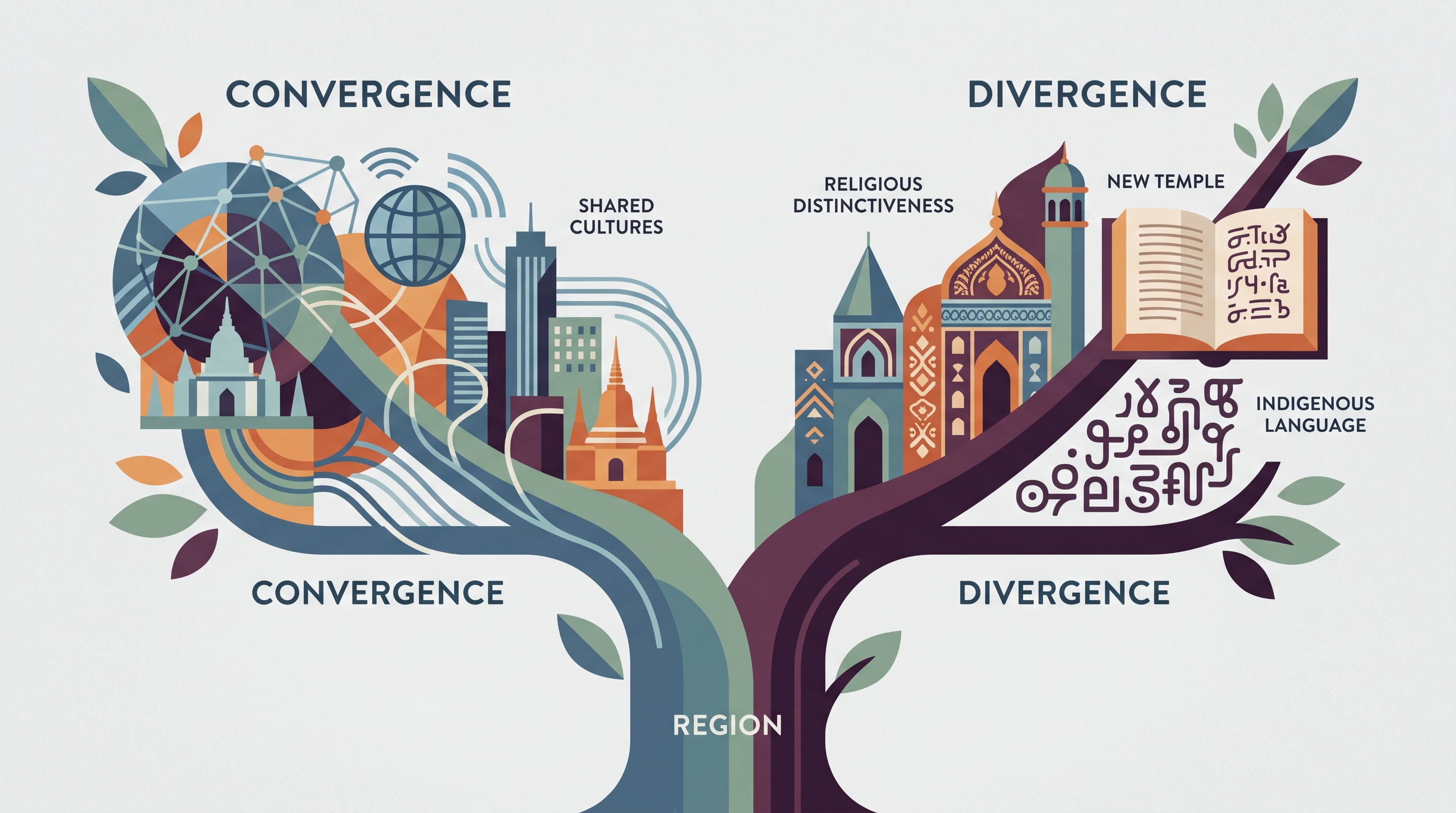
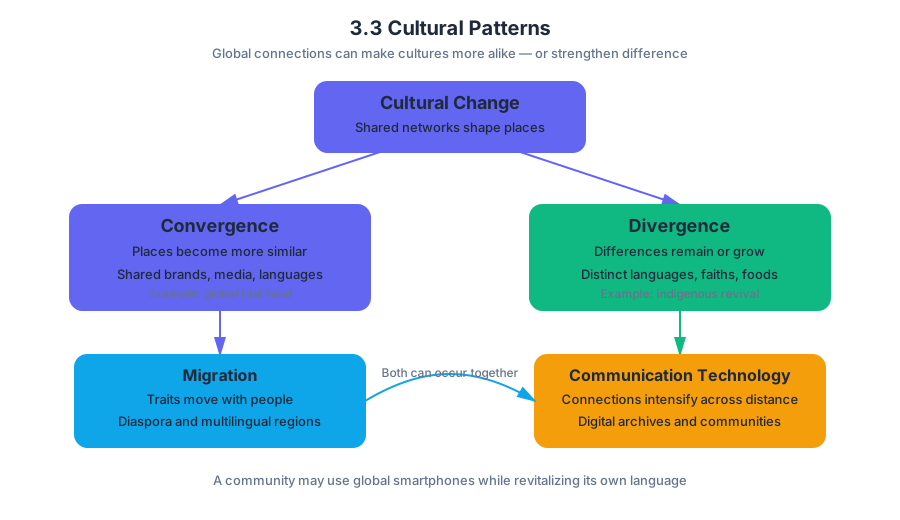
Essential Knowledge SPS-3.A.1–SPS-3.A.4: Cultural patterns may produce both cultural convergence, in which places become more alike, and cultural divergence, in which groups maintain or develop distinct identities.
Convergence and divergence
Cultural convergence occurs when different places or groups become more similar because they share cultural traits, technologies, institutions, products, or practices. The global use of English, international fast-food chains, and widely shared digital media can all contribute to convergence.
Cultural divergence occurs when cultural differences become stronger or remain distinct. A community may preserve its language, religion, foodways, architecture, or agricultural traditions even while participating in global networks. Convergence and divergence can occur simultaneously: a community may use global smartphones while revitalizing an indigenous language through those same devices.
| Process | Direction of cultural change | Geographic evidence |
|---|---|---|
| Cultural convergence | Places become more similar | Shared languages, brands, media, or technologies |
| Cultural divergence | Groups maintain or strengthen differences | Distinct religious landscapes, indigenous languages, or regional traditions |
| Migration | Traits move with people | Diaspora neighborhoods, multilingual regions, new religious structures |
| Communication technology | Connections intensify across distance | Global language use, online cultural communities, digital archives |
Migration as a cultural process
Migration can produce cultural convergence when migrants and host communities exchange traits. For example, migrants may bring a language, religion, cuisine, music, or clothing style to a destination, while also adopting some practices of the receiving society. Over time, a city may contain shared cultural institutions and blended practices that were previously associated with separate regions.
Migration can also produce cultural divergence. Migrants may establish places of worship, businesses, schools, media outlets, and neighborhoods that preserve a distinctive identity. This does not necessarily mean complete separation; it means that migration can maintain visible cultural differences within a larger society.
Key distinction: Migration does not automatically cause assimilation. It can create similarity through interaction, difference through cultural preservation, or both at once.
Reading cultural patterns from visual sources
A map showing religious architecture can reveal a regional religious pattern. The presence of mosques, churches, synagogues, temples, or other structures built for worship suggests that the associated religion is practiced in that region. If the structures are widespread and prominent, the religion may be practiced by a majority of the local population—but the buildings alone do not prove that every resident follows that faith.
To interpret a cultural map, move from pattern to process:
- Identify where the trait is concentrated.
- Identify where it is sparse or absent.
- Describe the pattern using geographic evidence.
- Connect the pattern to migration, environment, economics, history, or technology.
- Decide whether the process suggests convergence, divergence, or both.
Agriculture: culture meets environment
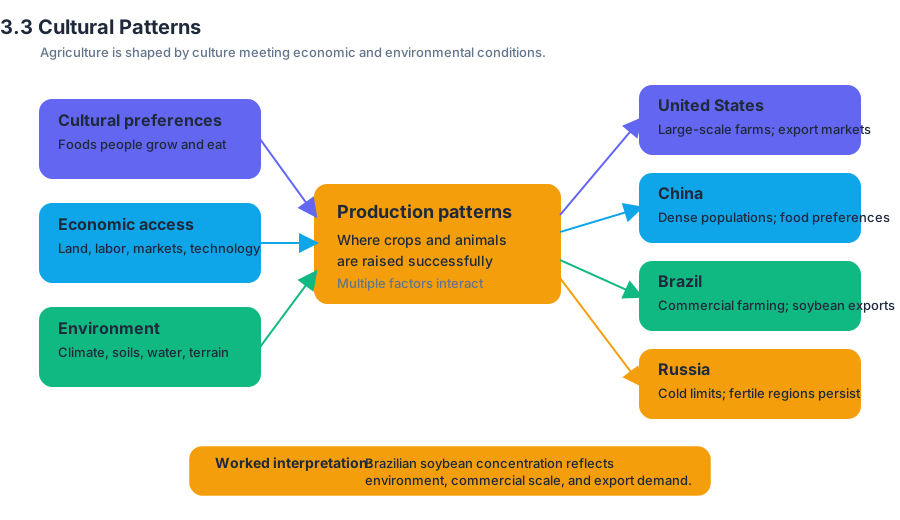
Agricultural production patterns differ across countries because agriculture is shaped by cultural, economic, and environmental factors. Cultural preferences influence which foods people grow and consume. Economic conditions influence access to land, labor, capital, markets, transportation, and technology. Environmental conditions—including climate, soils, water availability, and terrain—affect which crops and animals can be raised successfully.
Consider a comparison of agricultural production maps for the United States, China, Brazil, and Russia. A high-production area should not be explained by climate alone: dense populations and food preferences may increase production in parts of China; large-scale commercial farming and export markets may shape production in the United States and Brazil; and Russia’s production pattern is strongly constrained by its extensive cold environments, even though fertile areas support important agricultural regions.
Worked interpretation: If a map shows high soybean production concentrated in Brazil, a strong explanation combines several factors: suitable warm growing conditions, extensive land, commercial farming, investment, transportation networks, and international demand for animal feed and vegetable oil. Saying only “Brazil has a good climate” identifies one factor but does not explain the full cultural-economic-environmental pattern.
Communication technology and language change
The Internet and global communication can encourage cultural convergence by making widely used languages—especially English—more useful for education, employment, entertainment, science, and international communication. Members of indigenous-language communities may increasingly use a dominant global language, causing the indigenous language to be ignored, used less often, or lost across generations.
Technology can also support cultural divergence and preservation. Digital archives can record pronunciation, stories, and vocabulary; language-learning applications can make instruction widely available; and social media can connect speakers, teachers, elders, and younger learners. The same communication technology can therefore accelerate language loss or help revitalize a language, depending on how communities use it.
Named misconception: “Technology always destroys indigenous languages.”
The accurate explanation is conditional: technology may promote adoption of a dominant language through convergence, or provide resources for indigenous-language preservation.
AP skills in action
Skill 1.A: Define and explain geographic concepts, processes, models, and theories. Use precise definitions for convergence, divergence, cultural diffusion, and cultural identity rather than treating them as synonyms.
Skill 2.C: Explain spatial relationships. Connect the location of a religious structure, language region, or agricultural concentration to a process such as migration, globalization, environmental limitation, or market access.
Skill 3.A: Identify patterns and trends in maps and other visual sources. Describe concentrations, gaps, clusters, and contrasts before explaining why they occur.
Skill 5.B: Explain spatial relationships across different scales of analysis. A language may be declining globally but thriving in one local community; an agricultural pattern may be national in scale but vary sharply among subnational regions.
Retrieval check
A region contains new temples built by migrants, widespread English-language media, and a growing online archive of an indigenous language. What conclusion is best supported? The region shows both cultural convergence through migration and global communication and cultural divergence through religious distinctiveness and indigenous-language preservation. A strong answer identifies the visible pattern and explains the process connecting it to the evidence.
Source Materials
- AP Human Geography Course and Exam Description
- AP Human Geography Course and Exam Description Clarifications and Corrections
- AP Human Geography Course Overview
- AP Human Geography Course at a Glance
- AP Human Geography Course at a Glance Poster
- AP Human Geography
- AP Human Geography
- AP Human Geography Sample Syllabus 1