From the free course AP Human Geography on Lykke
4.1 Introduction to Political Geography
Key concepts: Political organization of space · Historical and current political processes and events · State sovereignty · Supranational organizations · Challenges to state sovereignty · EU and ASEAN · Communication technologies and sovereignty · Resource disputes on land and at sea · Gerrymandering
Political geography asks a deceptively powerful question: who controls which space, and how did that arrangement come to exist? The political organization of space results from historical and current processes, events, and ideas, so a political map is not simply a picture of borders—it is a record of conflict,…
4.1 Introduction to Political Geography
Political geography asks a deceptively powerful question: who controls which space, and how did that arrangement come to exist? The political organization of space results from historical and current processes, events, and ideas, so a political map is not simply a picture of borders—it is a record of conflict, cooperation, empire, independence, identity, and power.
PSO-4: The political organization of space results from historical and current processes, events, and ideas.
Political entities: the building blocks of the map
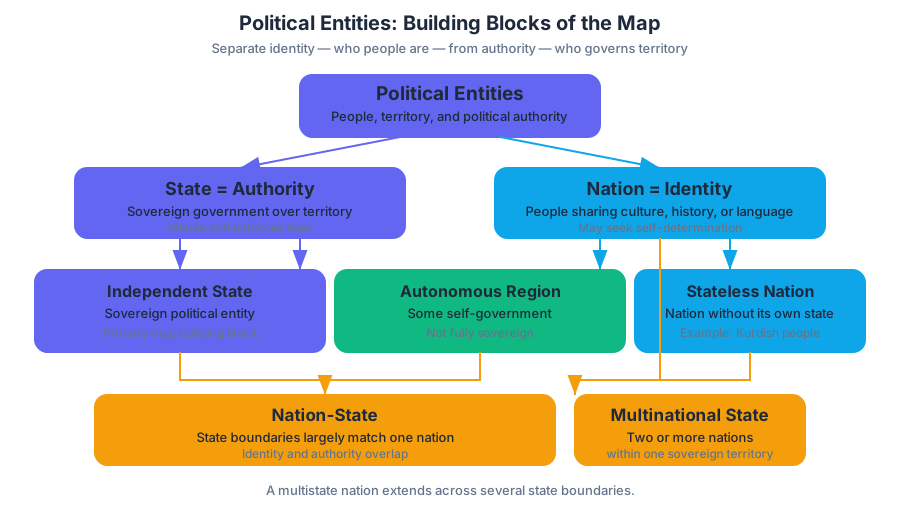
An independent state is a sovereign political entity with its own autonomous government. Sovereignty means the authority to control a territory, make and enforce laws, and conduct internal and external affairs without being controlled by another state. Independent states are the primary building blocks of the world political map.
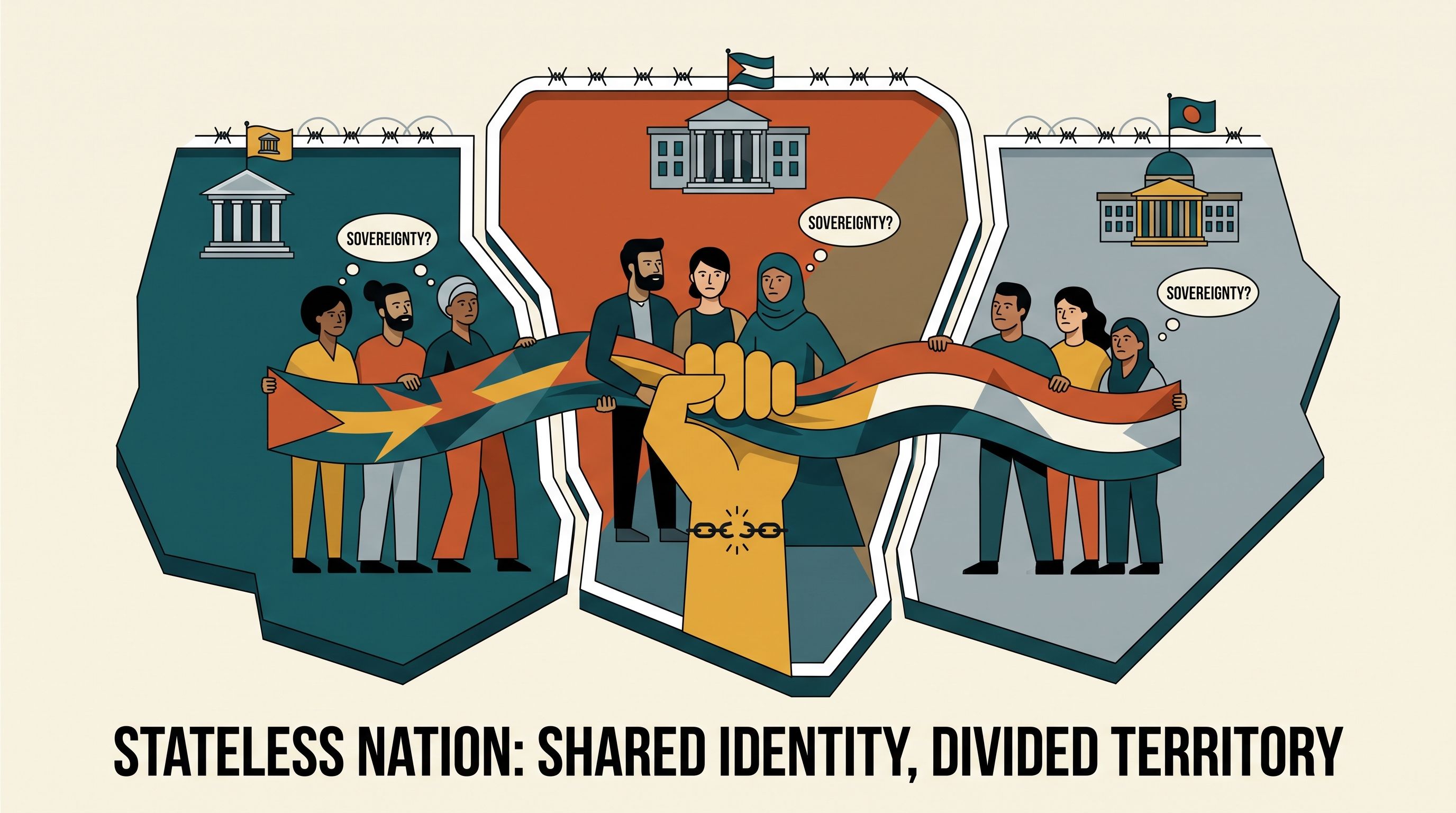
A nation is a group of people who share a common identity, often based on language, religion, ethnicity, history, or cultural traditions. A nation-state exists when the boundaries of a sovereign state largely correspond to the territory of one nation. A stateless nation is a nation that does not control an independent state of its own. A multinational state contains two or more nations within one sovereign territory, while a multistate nation is a nation whose members live across the boundaries of several states. Autonomous and semiautonomous regions, such as Native American reservations, possess some degree of self-government but do not have complete sovereignty.
A useful diagnostic is to separate identity from political authority: a nation describes a people, while a state describes a sovereign territorial-political organization. A nation may seek self-determination—the right of a people to choose its political status—without already being a state.
PSO-4.A: For world political maps, define the different types of political entities and identify a contemporary example of political entities.
PSO-4.A.1: Independent states are the primary building blocks of the world political map.
PSO-4.A.2: Types of political entities include nations, nation-states, stateless nations, multinational states, multistate nations, and autonomous and semiautonomous regions, such as Native American reservations.
Why political boundaries change
Contemporary boundaries reflect both older and ongoing processes. Colonialism established external control over territories; imperialism expanded political or economic influence; independence movements later challenged those arrangements. Devolution along national lines transfers power from a central government to a regional group seeking greater autonomy, and sometimes produces new political boundaries.
For example, a boundary may divide a culturally connected nation, while a state may contain several nations because earlier colonial or diplomatic processes grouped them together. The resulting map can therefore produce political tensions when the boundaries of government do not match the geography of identity, resources, or historical claims.
Supranational organizations and sovereignty
A supranational organization is an institution in which states cooperate around shared goals and may accept rules or monitoring that operate above the individual state. Such organizations can address transnational challenges, coordinate trade or security, reduce regulatory and transaction costs, and increase regional economic power.
The European Union (EU) illustrates deeper supranational cooperation through shared economic, legal, and political arrangements. The Association of Southeast Asian Nations (ASEAN) promotes regional cooperation among Southeast Asian states. Both can challenge sovereignty because member states may coordinate policies, follow common agreements, or accept oversight that limits completely independent decision-making in particular areas.
Key distinction: Supranational cooperation does not mean that member states cease to exist. It means that states voluntarily share some authority to achieve goals that may be difficult to accomplish separately.
Technology, resources, and contested control
Advances in communication technology may affect state sovereignty by allowing people, social movements, corporations, and governments to communicate political claims rapidly and to much larger audiences. Digital communication can strengthen a state, encourage democratization, support devolutionary movements, or increase a supranational organization’s ability to monitor whether member states follow shared agreements.
Political disputes over resources may occur on land or at sea. States can contest territory because control over a location may provide access to valuable minerals, energy reserves, fisheries, transportation routes, or freshwater. A boundary dispute is therefore not only a disagreement about lines on a map; it can also be a struggle over political authority and economic opportunity.
Gerrymandering: boundaries inside a state
Gerrymandering is the deliberate redrawing of electoral-district boundaries to give an advantage to a political party or group. It is a political-geography concept because it shows how the organization of space can influence political representation without changing the state’s international borders.
Misconception check — “A nation and a state are the same thing.”
They are not. A nation is a people with a shared identity; a state is a sovereign political territory. A stateless nation demonstrates why the distinction matters.
Skill connection and retrieval check
This topic is assessed through Skill 1.A: Concepts and Processes, especially when defining an independent state, distinguishing political entities, or explaining how sovereignty is affected. A strong response names the concept precisely and connects it to political authority over territory rather than offering only a vague description of “a country.”
Quick check: A culturally unified people lives across three countries, has no sovereign government of its own, and seeks political independence. Is it best described as a nation-state, multinational state, multistate nation, or stateless nation? Answer: stateless nation. Its shared identity exists, but it lacks an independent state exercising sovereignty over its own territory.
Source Materials
- AP Human Geography Course and Exam Description
- AP Human Geography Course and Exam Description Clarifications and Corrections
- AP Human Geography Course Overview
- AP Human Geography Course at a Glance
- AP Human Geography Course at a Glance Poster
- AP Human Geography
- AP Human Geography
- AP Human Geography Sample Syllabus 1
- AP Human Geography-AP Students-College board
- AP Human Geography Units: Complete Breakdown
- AP Human Geography-National Council for Geographic Foundation
- Free AP Human Geography Resources for 2026-Knowt