From the free course AP Human Geography on Lykke
3.7 Diffusion of Religion and Language
Key concepts: Culture traits and the cultural landscape · Placemaking and sense of place · Centripetal and centrifugal cultural forces · Relocation diffusion · Hierarchical diffusion · Contagious diffusion · Stimulus diffusion · Language creolization · Diffusion of religion and religious toponyms · Cultural diffusion and musical syncretism
Language and religion do more than communicate ideas or express belief: they leave visible patterns across Earth’s surface. A place-name, mosque, church, bilingual road sign, festival, restaurant, or musical tradition can reveal how cultural traits moved, mixed, and became attached to place.
3.7 Diffusion of Religion and Language
Language and religion do more than communicate ideas or express belief: they leave visible patterns across Earth’s surface. A place-name, mosque, church, bilingual road sign, festival, restaurant, or musical tradition can reveal how cultural traits moved, mixed, and became attached to place.
Learning Objective 3.7: Explain how language and religion influence cultural patterns.
Essential Knowledge 3.7.A: Language and religion are key elements of culture.
Essential Knowledge 3.7.B: Language and religion diffuse from cultural hearths through relocation and expansion processes.
Essential Knowledge 3.7.C: Language and religion influence cultural patterns and cultural landscapes.
Culture becomes visible in the landscape
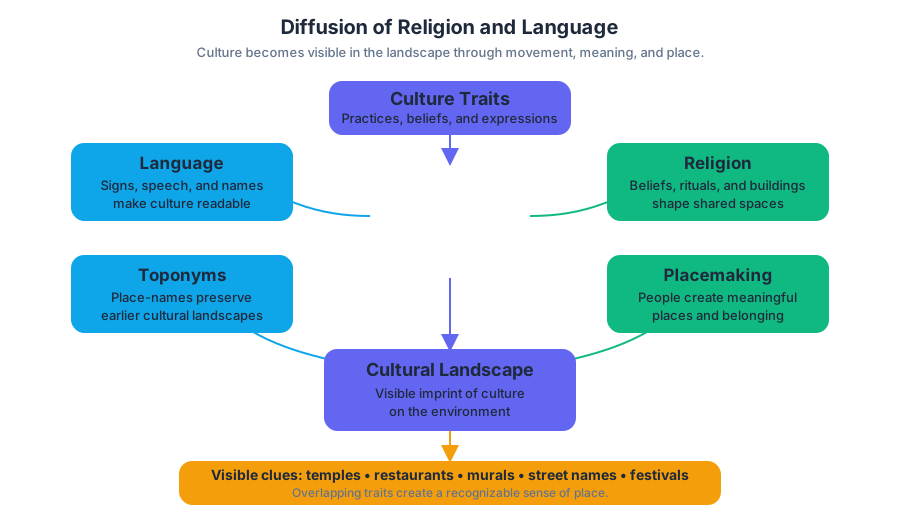
A culture trait is a particular practice, technology, belief, or material expression transmitted by a society. Culture traits include food preferences, art, architecture, language, religion, music, clothing, media, technology, and land use.
A cultural landscape is the visible imprint of human culture on the environment. For example, a landscape containing Hindu temples, vegetarian restaurants, sari shops, cricket fields, and signs written in several languages reflects overlapping cultural traits rather than a single isolated tradition.
Placemaking is the process through which people create meaningful places, while sense of place is the emotional and cultural meaning people attach to a location. Language and religion strengthen both: a neighborhood’s religious buildings, murals, street names, foods, and public celebrations can make it recognizable to insiders and outsiders.
Religious diffusion can also produce toponyms, or place-names. A name such as San Francisco reflects the historical diffusion of Christianity and Spanish influence; names associated with local Indigenous languages may preserve earlier cultural landscapes even after political control changes.
Cultural forces: unity and division
A cultural trait can operate as a centripetal force, a force that unifies people, or a centrifugal force, a force that divides them. A shared language may help residents communicate across a state and build collective identity. However, language or religious differences may produce political tension when one group receives greater recognition, resources, or authority than another.
| Cultural pattern | Likely geographic effect |
|---|---|
| Shared language in public institutions | Greater communication and cohesion |
| Common religious celebrations | Shared identity and placemaking |
| Several languages without equal recognition | Possible political or social division |
| Religious or linguistic boundary | Distinct cultural regions or conflict zones |
Misconception check: A cultural difference is not automatically a centrifugal force. It becomes divisive when it is connected to unequal power, exclusion, territorial claims, or competing identities.
Four pathways of diffusion
Relocation diffusion occurs when ideas or practices move with people to a new or distant location, including across a geographic barrier. Migrants may carry language, food, clothing, religion, music, or sport to a destination. Immigrants may also adopt culture traits from the majority population, producing a landscape with both retained and adopted traditions.
Hierarchical diffusion spreads an idea or practice from one important city, community, or person to another. A religious movement may spread through influential institutions, while a language may gain users when governments, schools, media companies, or major cities promote it.
Contagious diffusion spreads ideas or practices from person to person or along a transportation line. Face-to-face interaction, pilgrimage routes, migration corridors, and expanding networks can move a cultural trait outward through connected communities.
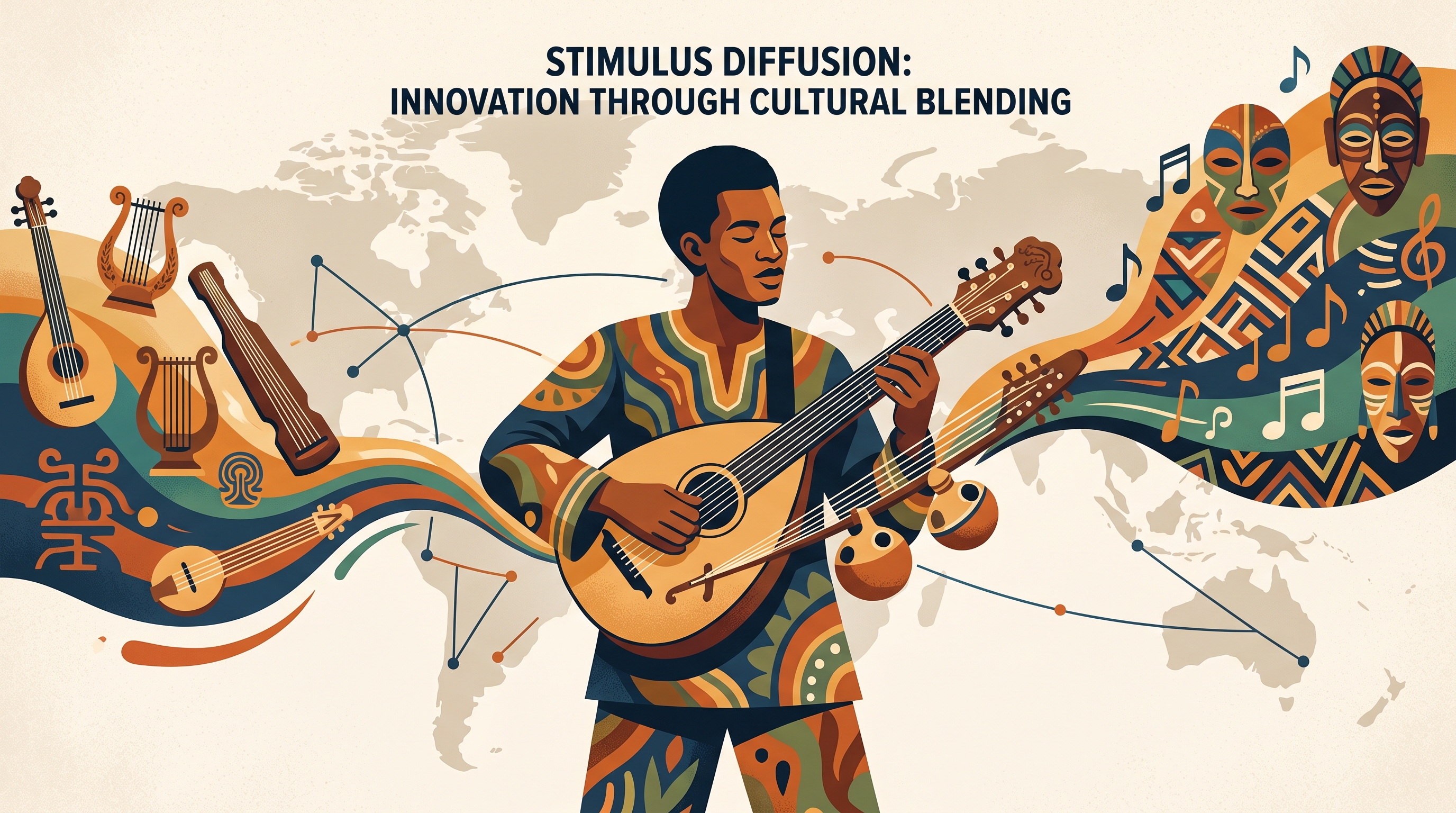
Stimulus diffusion occurs when one culture borrows an idea or practice but alters it. The receiving society accepts the underlying concept while adapting its form to local beliefs, resources, tastes, or rules.
Worked example: animals and cultural exchange
Domesticated pigs diffused from a Eurasian hearth through Asia and Europe with nomadic herders. This is primarily relocation diffusion because people transported the animal and the associated practice of raising it.
The Columbian Exchange later introduced domesticated animals to the Americas. The geographic result was not simply “one culture replacing another”: animals, farming practices, diets, labor systems, and land uses interacted with existing societies. The resulting cultural landscapes depended on local environments, beliefs, and economic systems.
Language creolization
Creolization is the process by which contact between groups speaking different or mutually unintelligible languages produces a new language or dialect. The new language blends selected features from two or more original languages and becomes a new form of communication.
For a one-point response, the essential chain is:
$$ \text{language contact} \rightarrow \text{mixing or syncretism} \rightarrow \text{new language or dialect} $$
For example, when speakers of different languages interact over time, the resulting creole may incorporate vocabulary from one language, grammatical structures from another, and pronunciation patterns shaped by both communities.
Music as cultural mixing
When different musical styles come into contact, their elements may combine to create a new style, tradition, instrument, dance, or genre. This is a cultural expression of stimulus diffusion and, in some cases, syncretism: the receiving culture does not merely copy a tradition but reshapes it.
AP Skill connection: 1.A: Identify geographic concepts, processes, models, and theories and 1.B: Describe geographic concepts, processes, models, and theories are used when distinguishing relocation, hierarchical, contagious, and stimulus diffusion. 2.A: Describe spatial patterns and 2.B: Explain spatial patterns are used when interpreting the distribution of languages, religions, toponyms, or cultural landscapes. 4.A: Identify relevant information from geographic data supports analysis of maps and photographs showing cultural patterns. 5.A: Identify the scales of analysis matters because a language can be dominant nationally but minority-language neighborhoods may remain visible locally.
Retrieval check: A language spreads from migrants to a distant city, is promoted by a national government, and is then blended with a local language. Identify the diffusion process most directly shown in each stage: migration, government promotion through major institutions, and language mixing.
Answer: relocation diffusion; hierarchical diffusion; and creolization through language contact.
Source Materials
- AP Human Geography Course and Exam Description
- AP Human Geography Course and Exam Description Clarifications and Corrections
- AP Human Geography Course Overview
- AP Human Geography Course at a Glance
- AP Human Geography Course at a Glance Poster
- AP Human Geography
- AP Human Geography
- AP Human Geography Sample Syllabus 1