From the free course AP Human Geography on Lykke
1.5 Human–Environmental Interaction
Key concepts: Human–environment interaction · Environmental determinism · Possibilism · Geographic concepts · Natural environment · Environmental sustainability · Relationships among geographic factors · Environmental injustice · Housing discrimination · Pull factors
A flooded neighborhood, a heat-exposed apartment, or a farm beside a shrinking reservoir reveals the same geographic question: how do natural environments influence human societies, and how do human decisions reshape those environments?
1.5 Human–Environmental Interaction
A flooded neighborhood, a heat-exposed apartment, or a farm beside a shrinking reservoir reveals the same geographic question: how do natural environments influence human societies, and how do human decisions reshape those environments? Human–environment interaction is not a one-way relationship. Physical conditions create opportunities and hazards, while technology, wealth, culture, and political choices determine who faces risk and who can avoid it.
PSO-1 — Geographers analyze relationships among and between places to reveal important spatial patterns.
PSO-1.B — Explain how major geographic concepts illustrate spatial relationships.
PSO-1.B.2 — Theories regarding the interaction of the natural environment with human societies have evolved from environmental determinism to possibilism.
Two theories of human–environment interaction
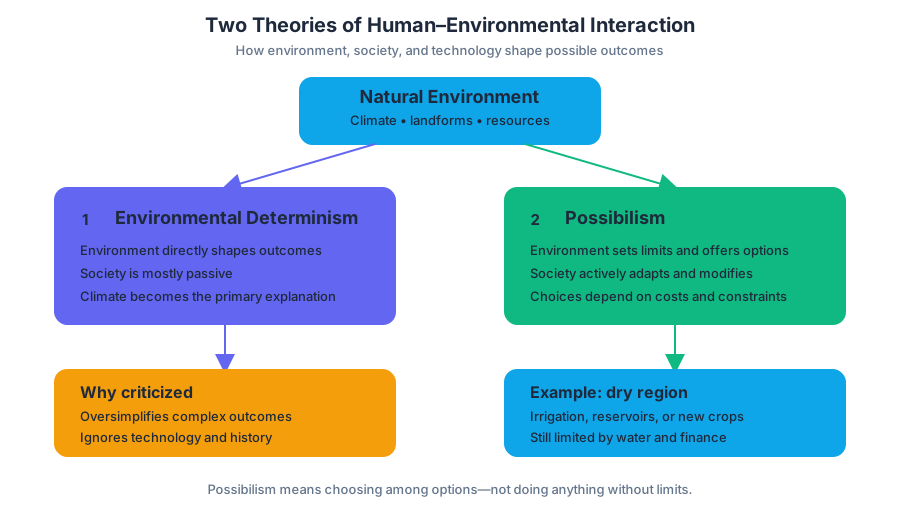
Environmental determinism is the belief that the natural environment strongly determines human behavior, culture, economic activity, or social development. In this view, climate, landforms, or available resources act almost like invisible forces: hot climates supposedly produce certain social behaviors, while temperate climates supposedly encourage particular forms of development.
Environmental determinism is historically important but widely criticized because it treats human societies as passive and oversimplifies complex outcomes. Two places with similar climates may develop very different economies because their residents possess different technologies, institutions, historical experiences, and access to capital.
Possibilism argues that the natural environment sets limits and offers opportunities, but people choose among many possible responses using culture, technology, and social organization. A dry environment does not make farming impossible; irrigation, drought-resistant crops, water pricing, and conservation may make agriculture possible—but each solution has costs and limits.
| Perspective | Role of the natural environment | Role of human society | Example |
|---|---|---|---|
| Environmental determinism | Directly shapes or determines human outcomes | Mostly passive | Climate is treated as the primary explanation for cultural or economic differences |
| Possibilism | Provides constraints and opportunities | Actively adapts and modifies | A dry region uses irrigation, reservoirs, or different crops, subject to water and financial limits |
Named misconception — “Possibilism means humans can do anything.” Possibilism does not erase environmental limits. A society may engineer around drought, cold, or steep terrain, but it cannot assume unlimited water, money, energy, or ecological resilience. The stronger geographic explanation connects environmental conditions with human choices rather than assigning all outcomes to only one side.
Sustainability and environmental injustice
Environmental sustainability means using resources and managing environments in ways that meet present needs without preventing future generations from meeting theirs. Sustainable decisions consider three connected questions: Can the environment continue to support the activity? Can the economy maintain it? Are its benefits and burdens distributed fairly?
Consider a photograph showing cracked soil, dead vegetation, and a nearly empty reservoir. A possible sustainability solution is to replace water-intensive crops with drought-resistant varieties while combining drip irrigation, groundwater monitoring, and limits on total water withdrawals. This solution addresses the visible environmental problem, but a complete geographic analysis also asks who can afford the new equipment and whether small farmers receive equal access to assistance.
Environmental injustice occurs when some populations experience greater environmental hazards or receive fewer environmental benefits because of income, race, political power, or other social conditions. For example, lower-income residents may be more likely to live near highways, industrial facilities, flood-prone land, or poorly maintained housing, while wealthier residents can relocate or pay for protection.
Housing, services, and human environments
Housing patterns are shaped not only by land and climate but also by political and financial decisions. Redlining was the discriminatory practice of denying loans, insurance, or investment to residents of particular neighborhoods, often based on racial composition. Blockbusting involved real-estate agents encouraging white residents to sell by spreading fears that racial or ethnic change would reduce property values, then profiting by reselling homes to new residents.
These practices changed the human environment over time: they influenced where people could buy homes, how neighborhoods accumulated wealth, where infrastructure was built, and which communities remained exposed to hazards. The pattern is not environmental determinism; it is a socially produced relationship between political decisions, housing markets, and physical risk.
Affordability and access to services also shape human environments. When housing costs rise near reliable transportation, schools, clinics, grocery stores, or employment, households with lower incomes may be pushed toward areas with longer commutes, fewer services, or greater exposure to pollution and hazards. A map showing unequal access is therefore evidence of both spatial pattern and unequal opportunity.
Pull factors and environmental choices
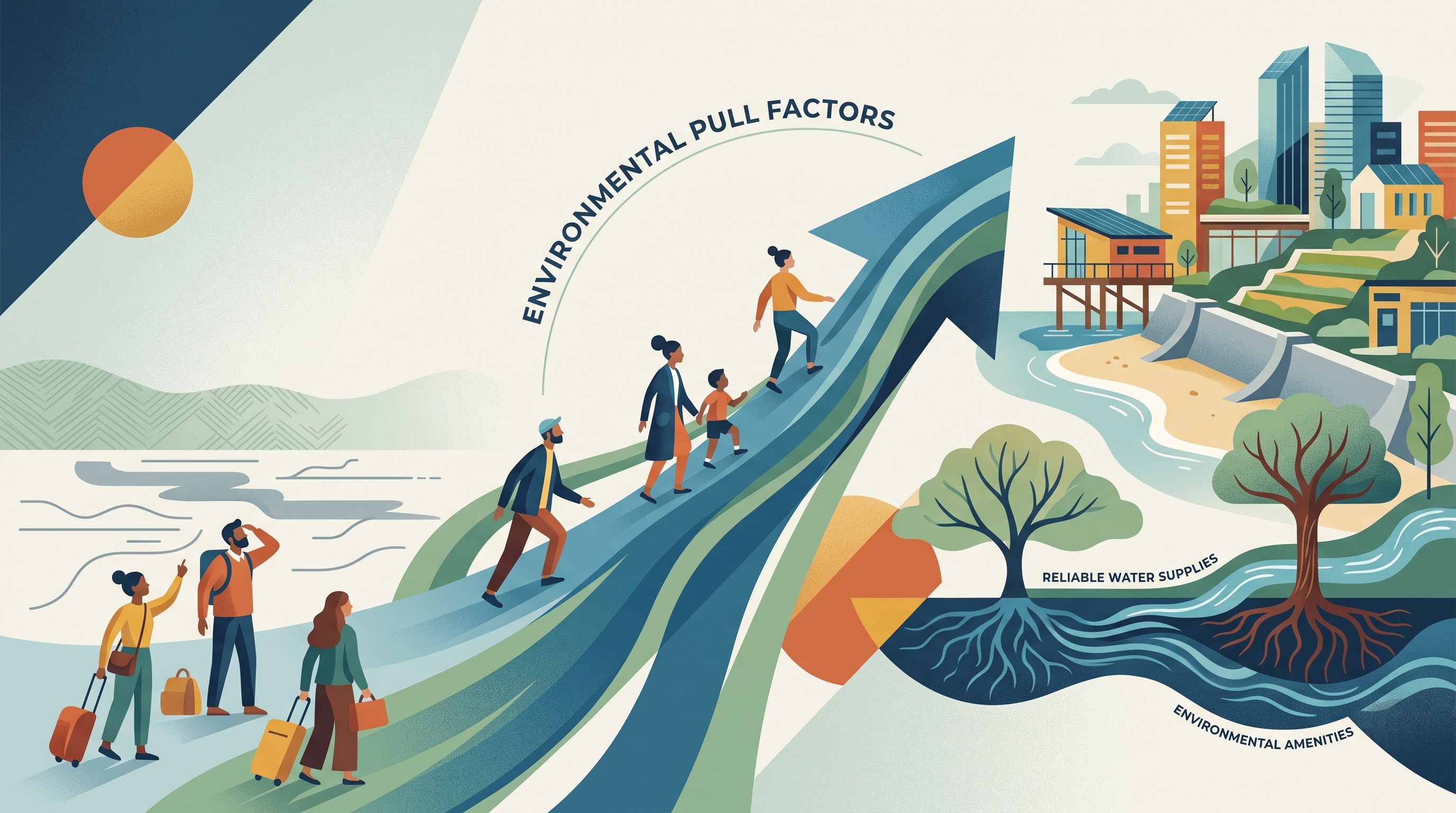
A pull factor is a condition that attracts people toward a destination. Higher wages, safer housing, available services, environmental amenities, or reliable water supplies can draw migrants, even when the destination has high costs. Environmental conditions can therefore influence population movement through both hazards that push people away and opportunities that pull them toward another place.
Retrieval check: A coastal city builds flood barriers, preserves wetlands, and offers grants so low-income households can elevate homes. Which idea best explains the response: environmental determinism or possibilism? What sustainability and environmental-justice question should be asked next?
Answer: Possibilism, because people are adapting to environmental constraints through organized choices and technology. The next question is whether protection and financial support reach all residents fairly.
Source Materials
- AP Human Geography Course and Exam Description
- AP Human Geography Course and Exam Description Clarifications and Corrections
- AP Human Geography Course Overview
- AP Human Geography Course at a Glance
- AP Human Geography Course at a Glance Poster
- AP Human Geography
- AP Human Geography
- AP Human Geography Sample Syllabus 1