From the free course AP Human Geography on Lykke
4.4 Defining Political Boundaries
Key concepts: Territoriality · Political geography · Political boundaries · Administrative control · Sovereignty · Internal boundaries · Natural-resource management · Ecosystem protection · International recognition · Foreign policy
Political boundaries are lines or zones that delimit where a government’s administrative authority applies. They turn territorial control into a visible political arrangement: a state, province, district, or other governing unit can claim jurisdiction over a defined area.
4.4 Defining Political Boundaries
Political boundaries are lines or zones that delimit where a government’s administrative authority applies. They turn territorial control into a visible political arrangement: a state, province, district, or other governing unit can claim jurisdiction over a defined area.
From territoriality to boundaries
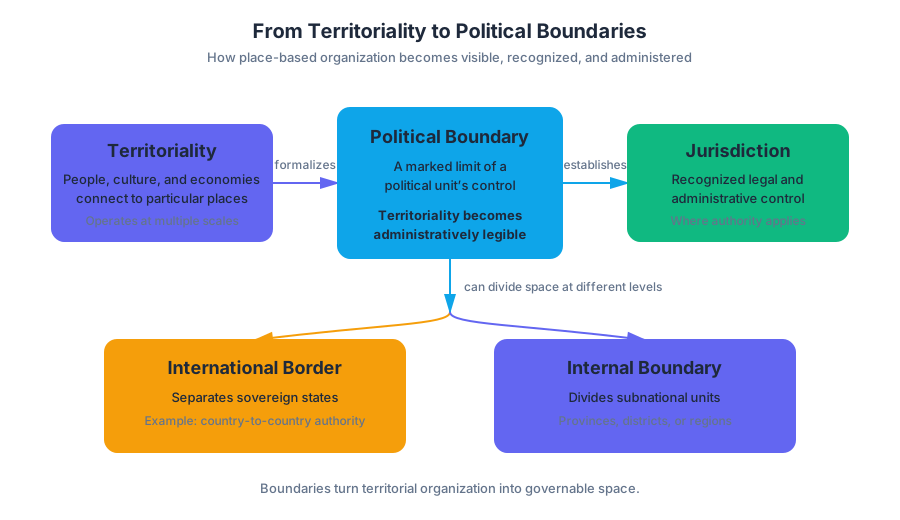
Territoriality connects people, culture, and economic systems to particular places and can operate at multiple scales. Political boundaries formalize that place-based organization by marking the space in which a political unit claims control.
Territoriality becomes administratively legible through boundaries.
A boundary does not merely describe where one place ends; it establishes a jurisdiction, meaning a recognized area of legal and administrative control. The boundary might be an international border between states or an internal boundary dividing provinces, states, districts, territories, or autonomous regions.
Sovereignty: authority inside and recognition outside
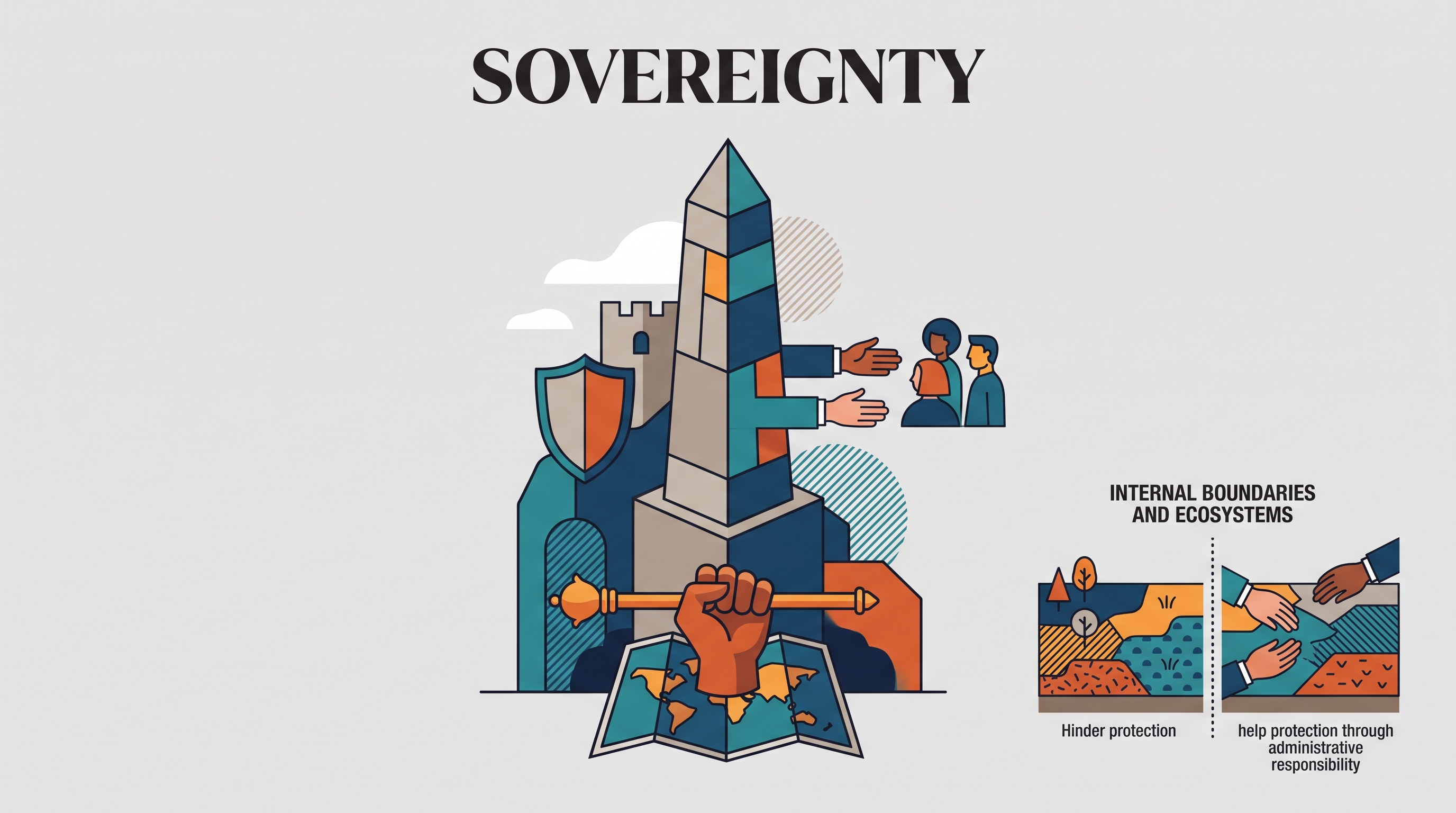
Sovereignty is a state’s authority to govern its territory without outside interference. Internally, sovereignty includes the legal power to create and enforce laws, manage land and resources, establish governmental institutions, and control activity within the state’s borders.
Externally, sovereignty involves recognition by other states and foreign entities. A state’s authority is therefore both practical and international: it governs within its territory, while other states acknowledge its right to do so.
| Dimension of sovereignty | What it means |
|---|---|
| Internal control | The state governs people, land, and resources within its territory. |
| Legal authority | The state creates and enforces laws inside its borders. |
| Border defense | The state may defend its territory against invasion. |
| Border control | The state may regulate immigration and other cross-border movement. |
| Foreign policy | The state may conduct diplomacy, form alliances, and recognize other states. |
| International recognition | Other states and foreign entities acknowledge the state’s authority. |
For example, a sovereign state can defend its border against an invading army, regulate entry by immigrants, establish its own criminal laws, and negotiate treaties with other states. These powers are different expressions of the same underlying principle: the state claims final political authority over its territory.
A precise exam definition
A strong description of sovereignty must connect the concept to the state. An answer earns conceptual precision by explaining that a sovereign state has the right to control what happens inside its borders without interference from outside states or entities, is recognized by the international community, or can defend its borders against invasion.
Exam-ready idea: Sovereignty is the state’s recognized right to exercise internal control over its territory and conduct its external affairs.
Internal boundaries and resource management
Internal boundaries divide a state into subnational units such as provinces, states, districts, territories, special administrative regions, or autonomous zones. Their importance here is administrative: they can make it easier or harder for governments to manage resources and ecosystems that cross political divisions.
Consider a river basin shared by two provinces. If the internal boundary is supported by coordinated rules, each province can contribute data and funding to protect the watershed. If the provinces use conflicting regulations, the same boundary may hinder ecosystem protection because the river’s ecological system does not stop where the administrative line does.
The same issue applies to the distribution of natural resources. A forest, aquifer, mineral deposit, or grazing region may extend across several internal jurisdictions. Boundaries can clarify which government is responsible, but they can also fragment management when each unit pursues separate priorities.
Skills and reasoning processes
This topic most directly develops 1.B Define geographic concepts, processes, models, and theories: define territoriality, political boundaries, and sovereignty precisely rather than using vague words such as “ownership.” It also uses 1.C Explain geographic concepts, processes, models, and theories when connecting sovereignty to internal control, international recognition, and border defense.
A boundary example also engages 2.A Identify spatial patterns and processes, 2.B Explain spatial patterns and processes, and 2.C Explain spatial relationships. The key spatial relationship is that internal administrative lines may align poorly with the physical distribution of ecosystems or resources. 5.A Identify the scales of analysis and 5.B Explain patterns and processes at different scales apply when comparing state sovereignty with provincial or district authority.
Misconception check
Misconception: sovereignty means unlimited power. Sovereignty means a state claims final authority over its territory, but that authority is shaped by international recognition, treaties, political agreements, and the practical ability to enforce decisions. A boundary can mark legal jurisdiction without guaranteeing perfect control on the ground.
Retrieval check
A country’s government creates laws inside its territory, defends its borders, and sends diplomats abroad. Which concept unifies these actions, and why can an internal boundary either help or hinder ecosystem protection?
Answer: The unifying concept is sovereignty, because the state exercises legal authority internally, defends its territory, and conducts foreign policy. An internal boundary can help ecosystem protection by assigning administrative responsibility, but it can hinder protection when separate jurisdictions manage one connected ecosystem inconsistently.
Source Materials
- AP Human Geography Course and Exam Description
- AP Human Geography Course and Exam Description Clarifications and Corrections
- AP Human Geography Course Overview
- AP Human Geography Course at a Glance
- AP Human Geography Course at a Glance Poster
- AP Human Geography
- AP Human Geography
- AP Human Geography Sample Syllabus 1