From the free course AP Human Geography on Lykke
2.4 Population Dynamics
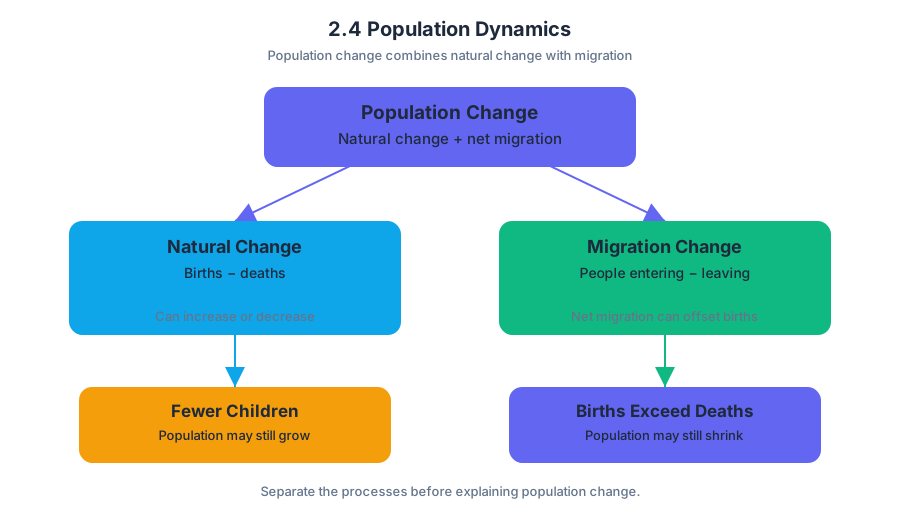
A population can grow even when families are having fewer children—and shrink even when births still outnumber deaths—because population dynamics tracks the combined effects of natural change and migration.
2.4 Population Dynamics
A population can grow even when families are having fewer children—and shrink even when births still outnumber deaths—because population dynamics tracks the combined effects of natural change and migration.
Population change = natural increase or decrease + net migration
Natural change compares births with deaths. Migration change compares people entering with people leaving. Separating these processes prevents a common analytical mistake: treating every population increase as the result of high fertility.
Natural increase and decrease
The crude birth rate (CBR) is the number of live births per $1{,}000$ people in a population during one year. The crude death rate (CDR) is the number of deaths per $1{,}000$ people during one year. “Crude” means that the rate uses the total population as its denominator rather than controlling for age structure or other characteristics.
The difference between the CBR and CDR is the natural increase rate (NIR), expressed as a percentage:
$$ \text{NIR}=\frac{\text{CBR}-\text{CDR}}{10} $$
The division by $10$ converts a difference measured per $1{,}000$ people into a percentage. If a country has a CBR of $24$ and a CDR of $9$, its natural increase is $15$ per $1{,}000$, or an NIR of $1.5%$. If deaths exceed births, the NIR becomes negative: the population experiences natural decrease.
Worked example: separating natural change from migration
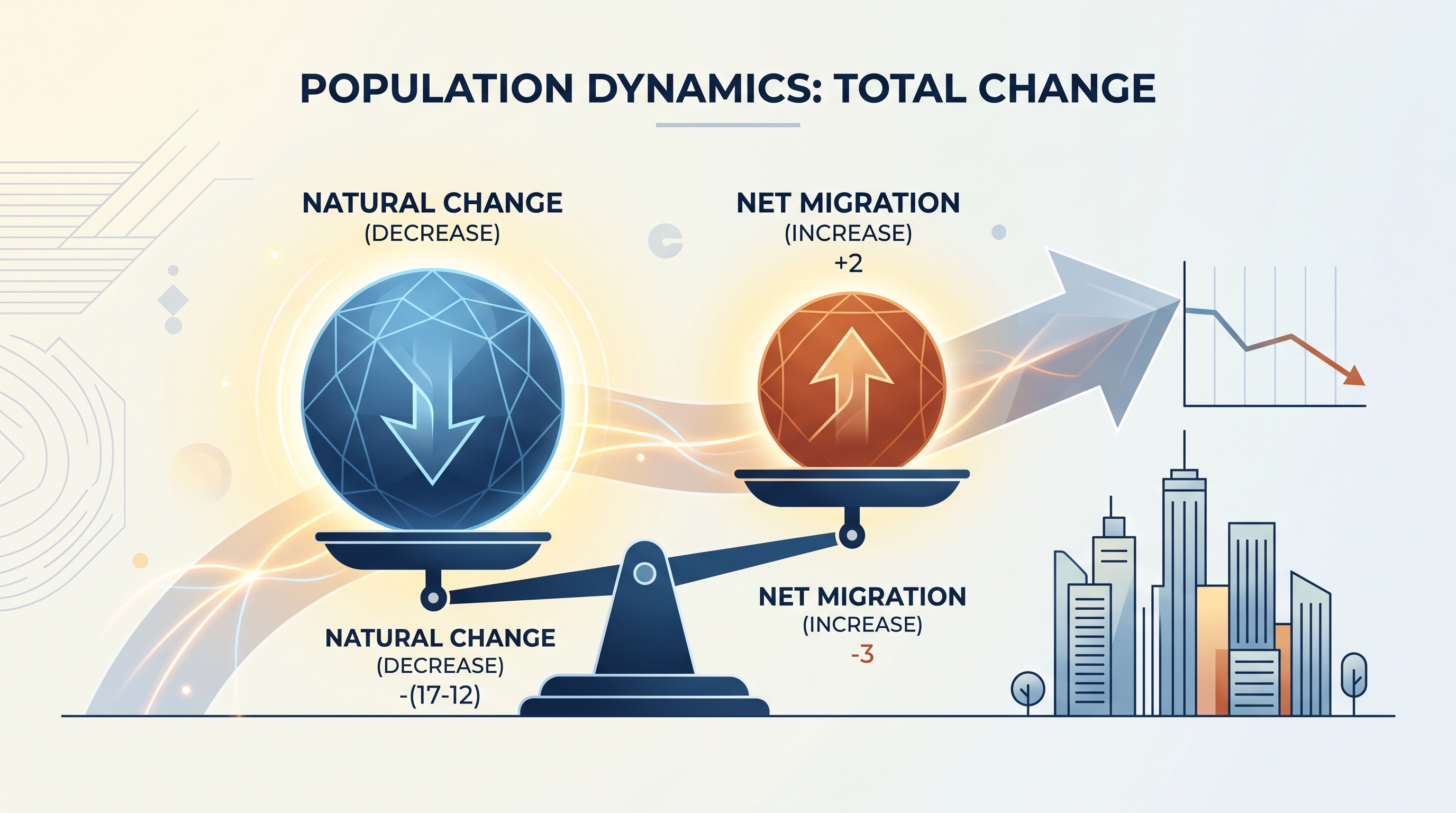
Suppose a country records a CBR of $12$ and a CDR of $17$ per $1{,}000$ people. Its natural change is:
$$ 12-17=-5\text{ per }1{,}000 $$
Therefore:
$$ \text{NIR}=\frac{12-17}{10}=-0.5% $$
The country also receives net migration of $+2$ per $1{,}000$. Migration reduces the loss, but it does not eliminate it:
$$ -5+2=-3\text{ per }1{,}000 $$
Total population would decline because net migration of $+2$ per $1{,}000$ is insufficient to offset the natural decrease of $5$ per $1{,}000$. Population growth would require net migration greater than $+5$ per $1{,}000$.
Net migration
Net migration is the difference between immigration and emigration:
$$ \text{Net migration}=\text{immigration}-\text{emigration} $$
A positive value means more people enter than leave; a negative value means more people leave than enter. Combining the two components gives the total population-change rate:
$$ \text{Total change}=(\text{CBR}-\text{CDR})+\text{net migration} $$
For example, a country with an NIR of $1.2%$ and net migration of $-0.4%$ still grows overall at approximately $0.8%$ per year. Conversely, a country with an NIR of $-0.5%$ needs net migration above $0.5%$ merely to avoid decline.
Why rates can mislead
CBR and CDR are useful for comparing populations, but they are not complete explanations. A high CDR may reflect a large elderly population rather than poor health care, while a low CBR may reflect delayed childbearing, urbanization, or access to contraception. Because these are crude rates, the age composition already examined in population pyramids helps explain why the rates differ.
Named misconception — “Positive NIR always means population growth.” A positive NIR describes natural increase only. If emigration is large enough, total population can still fall. The reverse is also possible: a country with natural decrease can grow when net immigration more than compensates for deaths exceeding births.
Named misconception — “A CBR of $12$ means $12%$ of the population gave birth.” It means $12$ births per $1{,}000$ people, or $1.2%$ of the total population before deaths and migration are considered.
Skill focus: Skill 3.C Data Analysis
Topic 2.4 is associated with IMP and Skill 3: Data Analysis, especially Skill 3.C: Describe spatial patterns and relationships presented in maps, tables, charts, graphs, and diagrams. In practice, read the data in sequence: identify whether births or deaths are larger, calculate natural change, add net migration, and then state whether the total population grows or declines.
Retrieval check: A country has a CBR of $12$, a CDR of $17$, and net migration of $+2$ per $1{,}000$. What is its NIR, and does its total population grow?
The NIR is $-0.5%$. Natural decrease is $5$ per $1{,}000$, while net migration adds only $2$ per $1{,}000$, so total population declines by $3$ per $1{,}000$. The key conclusion is that population change must be analyzed by combining natural change with net migration, not by looking at either component alone.
Source Materials
- AP Human Geography Course and Exam Description
- AP Human Geography Course and Exam Description Clarifications and Corrections
- AP Human Geography Course Overview
- AP Human Geography Course at a Glance
- AP Human Geography Course at a Glance Poster
- AP Human Geography
- AP Human Geography
- AP Human Geography Sample Syllabus 1