From the free course AP Human Geography on Lykke
2.6 Malthusian Theory
Key concepts: Malthusian Theory · Population growth · Food production · Agricultural technological advancements · Agricultural revolutions · Expensive farm inputs · Agricultural production costs · Farm profitability · Rural-to-urban migration · Wealth gap between farms
A population can grow rapidly even while the food system supporting it changes slowly. Malthusian theory is the argument that population growth can eventually outpace food production, creating pressure on resources and lowering living standards unless population growth is checked.
2.6 Malthusian Theory
A population can grow rapidly even while the food system supporting it changes slowly. Malthusian theory is the argument that population growth can eventually outpace food production, creating pressure on resources and lowering living standards unless population growth is checked.
Core idea: If the number of people rises faster than the food supply, the gap between population and food production can produce hunger, disease, conflict, or other limits on population growth.
The Malthusian model
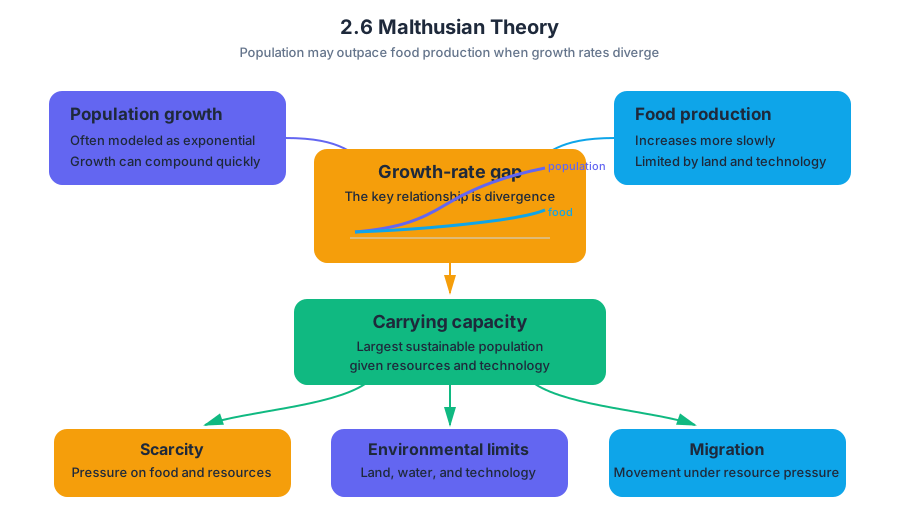
Thomas Malthus proposed that population tends to increase faster than food production. In simplified form, population growth is often represented as exponential, while food production is represented as increasing more slowly. The crucial relationship is not a memorized graph but the possibility that the two growth rates diverge.
A Malthusian explanation focuses on carrying capacity, the largest population an environment can sustainably support with available resources and technology. When population approaches or exceeds that capacity, scarcity becomes more likely. In human geography, the theory connects population dynamics to agricultural production, environmental limits, and migration.
Why Malthusian theory is limited
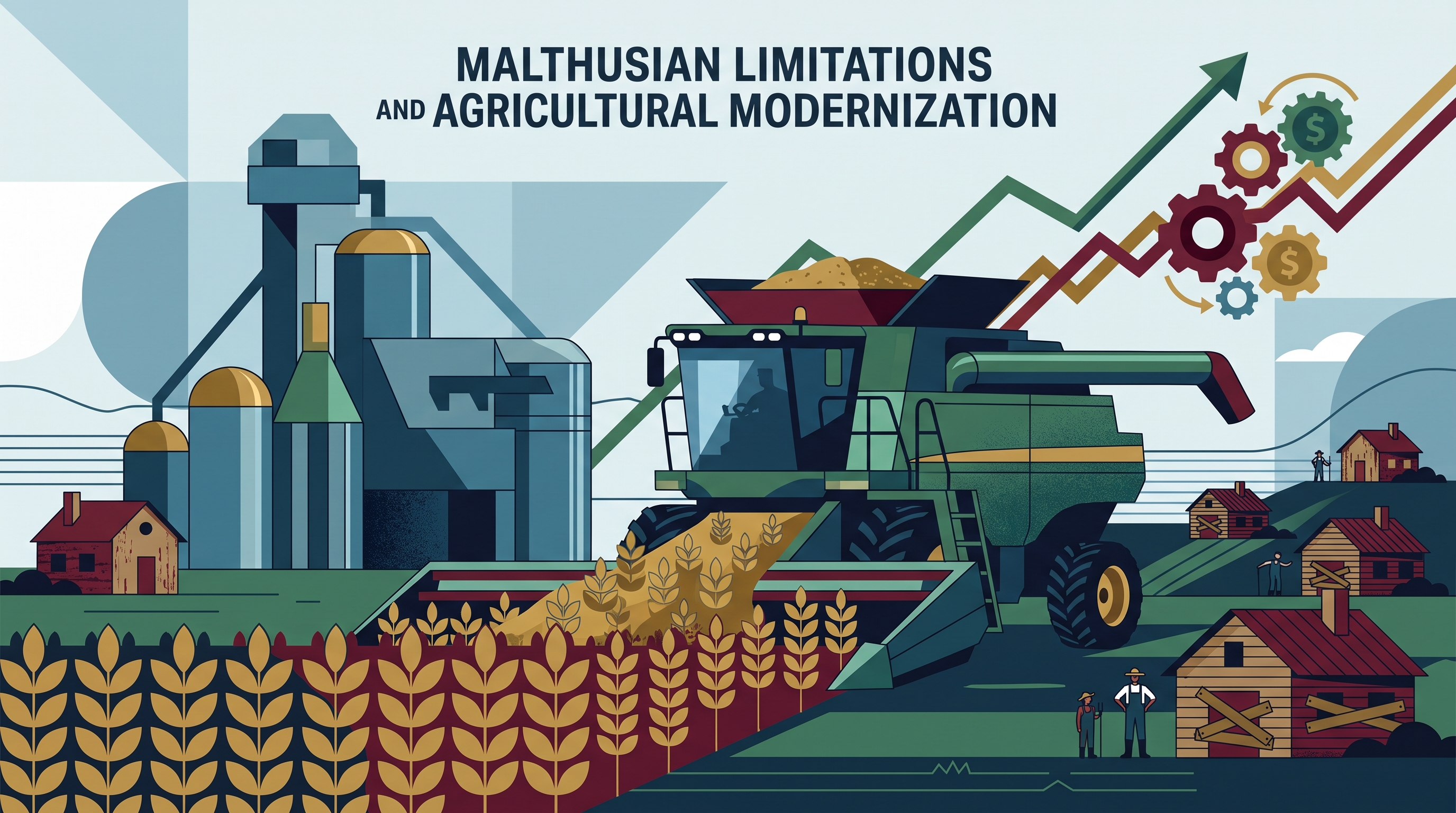
The major weakness of Malthusian theory is that Malthus failed to predict the impact of agricultural technological advancements. Agricultural revolutions introduced new methods and inputs that allowed food production to increase faster than he anticipated.
Examples include high-yield seeds, irrigation, mechanization, synthetic fertilizers, pesticides, improved transportation, and expanded commercial farming. These changes can raise output per unit of land, allowing food production to outpace population growth rather than fall permanently behind it.
Exam-ready weakness: Malthusian theory assumes that food production cannot keep pace with population growth, but agricultural revolutions have increased food production at a rate that can outpace population growth.
Worked example: when technology changes the prediction
Imagine that a farming region has $100$ farms producing enough grain for $1{,}000$ people. The population then grows to $1{,}300$. A strictly Malthusian prediction would expect increasing scarcity because the population has risen by $30%$ without a comparable increase in farmland.
Now suppose farmers adopt high-yield seeds, irrigation, and improved fertilizers. If production rises from enough for $1{,}000$ people to enough for $1{,}600$, food production has increased faster than population. The original population-pressure prediction no longer holds because technology changed the relationship between land, food, and people.
The example does not prove that scarcity is impossible. It shows why Malthusian theory is a useful warning about resource limits but an incomplete prediction of modern food production. Technology can expand effective carrying capacity, although access to that technology is unequal.
The costs of agricultural advancement
Agricultural technology can increase total production while making farming more expensive. Farm inputs are the resources used to produce crops or livestock. Expensive inputs include high-yield seeds, agricultural chemicals, and fossil fuels used in machinery, irrigation, transportation, and processing.
When input prices rise, the cost of agricultural production increases and farm profits may shrink. A farm can therefore produce more food and still become financially vulnerable. Changes in farming conditions—such as higher input costs, altered land-use patterns, or changing market prices—can cause farms to struggle or close.
Unequal effects on farms
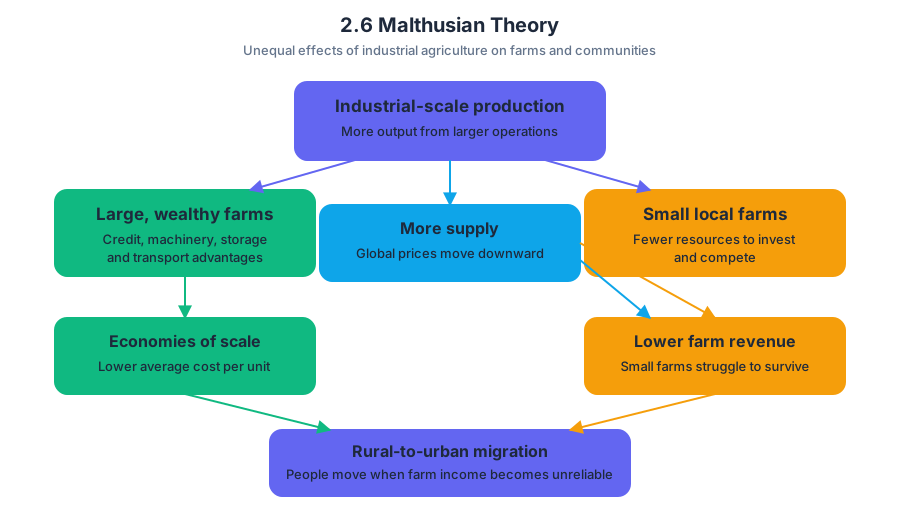
Large, wealthy farms often have advantages in purchasing, machinery, storage, transportation, and access to credit. They may benefit from economies of scale, in which producing at a larger scale lowers the average cost per unit. Smaller farms may lack those advantages and find it harder to compete.
Industrial-scale food production can also increase supply and drive down global prices. Lower prices may benefit consumers, but they can reduce the revenue available to small local farms. If smaller farms close while larger farms expand, agricultural change can contribute to a wider wealth gap between smaller farms and larger, wealthier farms.
A common geographic consequence is rural-to-urban migration: people leave farming communities and move to cities because agricultural work no longer provides dependable income. The migration is associated with changes in farming conditions, not necessarily with a direct population-policy decision.
Misconception check
Misconception: “Malthus was simply wrong because the world produces enough food.” The stronger interpretation is more precise: agricultural technological advancements weakened Malthus’s prediction that population growth would inevitably outpace food production, but food availability does not guarantee equal access, farm profitability, or economic security.
Misconception: “More technology always helps every farmer.” Technology can raise production while increasing dependence on costly seeds, chemicals, fuel, machinery, and credit. The effects differ by farm size, market access, land ownership, and local economic conditions.
Retrieval check
A region adopts high-yield seeds and mechanized equipment, doubles its crop output, and then sees many small farms close as input costs rise and crop prices fall. What is the best explanation? The evidence demonstrates a weakness in Malthusian theory because agricultural technology increased food production, while expensive inputs and economies of scale disadvantaged smaller farms and encouraged rural-to-urban migration.
Source Materials
- AP Human Geography Course and Exam Description
- AP Human Geography Course and Exam Description Clarifications and Corrections
- AP Human Geography Course Overview
- AP Human Geography Course at a Glance
- AP Human Geography Course at a Glance Poster
- AP Human Geography
- AP Human Geography
- AP Human Geography Sample Syllabus 1
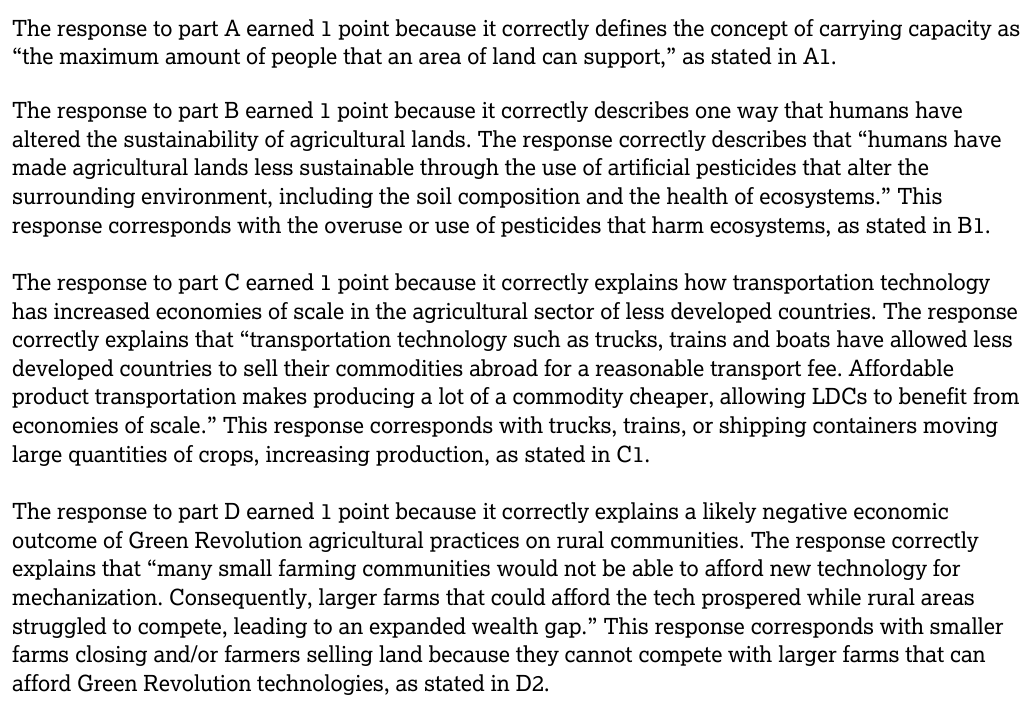
- The response to part E earned 1 point because it correctly explains one weakness of Malthusian theory in predicting the relationship between food production and population growth in contemporary socie