From the free course AP Human Geography on Lykke
7.1 The Industrial Revolution
Key concepts: Industrial Revolution · Industrialization · Population growth · Diffusion of technology and industry · Urbanization · Changing class structures · Colonialism · Imperialism · Industrial raw materials and markets · Source analysis of maps, images, and landscapes
The Industrial Revolution was a major transformation in which new technologies, available natural resources, and mechanized production changed how people worked, lived, moved, and organized society.
7.1 The Industrial Revolution
The Industrial Revolution was a major transformation in which new technologies, available natural resources, and mechanized production changed how people worked, lived, moved, and organized society. It began in a particular industrial hearth but did not remain there: industrialization spread outward, producing both higher standards of living and geographically uneven development.
Enduring Understanding (SPS-7): Industrialization, past and present, has facilitated improvements in standards of living, but it has also contributed to geographically uneven development.
Learning Objective (SPS-7.A): Explain how the Industrial Revolution facilitated the growth and diffusion of industrialization.
Essential Knowledge:
SPS-7.A.1: Industrialization began as a result of new technologies and was facilitated by the availability of natural resources.
SPS-7.A.2: As industrialization spread it caused food supplies to increase and populations to grow; it allowed workers to seek new industrial jobs in the cities and changed class structures.
SPS-7.A.3: Investors in industry sought out more raw materials and new markets, a factor that contributed to the rise of colonialism and imperialism.
From new technology to industrial growth
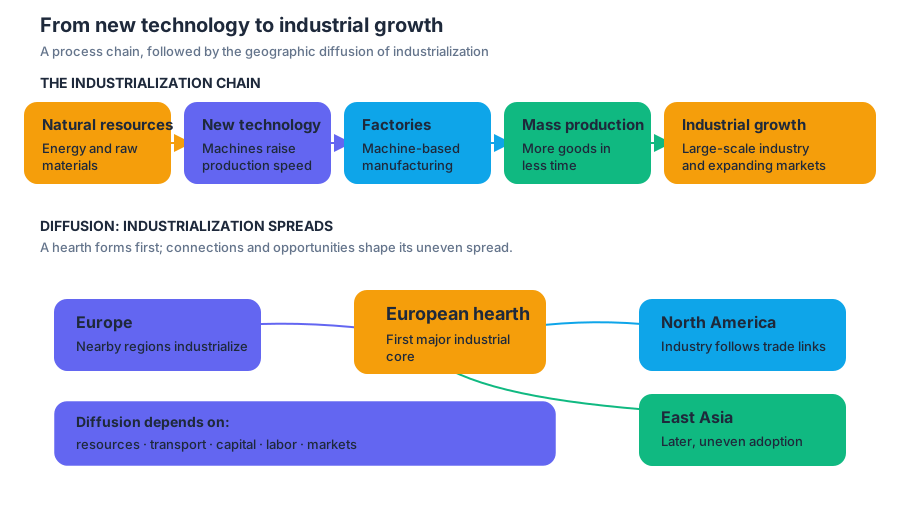
Industrialization means the development and spread of machine-based manufacturing and large-scale industry. The process began when new technologies made it possible to produce goods more quickly and in greater quantities than household or small-workshop production. Natural resources supported this transformation by supplying the energy and raw materials that factories required.
The process can be represented as a chain:
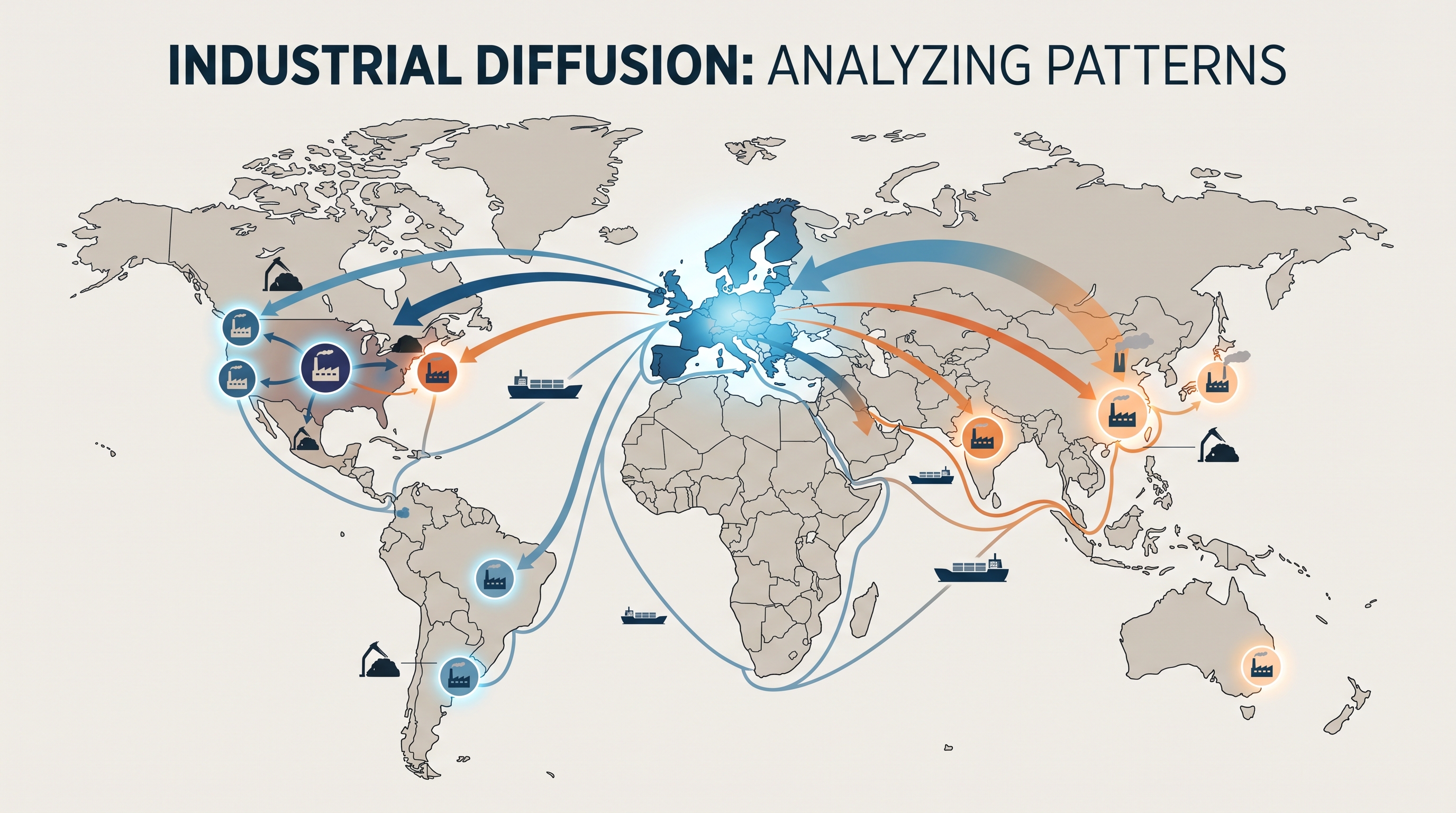
A crucial geographic idea is diffusion: the movement of a process, innovation, or activity from one place to another. Industrialization first developed in a hearth in Europe and then expanded to other parts of Europe, North America, and East Asia. Its spread was not instantaneous or uniform; places with useful resources, transportation links, investment capital, labor, and access to markets were more likely to industrialize.
Food supplies, population growth, and urbanization
Industrialization helped increase food supplies through improved production, processing, transportation, and access to markets. When food became more abundant and reliable, death rates could decline and populations could grow. Population growth then supplied factories with both workers and consumers, creating a reinforcing relationship between industrial production and demographic change.
Industrial jobs were concentrated in cities, where factories could gather labor, power, transportation, and financial services in one place. Workers therefore migrated from rural areas toward industrial cities in search of wages. This process contributed to urbanization, the growth in the number and proportion of people living in urban areas.
The movement can be visualized as a feedback loop:
Worked example: A rural worker who once depended on agricultural labor may move to a growing factory city because a textile mill offers regular wages. The worker’s arrival increases the city’s labor supply; the factory’s production attracts merchants and transport services; and the expanding city creates additional jobs. The result is not simply “people moving to cities,” but a connected process involving employment, migration, markets, and urban growth.
Changing class structures
Industrialization changed class structures by expanding the industrial working class, whose members earned wages in factories, mines, and related jobs. It also strengthened an industrial and commercial investor class that owned factories, financed production, or controlled trade. Social position increasingly reflected relationships to industrial capital and wage labor, not only land ownership or inherited status.
These changes produced both opportunity and inequality. Industrialization could improve incomes, access to manufactured goods, transportation, and public services over time, yet its benefits were unevenly distributed among regions and social groups. A city might display modern factories and prosperous investors alongside crowded housing and poorly paid workers.
Misconception check: Industrialization did not immediately improve living conditions for everyone. The long-term process facilitated improvements in standards of living, but early industrial growth could involve dangerous work, pollution, overcrowding, and severe inequality.
Raw materials, markets, colonialism, and imperialism
Industrial investors sought two things beyond the factory: raw materials for production and markets where manufactured goods could be sold. As industrial production expanded, investors and states searched across wider territories for supplies and consumers. This economic demand helped contribute to the rise of colonialism, the establishment of political control over another territory, and imperialism, the broader extension of power or influence over other regions.
The connection is causal rather than merely chronological:
| Industrial need | Geographic consequence |
|---|---|
| More raw materials | Expansion of overseas economic and political control |
| More markets | Pressure to connect other regions to industrial trade |
| Investment opportunities | Infrastructure and production organized around imperial interests |
| Industrial competition | Uneven development among regions integrated into the system differently |
Colonialism and imperialism did not develop from industrial demand alone, but the search for resources and markets was an important factor. Industrial power therefore reshaped political relationships as well as economic landscapes.
Reading industrialization in maps and landscapes
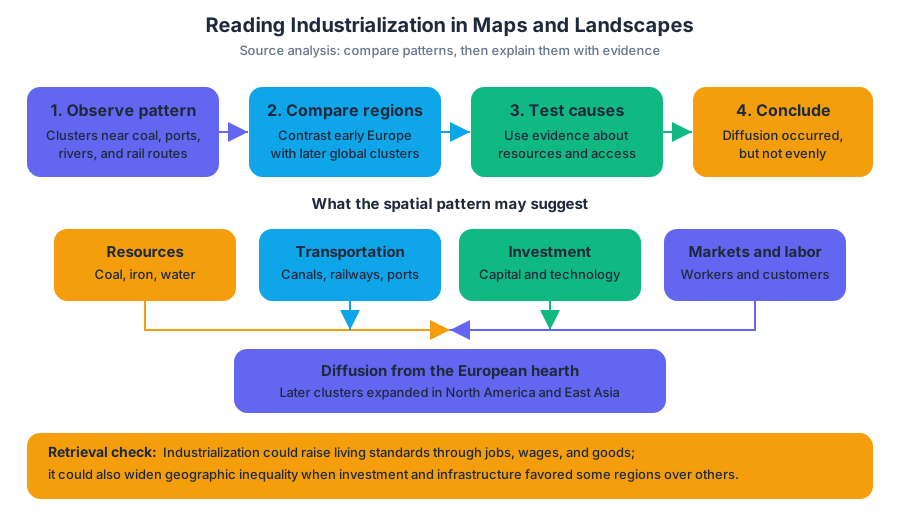
Source Analysis (4.D): Compare patterns and trends in visual sources to draw conclusions. When examining a map, image, or landscape, identify where industrial activity is concentrated, compare regions, and connect visible patterns to possible causes such as resources, transportation, labor, investment, or markets.
Worked visual analysis: Suppose a map shows early industrial concentrations near resource-rich areas and major transport routes, followed later by expanding clusters in North America and East Asia. A strong conclusion would identify the spatial pattern, describe the diffusion from the original European hearth, and explain that resources, transportation, investment, and market access helped industrialization spread. Do not claim that every location along a route industrialized equally; pattern shows distribution, while explanation requires evidence about the process.
Retrieval check: Why could industrialization increase both standards of living and geographic inequality? In two connected sentences, explain one pathway from industrialization to improved living conditions and one pathway from industrialization to uneven development.
Source Materials
- AP Human Geography Course and Exam Description
- AP Human Geography Course and Exam Description Clarifications and Corrections
- AP Human Geography Course Overview
- AP Human Geography Course at a Glance
- AP Human Geography Course at a Glance Poster
- AP Human Geography
- AP Human Geography
- AP Human Geography Sample Syllabus 1
- AP Human Geography-AP Students-College board
- AP Human Geography Units: Complete Breakdown
- AP Human Geography-National Council for Geographic Foundation
- Free AP Human Geography Resources for 2026-Knowt