From the free course AP Human Geography on Lykke
6.3 Cities and Globalization
Key concepts: Deindustrialization · International division of labor · Economic sector shift · Core countries · Higher-paying jobs · Outsourcing · Offshoring · Economic restructuring · Globalization · Metacities
Globalization links cities through production networks, but it does not distribute the same kinds of work or income evenly around the world. A shirt may be designed in a core-country city, manufactured in a newly industrialized country, shipped through several ports, and marketed through a global financial center.
6.3 Cities and Globalization
Globalization links cities through production networks, but it does not distribute the same kinds of work or income evenly around the world. A shirt may be designed in a core-country city, manufactured in a newly industrialized country, shipped through several ports, and marketed through a global financial center.
From deindustrialization to an international division of labor
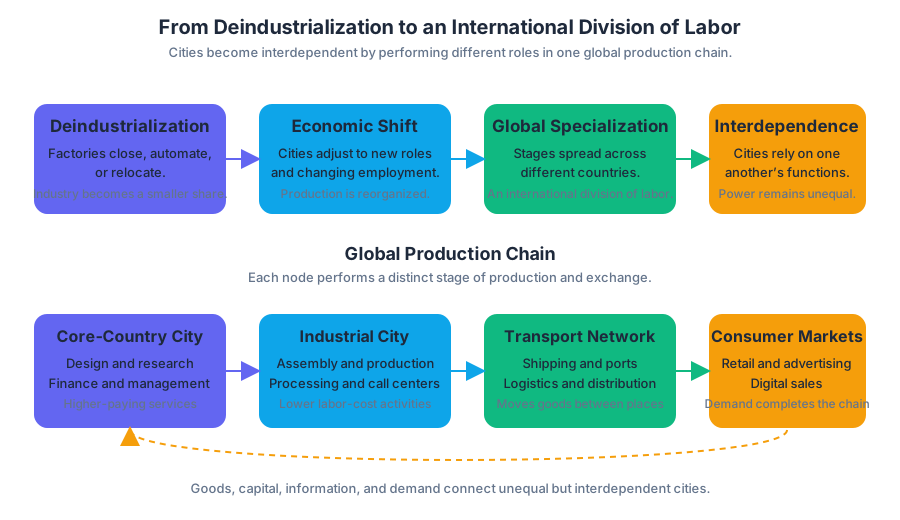
Deindustrialization is the decline of manufacturing employment and industrial activity in a place. It does not necessarily mean that every factory disappears; rather, manufacturing becomes a smaller share of employment and economic output. As factories close, automate, or relocate, cities must adjust to a new economic role.
An international division of labor is the geographic separation of stages of production among countries. Core countries often retain higher-paying work such as corporate management, research and development, finance, design, and advanced technical services. Newly industrialized or semiperipheral countries may gain manufacturing, assembly, call-center, logistics, and other jobs that require lower labor costs.
The process can be visualized as a chain:
Core-country city → product design, finance, management
Newly industrialized city → assembly, manufacturing, processing
Global transport network → shipping, ports, distribution
Consumer markets → retail, advertising, digital sales
This arrangement creates interdependence: cities are connected because each performs a different function, not because they all possess the same economic power.
Economic sector shift
Deindustrialization also produces an economic sector shift—a movement in employment and output from the primary and secondary sectors toward the tertiary and quaternary sectors.
| Earlier industrial emphasis | Growing postindustrial emphasis |
|---|---|
| Factory production | Finance and business services |
| Steel, machinery, and textiles | Information technology and research |
| Large industrial workforces | Specialized professional employment |
| Warehouses and production plants | Offices, laboratories, and service hubs |
A city that once depended on steel mills may replace some industrial jobs with software firms, medical research, higher education, tourism, or corporate headquarters. These newer activities can generate substantial wealth, but they may not replace the same number of jobs or provide equal access to workers who previously held industrial positions.
Outsourcing, offshoring, and economic restructuring
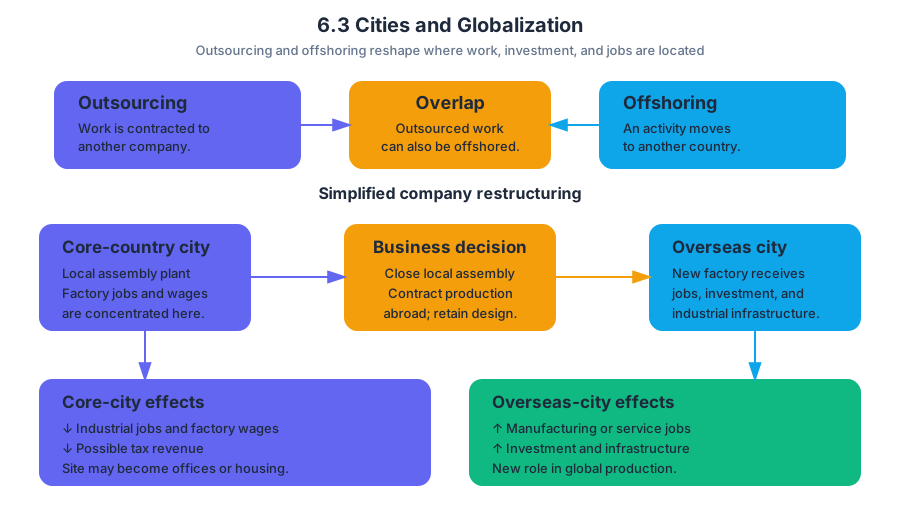
Outsourcing occurs when a company contracts work to another company rather than performing that work internally. Offshoring occurs when a company moves an activity to another country. The two processes can overlap: a firm might outsource customer support to an independent company located overseas, making the activity both outsourced and offshored.
Together with economic restructuring, these processes have contributed to globalization. Economic restructuring means reorganizing an economy or firm so that production, employment, investment, and services operate differently. The result may be a decline in industrial jobs in core countries and an increase in manufacturing or service employment in newly industrialized countries.
Consider a simplified example. A company based in a core-country city closes its local assembly plant, contracts production to a factory abroad, and keeps product design and corporate finance at home. The core city loses factory wages and possibly tax revenue, while the overseas city gains jobs, investment, and industrial infrastructure. The original city may then convert the factory site into offices or apartments and offer lower taxes to attract replacement businesses.
How restructuring changes cities
Economic restructuring changes more than a city’s job titles. It can alter:
- Employment base: industrial jobs decline while service, managerial, and technical jobs grow.
- Land use: factories and rail yards may become offices, housing, retail districts, or abandoned brownfields.
- Tax revenue: the city may lose business and wage taxes when plants close, then seek new firms to restore its revenue base.
- Income distribution: higher-paying professional work may expand while displaced workers face unemployment or lower-wage service work.
- International position: the city may shift from a production center to a headquarters, finance, design, logistics, or innovation center.
A city can therefore become more globally connected while also experiencing local economic hardship. Globalization may increase investment and high-income employment in one district while leaving former industrial neighborhoods with unemployment, vacancy, and declining public services.
Misconception check
Common misconception: Deindustrialization means that a country has stopped being economically important.
Deindustrialization means that manufacturing has declined as a share of the economy or workforce—not that all industry has vanished or that the country has become poor. Core countries may lose routine factory jobs while retaining highly paid control functions. The key question is which activities remain, where they are located, and who benefits from them.
AP skill lens: Topic 6.3
This topic is especially suited to 1.A Define a concept, process, or model, 1.B Explain a concept, process, or model, 2.B Explain spatial relationships, 2.C Explain a spatial pattern using concepts, processes, or models, 3.B Explain patterns and trends in geographic data, and 5.B Explain spatial relationships across scales. A strong response connects a process to a spatial consequence: outsourcing or offshoring changes where jobs occur; deindustrialization changes the economic sector mix; restructuring changes the city’s land use and global role.
Retrieval check
A core-country city loses routine manufacturing jobs but gains corporate headquarters, research laboratories, and financial services. Identify one process causing the employment change and explain one resulting spatial consequence.
Answer: Deindustrialization, outsourcing, offshoring, or economic restructuring may cause the loss of manufacturing jobs. The city may shift toward higher-paying management and research functions, while former factories are redeveloped or abandoned and production expands in newly industrialized countries.

Source Materials
- AP Human Geography Course and Exam Description
- AP Human Geography Course and Exam Description Clarifications and Corrections
- AP Human Geography Course Overview
- AP Human Geography Course at a Glance
- AP Human Geography Course at a Glance Poster
- AP Human Geography
- AP Human Geography
- AP Human Geography Sample Syllabus 1