From the free course AP Human Geography on Lykke
5.9 The Global System of Agriculture
Key concepts: Globalized agricultural system · Global food distribution networks · International trade and export commodities · Political relationships and infrastructure · Commodity chains · Commercial agriculture replacing family farms · Economies of scale · Carrying capacity · Spatial patterns of cow’s milk and pork production · Environmental and health impacts of intensive agriculture
A cup of coffee, a carton of milk, or a package of pork may cross several borders before reaching a consumer. Globalized agriculture is therefore an interconnected system in which production, processing, transportation, distribution, and consumption operate across multiple places and geographic scales.
5.9 The Global System of Agriculture
A cup of coffee, a carton of milk, or a package of pork may cross several borders before reaching a consumer. Globalized agriculture is therefore an interconnected system in which production, processing, transportation, distribution, and consumption operate across multiple places and geographic scales.
PSO-5.E: Agriculture functions as a global system shaped by trade, political relationships, infrastructure, and interdependence.
From local farm to global commodity chain
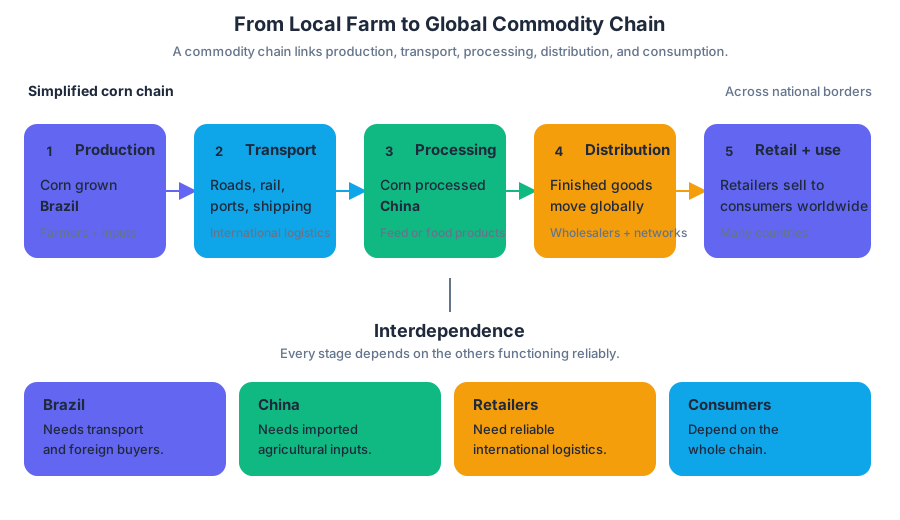
A commodity chain is the linked sequence of activities that moves an agricultural product from production to consumption. The chain may include farmers, input suppliers, processors, exporters, shipping companies, wholesalers, retailers, and consumers. Large commercial operations increasingly organize these stages across national borders.
Consider a simplified corn chain:
- Corn is grown in Brazil.
- It is transported through roads, railways, and ports.
- Processing occurs in China, where the corn may become animal feed or another food product.
- Finished goods move through international distribution networks.
- Multinational retailers sell those goods to consumers in many countries.
This example shows interdependence: Brazil depends on transportation and foreign buyers, China depends on imported agricultural inputs, retailers depend on reliable international logistics, and consumers depend on the entire chain functioning. A disruption at one point—such as a port closure, trade restriction, or conflict—can affect distant producers and consumers.
Economies of scale and commercial agriculture
Economies of scale occur when the average cost of producing each unit falls as the operation becomes larger. A large farm may spread the cost of machinery, storage, irrigation, data systems, and transportation across thousands of hectares or many animals. This economic advantage helps explain why large-scale commercial agricultural operations are replacing small family farms (PSO-5.C.3).
Technology has strengthened these economies of scale and increased the carrying capacity of land—the number of people or amount of activity that available resources can support under particular conditions (PSO-5.C.5). Mechanization, improved seeds, genetic modification, fertilizers, refrigeration, and digital logistics can raise output, but they may also make small farms less competitive when they cannot afford comparable equipment or access to large markets.
Common misconception: “Commercial agriculture” simply means farming for profit, while “family farming” does not.
Correction: A family farm can sell products commercially. The important distinction is that commercial agriculture is generally organized around large-scale production, markets, processing, and distribution, whereas small family farms often operate with fewer resources and less bargaining power in global commodity chains.
Distribution depends on more than physical geography
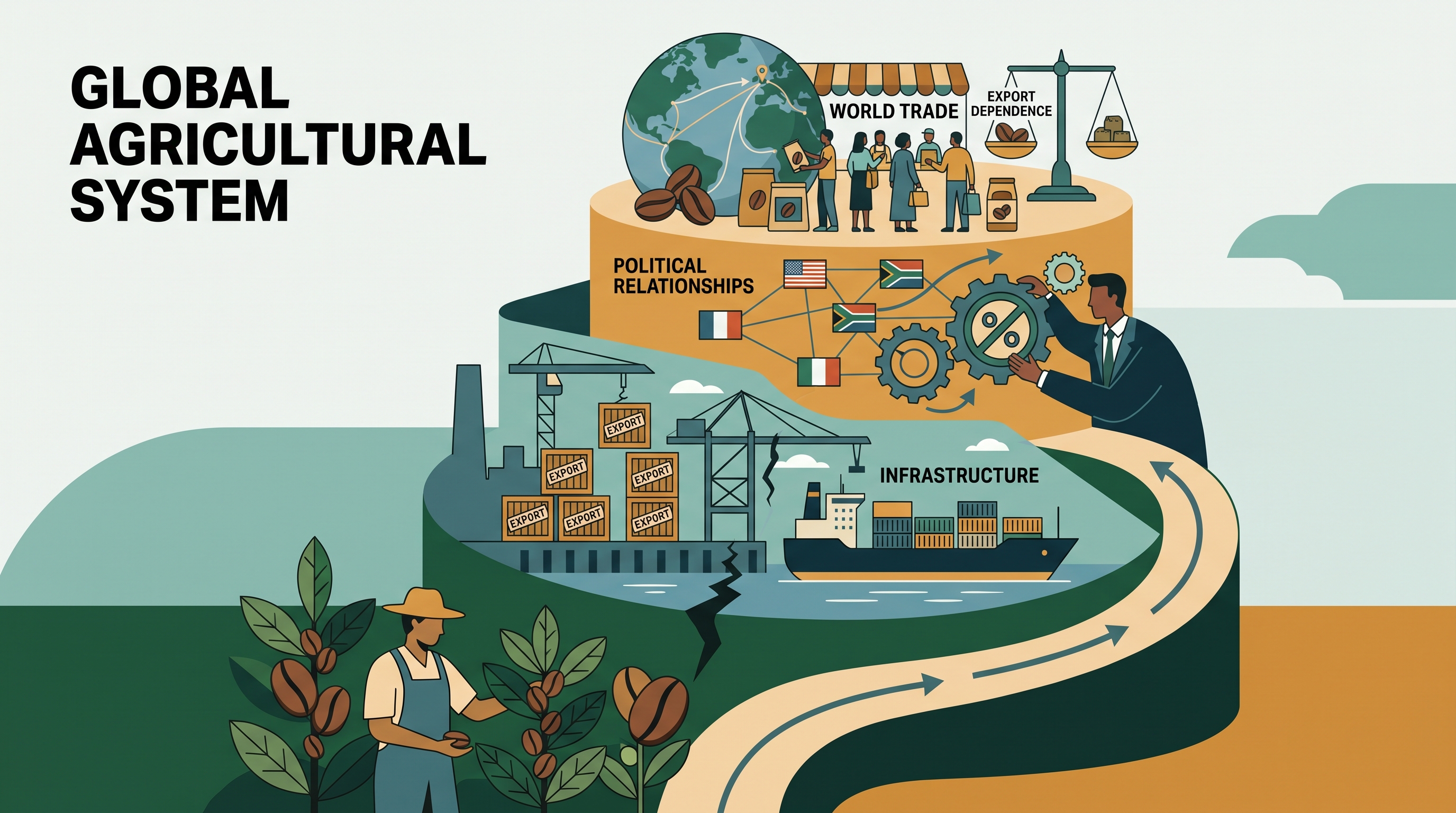
Global food distribution networks are shaped by political relationships, infrastructure, and patterns of world trade (PSO-5.E.3). Roads and railways connect farms to ports; refrigerated storage allows perishable products to travel farther; trade agreements influence tariffs and market access; and diplomatic relationships can encourage or restrict exchange.
Many countries depend heavily on one or more export commodities, such as coffee, bananas, cocoa, or another crop produced mainly for foreign markets. Export dependence can generate income and employment, but it also creates vulnerability: a fall in world prices, a disease outbreak, or a change in trade policy can affect national revenue and local livelihoods.
Reading agricultural patterns at multiple scales
The global system must be analyzed at more than one scale, applying geographic concepts, processes, models, or theories across local, national, regional, and global contexts (Skill 5.D: Scale Analysis). A global map may show where production is concentrated, but it does not by itself explain why that pattern exists or who controls the movement of the product.
The Food and Agriculture Organization’s 2018 global choropleth maps illustrate this distinction. Cow’s milk production varied considerably by country, as did pork production. Comparing the maps requires describing spatial patterns—such as concentrations and areas of lower production—then connecting those patterns to population, markets, infrastructure, cultural practices, environmental conditions, and trade relationships.
A country may produce large quantities of a commodity without consuming most of it. Conversely, a country may consume substantial amounts while importing much of its supply. Production maps therefore reveal only one stage of the commodity chain; they do not automatically measure food security, consumption, income, or trade dependence.
The system’s trade-offs
Increasing international trade can produce global economic, social, cultural, and environmental outcomes. It can connect producers to larger markets and raise carrying capacity through technology, while also encouraging intensive operations and specialized production. These effects must be evaluated as consequences of agricultural practices rather than assumed from production totals alone.
Retrieval check
A country grows coffee for export, but its main port is unreliable and a new trade agreement raises tariffs. Explain how infrastructure, political relationships, and world trade could affect the country’s commodity chain and export dependence. For full credit, connect each factor to a specific stage between production and consumption.

Source Materials
- AP Human Geography Course and Exam Description
- AP Human Geography Course and Exam Description Clarifications and Corrections
- AP Human Geography Course Overview
- AP Human Geography Course at a Glance
- AP Human Geography Course at a Glance Poster
- AP Human Geography
- AP Human Geography
- AP Human Geography Sample Syllabus 1
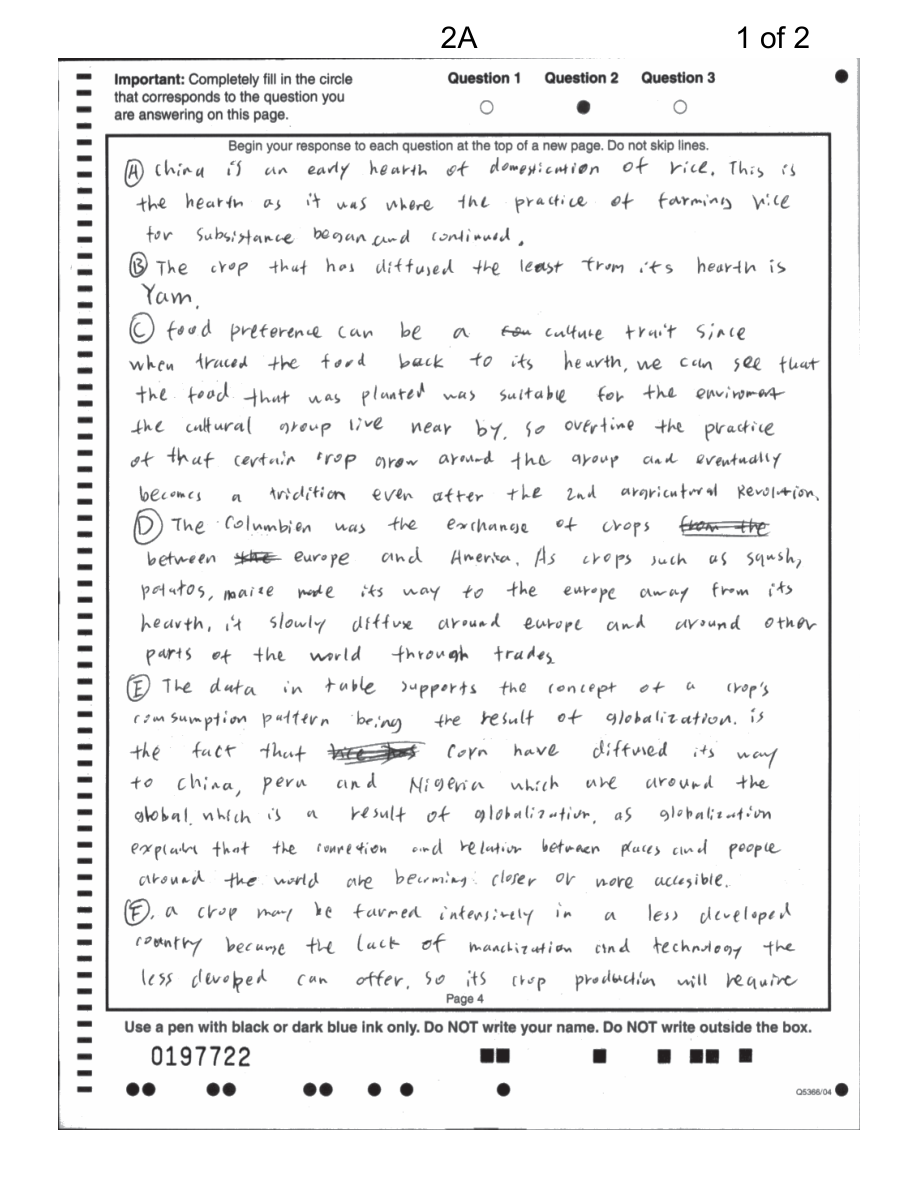
- Figure — Sample Responses Q2 - Set 1 (p. 5)
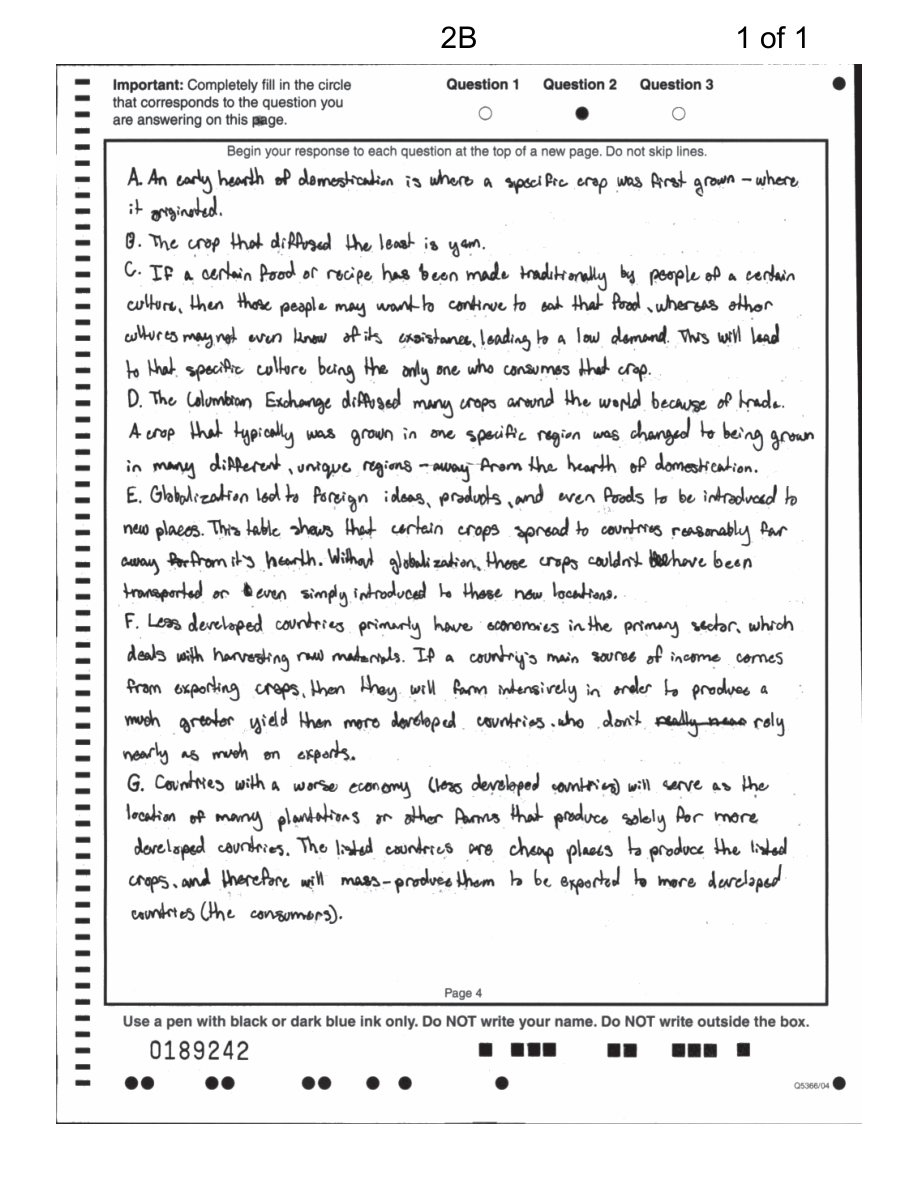
- Figure — Sample Responses Q2 - Set 1 (p. 6)
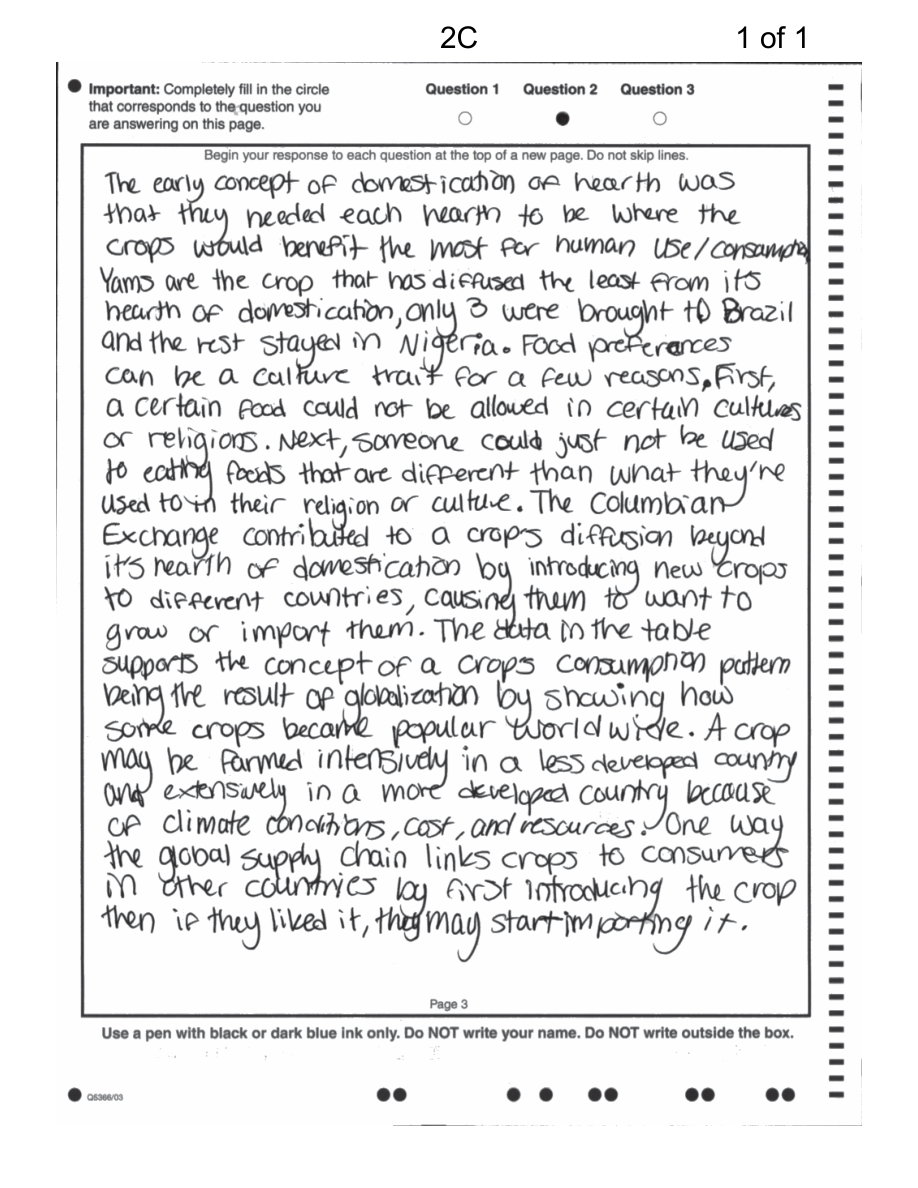
- Figure — Sample Responses Q2 - Set 1 (p. 7)
- Figure — Sample Responses Q2 - Set 1 (p. 8)