From the free course AP Human Geography on Lykke
6.8 Urban Sustainability
Key concepts: Urban sustainability · Quality of life and standards of living · High-quality urban infrastructure · Suburban sprawl · Habitat fragmentation and biodiversity loss · Urban heat islands · Transportation networks and traffic congestion · Land-use competition · Transportation-oriented development (TOD) · Multilevel urban governance
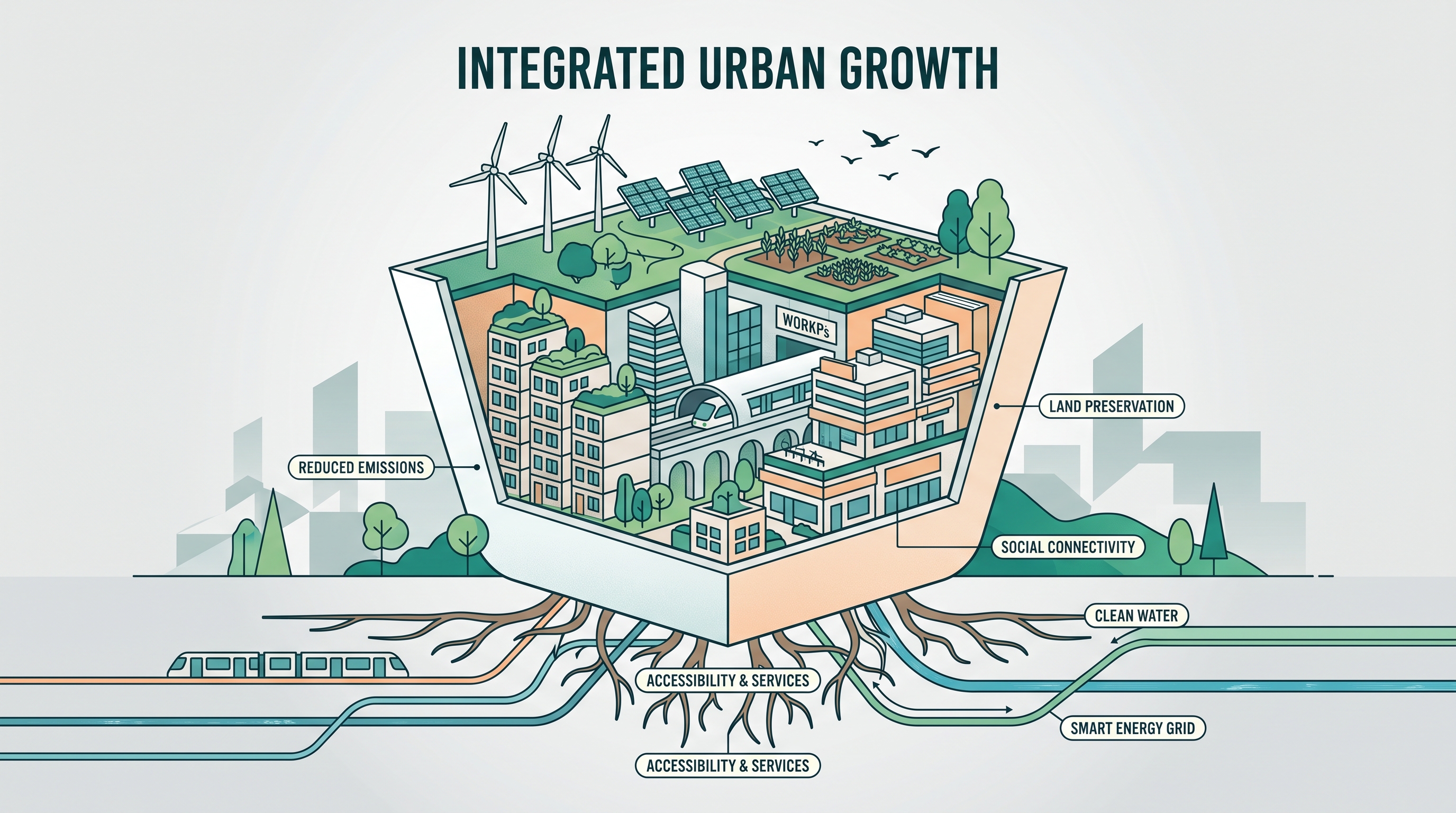
Urban sustainability asks whether a city can support a good quality of life over time without exhausting the environmental, social, and economic systems on which residents depend.
6.8 Urban Sustainability
Urban sustainability asks whether a city can support a good quality of life over time without exhausting the environmental, social, and economic systems on which residents depend. A city may grow wealthier while becoming less sustainable if longer commutes, polluted air, lost habitat, rising heat, and unequal access to services undermine daily life.
Quality of life, standards of living, and sustainability
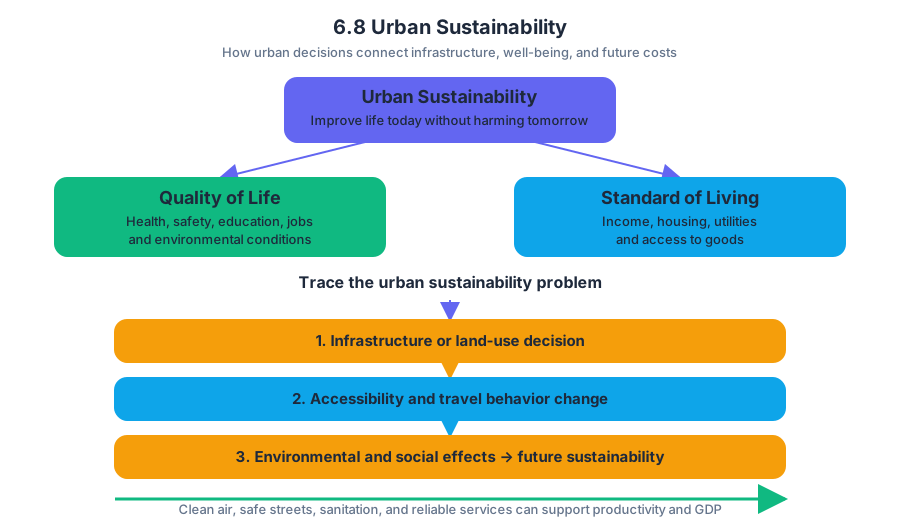
Quality of life describes residents’ overall well-being, including health, safety, education, access to employment, and environmental conditions. Standards of living focus more narrowly on material conditions such as income, housing, utilities, transportation, and access to goods and services. Urban sustainability connects the two: a city is more sustainable when it improves present well-being without shifting excessive environmental or social costs onto future residents.
The quality of previously established urban infrastructure matters because it determines whether residents can actually reach opportunities. Reliable housing, transportation, communications, schools, commercial buildings, public utilities, and health services can improve access to employment, education, health care, and daily necessities. However, infrastructure is not automatically sustainable: expanding roads may improve short-term mobility while encouraging automobile dependence, congestion, pollution, inefficient energy use, and further outward growth.
A useful way to trace an urban sustainability problem is:
Infrastructure or land-use decision
$\downarrow$
Change in accessibility and travel behavior
$\downarrow$
Environmental and social effects
$\downarrow$
Change in quality of life and long-term sustainability
A healthier urban environment can also produce economic benefits. Cleaner air, safer streets, effective sanitation, and dependable access to services can support a healthier workforce; fewer workers missing work because of illness can increase productivity and potentially raise a city’s gross domestic product, or GDP. Sustainability therefore is not simply “protecting nature”: it involves balancing environmental health, social well-being, and economic activity.
Suburban sprawl and environmental costs
Suburban sprawl is the outward, often low-density expansion of urban development into surrounding rural or undeveloped land. Sprawl commonly separates homes from workplaces, schools, and shops, increasing dependence on private vehicles and lengthening commuting distances.
The environmental effects form a connected chain:
| Sprawl-related change | Likely consequence |
|---|---|
| Development spreads across undeveloped land | Habitat fragmentation and decreased biodiversity |
| More residents commute longer distances | More traffic congestion and vehicle emissions |
| More roads and buildings cover land | Less land for local food production, conservation, or greenbelts |
| Larger transportation networks serve dispersed development | Greater energy use and potential contribution to urban heat islands |
Habitat fragmentation occurs when continuous ecosystems are divided into smaller, isolated patches by roads, buildings, and other development. Even if some vegetation remains, fragmented habitat may support fewer species because organisms lose feeding areas, migration routes, and breeding connections. The issue is not merely the total amount of land developed; where and how development divides the landscape also matters.
A common misconception is that suburban development is environmentally harmless because each individual neighborhood may contain trees or open lawns. The correction is that scattered development can create cumulative effects: roads divide habitats, driving increases, and land that could have supported conservation, greenbelts, or local food production is permanently converted.
Transportation planning and transportation-oriented development
Urban sustainability is closely connected to urban governance—the way decisions are made and implemented—and to transportation planning. Expanding a road network may increase capacity temporarily, but it can also encourage additional driving and produce more congestion. By contrast, transportation-oriented development, or TOD, concentrates housing, employment, services, and commercial activity near reliable public transportation.
For example, suppose a metropolitan area extends a rail line to a dense mixed-use district rather than building a highway through undeveloped land. Residents near stations may be able to walk to transit, jobs, schools, and shops, reducing the number of car trips. That can decrease congestion, air pollution, noise pollution, fuel use, and the pressure to build additional roads. The sustainability benefit comes from the linked land-use and transportation pattern—not from the rail line alone.
Governance affects whether such planning succeeds. Power may be dispersed or shared among central, subnational, and local governments. A central government may fund rail construction, a subnational government may coordinate regional routes, and local governments may control zoning around stations. If these governments pursue conflicting policies, transportation investment may fail to produce compact, accessible development.
Urban heat islands
An urban heat island is a built-up urban area that is warmer than nearby less-developed surroundings. Dense concentrations of pavement, roads, roofs, and buildings absorb and retain heat, while extensive transportation activity and energy use can add further heat. Sprawling transportation networks can therefore contribute to urban heat islands indirectly through greater pavement, automobile use, and inefficient energy consumption.
The key distinction is between a single project and its system-wide effect. A new road may make one trip faster, yet a metropolitan pattern of dispersed housing and automobile dependence can increase total vehicle travel, congestion, emissions, and heat. Conversely, compact development and effective public transportation can support sustainability by reducing car use and protecting undeveloped land.
Misconception check and retrieval
Misconception check: “Urban sustainability means stopping all growth.” Not necessarily. Sustainable urban growth improves access to housing, employment, education, services, and transportation while limiting pollution, inefficient energy use, habitat loss, congestion, and avoidable land consumption.
Retrieval check: A city builds a rail extension, but permits low-density development far beyond the stations. Identify one reason the project may produce fewer sustainability benefits than expected. A strong answer explains that if development remains dispersed, residents may still depend on cars; traffic, energy use, pollution, and land consumption may continue despite the transit investment. This reasoning applies 1.C: Explain geographic concepts, processes, models, and theories, 2.C: Explain spatial relationships, and 5.C: Explain how changing spatial scales affect geographic patterns and processes, especially through the Impacts and Interactions (IMP) and Spatial Process and Societal Change (SPS) big ideas.
Source Materials
- AP Human Geography Course and Exam Description
- AP Human Geography Course and Exam Description Clarifications and Corrections
- AP Human Geography Course Overview
- AP Human Geography Course at a Glance
- AP Human Geography Course at a Glance Poster
- AP Human Geography
- AP Human Geography
- AP Human Geography Sample Syllabus 1