From the free course AP Human Geography on Lykke
6.2 Cities Across the World
Key concepts: Cities across the world · Urbanization · Suburbanization · Edge cities · Exurbs · Urbanism · Greenbelts · Slow-growth cities · Sustainable urban options · Spatial relationships and geographic similarities and differences
A city is not simply a large settlement: it is a spatial concentration of people, activities, institutions, and connections whose form reflects both physical geography and human choices.
6.2 Cities Across the World
A city is not simply a large settlement: it is a spatial concentration of people, activities, institutions, and connections whose form reflects both physical geography and human choices. The same process—urbanization—can produce a dense metropolitan core in one region, a sprawling highway corridor in another, or a rapidly expanding megacity in a peripheral country.
PSO-6 — Enduring Understanding: The presence and growth of cities vary across geographical locations because of physical geography and resources.
Urbanization, suburbanization, and urbanism
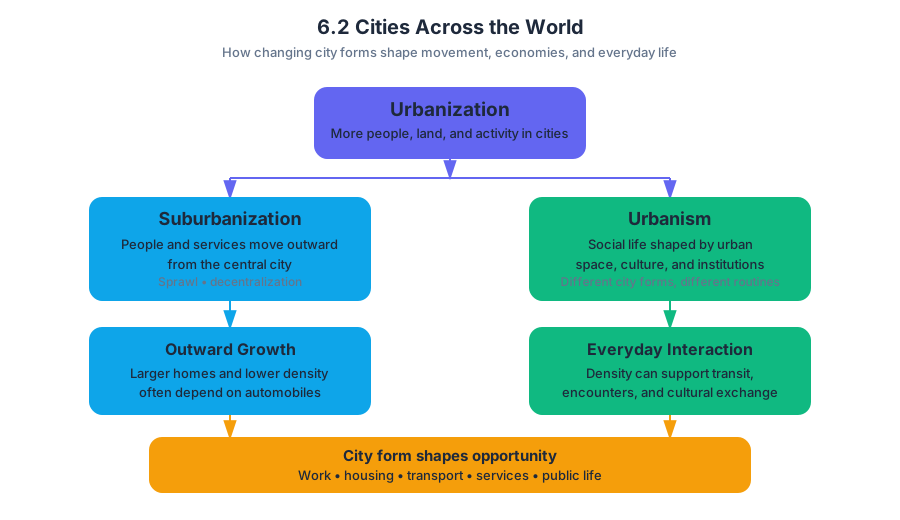
Urbanization is the growth in the number and share of people living in urban areas, accompanied by the expansion of urban land uses and urban economies. It changes not only population distribution but also employment, transportation, housing, political influence, and access to services.
Suburbanization is the movement of people, residences, businesses, and services from a central city toward surrounding areas. It often results from rising incomes, automobile ownership, improved roads, desire for larger homes, perceived safety, or the search for lower-density environments. When development spreads outward in a discontinuous or low-density pattern, it is called sprawl; when activities and decision-making move away from the historic central city, the process is decentralization.
Urbanism means the patterns of social life, culture, institutions, and human interaction shaped by urban environments. Dense apartment districts may encourage frequent encounters, public transit, and mixed cultural exchange, while automobile-oriented suburbs may produce more private, household-centered routines. Urbanism therefore differs among city forms: the physical layout of a city helps shape how people work, socialize, obtain services, and participate in public life.
New urban forms created by outward growth
PSO-6.A — Learning Objective: Explain the processes that initiate and drive urbanization and suburbanization. Suburbanization and sprawl do not merely enlarge an existing city; they create new land-use forms with distinct relationships to the central city.
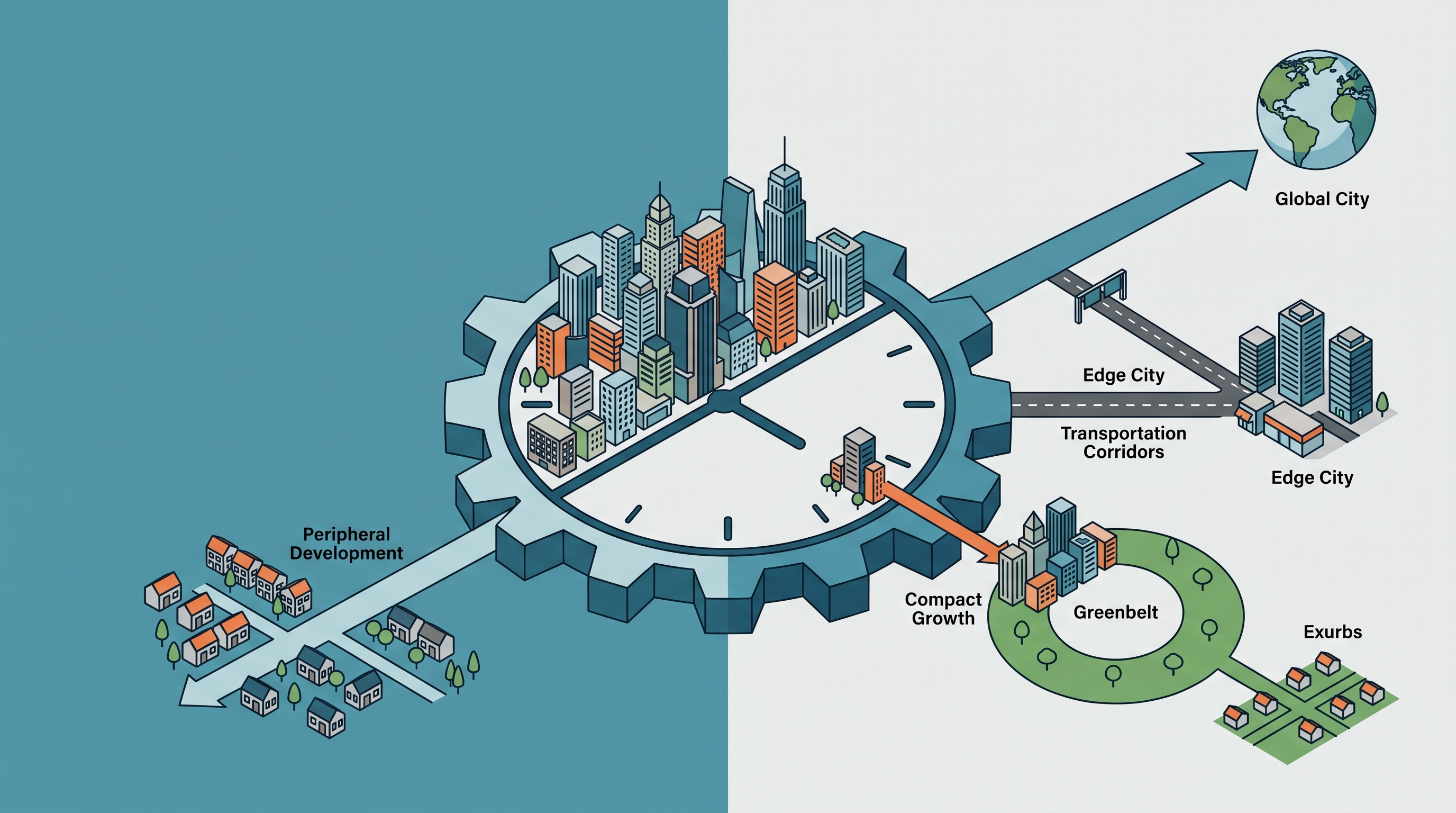
- An edge city is a concentrated node of offices, retail, entertainment, and other economic activity that develops on the outskirts of a metropolitan area, often near major highways. It may have more jobs and commercial space than housing and can function as a secondary urban center.
- An exurb is a lower-density settlement beyond the suburbs. Exurbs remain connected to a metropolitan economy but are more distant, less urban in appearance, and often dependent on long-distance commuting.
- A boomburb is a rapidly growing suburban municipality that becomes city-sized in population but may lack the traditional downtown, density, or historic identity of an older central city.
- A greenbelt is a band of open or protected land surrounding or separating urbanized areas. It can limit outward expansion, preserve farmland or ecosystems, and create a sharper boundary between city and countryside.
- A slow-growth city is a city or municipality that deliberately restricts or moderates development through land-use regulations, growth limits, zoning, or infrastructure controls.
The forms can be read as a spatial sequence:
central city → suburbs → edge city → exurbs → rural or protected land
This sequence is not universal. A greenbelt may interrupt it, a new edge city may rival the historic core, and a slow-growth policy may redirect development into neighboring jurisdictions rather than eliminate regional growth.
Cities in different world regions
PSO-6.A.3 — Essential Knowledge: Megacities and metacities are distinct spatial outcomes of urbanization increasingly located in countries of the periphery and semiperiphery. A megacity is an urban agglomeration with at least $10$ million residents. A metacity is an even larger urban agglomeration, generally exceeding $20$ million residents. These categories describe population scale, not automatically wealth, density, governance quality, or sustainability.
Cities in core regions often have older infrastructure, established suburban systems, and slower population growth, although they may experience redevelopment, immigration, or renewed central-city growth. Cities in semiperipheral and peripheral regions may grow much faster because of rural-to-urban migration, natural increase, industrial expansion, and concentration of education, employment, health care, and government services. Rapid growth can generate innovation and opportunity, but it can also outpace housing, sanitation, transportation, and formal employment.
Worked comparison: Imagine comparing a mature core-region metropolitan area with a rapidly growing peripheral-region megacity. The core-region city may show a historic central business district, extensive suburbs, edge cities, and a regulated greenbelt. The peripheral-region city may show a dense formal core beside informal housing, intense migration inflows, and expanding infrastructure at the urban edge. Both are urbanizing, but their different rates of growth, resource access, governance capacity, and physical settings produce different landscapes and challenges.
Social change, livability, and sustainability
Changing social values influence urban form. Preferences for privacy, larger homes, environmental protection, cultural amenities, safety, or walkable neighborhoods can shift demand toward suburbs, exurbs, compact central districts, or protected greenbelts. Access to universities, jobs, hospitals, and reliable transportation also attracts people and investment, reinforcing particular urban locations.
Options for improving urban livability—the quality, safety, accessibility, and comfort of daily life—include reliable public transit, affordable housing, mixed-use neighborhoods, pedestrian infrastructure, parks, clean water, effective waste systems, and equitable access to schools and health care. Sustainability requires weighing present needs against long-term environmental and social effects, such as energy use, congestion, air pollution, water demand, and loss of farmland.
Applying spatial relationships
2.D — Spatial Relationships: Explain the significance of geographic similarities and differences among different locations and/or at different times. To apply this skill, do more than state that two cities are “similar” or “different.” Identify a pattern, connect it to a geographic process, and explain why location, resources, scale, or regional position produces the outcome.
The urban-growth-of-cities resource can be analyzed as a visual record of these processes. Look for the direction of expansion, changes in density, the appearance of peripheral development, transportation corridors, and remaining open land. Then ask: Is growth compact or sprawling? Is the city connected to a greenbelt? Are new districts functioning as edge cities? Does the pattern suggest a core, semiperipheral, or peripheral urban context?
Misconception check: A megacity is not automatically a “global city,” and suburbanization does not mean that the entire population leaves the central city. These terms describe different dimensions: population scale, global economic connections, and the relocation or decentralization of urban activities.
Retrieval check: A metropolitan region contains a historic downtown, a highway-centered office-and-retail cluster, distant low-density settlements, and a protected ring of open land. Identify the edge city, exurbs, and greenbelt, then explain one way this arrangement could affect urbanism and one policy that could improve sustainability.
Source Materials
- AP Human Geography Course and Exam Description
- AP Human Geography Course and Exam Description Clarifications and Corrections
- AP Human Geography Course Overview
- AP Human Geography Course at a Glance
- AP Human Geography Course at a Glance Poster
- AP Human Geography
- AP Human Geography
- AP Human Geography Sample Syllabus 1