From the free course AP Human Geography on Lykke
5.6 Agricultural Production Regions
Key concepts: Agricultural production regions · Availability of resources and cultural practices · Agricultural land-use patterns · Spatial relationships · Agricultural practices and landscape alteration · Slash-and-burn agriculture · Terrace farming and irrigation · Shifting cultivation and pastoral nomadism · Societal effects of agriculture · Spatial patterns of cow’s milk and pork production
Agricultural production regions are areas whose farming patterns reflect both economic purpose and cultural practice. A field system is never determined by climate or soil alone: farmers also respond to land costs, transportation, markets, dietary traditions, available labor, and the resources valued by a society.
5.6 Agricultural Production Regions
Agricultural production regions are areas whose farming patterns reflect both economic purpose and cultural practice. A field system is never determined by climate or soil alone: farmers also respond to land costs, transportation, markets, dietary traditions, available labor, and the resources valued by a society.
Enduring Understanding PSO-5: Availability of resources and cultural practices influence agricultural practices and land-use patterns.
Under Learning Objective PSO-5.C, the key task is to explain how economic forces influence agricultural practices. Essential Knowledge PSO-5.C.1 identifies agricultural production regions by the extent to which they reflect subsistence practices—production mainly for the farmer’s household or local community—or commercial practices—production for sale. A region may also be organized around monocropping, the large-scale cultivation of one major crop, when market demand makes specialization profitable.
Resources, culture, and land-use patterns
Resources shape what is possible, while cultural practices shape what is preferred or acceptable. Water availability encourages irrigation; steep slopes may encourage terracing; extensive grasslands support pastoral nomadism; and religious or dietary traditions influence which animals farmers raise. Economic forces then connect these choices to markets: a farmer may grow food for household consumption, produce a cash crop for export, or combine both strategies to reduce risk.
Essential Knowledge PSO-5.C.2 connects farming intensity to land costs through bid-rent theory. Intensive farming uses substantial labor, capital, or inputs on a relatively small area, making sense where land is expensive or scarce. Extensive farming uses more land with fewer inputs per unit of area, making sense where land is cheaper or population density is lower. These are tendencies, not rigid rules: technology, infrastructure, government policy, and culture can alter the pattern.
| Agricultural pattern | Main economic logic | Possible landscape expression |
|---|---|---|
| Subsistence farming | Feed the producer and household | Diverse small plots |
| Commercial farming | Produce for markets and profit | Large farms or specialized production |
| Monocropping | Concentrate on a profitable crop | Extensive single-crop fields |
| Intensive farming | Maximize output from costly land | Terraces, irrigation, dense labor |
| Extensive farming | Use broad areas where land is less costly | Ranching, pastoralism, large grain farms |
Agriculture alters landscapes and societies
Agricultural practices change physical landscapes. Slash-and-burn agriculture clears vegetation by cutting and burning it, temporarily releasing nutrients into the soil. In shifting cultivation, farmers move plots after soil fertility declines, allowing previously used land to recover. If population pressure shortens the fallow period, however, repeated clearing can contribute to deforestation, erosion, and declining soil fertility.
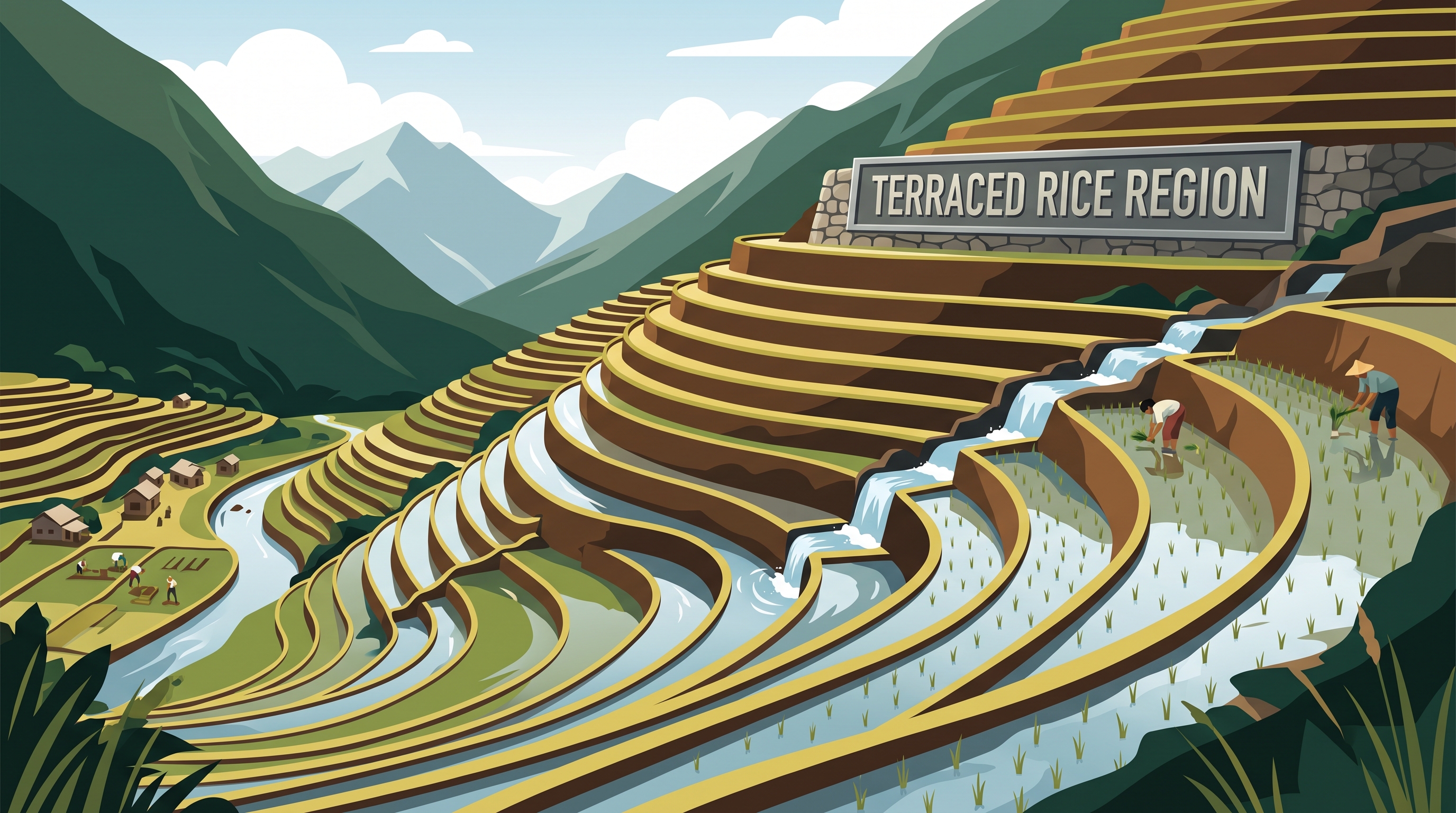
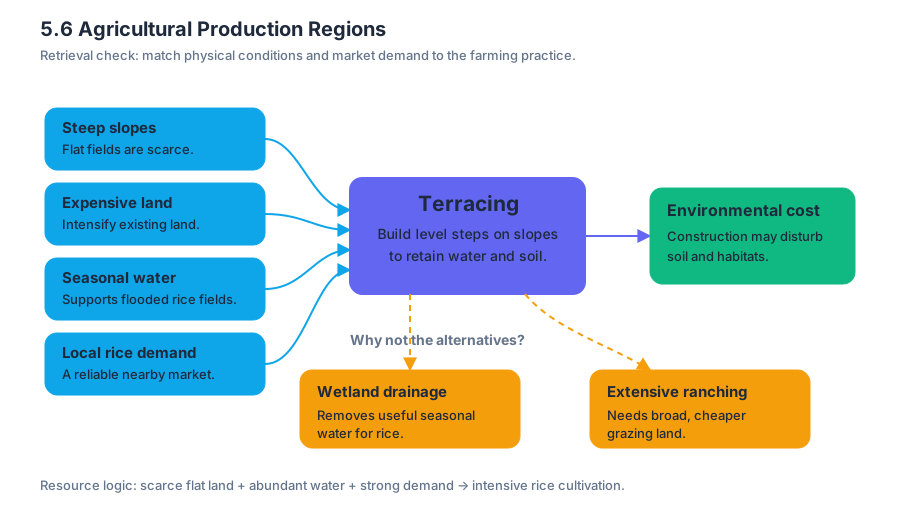
Other practices create different alterations. Terracing converts slopes into level steps that reduce runoff and make cultivation possible. Irrigation brings water to fields but can contribute to salinization when evaporation leaves salts behind. Wetland drainage creates farmland while removing habitats and natural flood storage. Pastoral nomadism uses seasonal movement across grazing areas; overgrazing can occur when herd size or land pressure exceeds the landscape’s capacity.
These practices also produce societal consequences, identified in IMP-5.A.2 and IMP-5.A.3. Agricultural change can alter diets, change the role of women in agricultural production, and shift agriculture’s economic purpose from household subsistence toward wage labor, commercial farming, or export production. These effects vary by region and scale rather than appearing everywhere in the same form.
Worked map comparison: cow’s milk and pork in Asia
A strong spatial analysis compares both maps. Suppose the cow’s-milk map shows medium or high production across most Asian countries, while the pork map shows high production concentrated in particular regions and low production elsewhere. The correct conclusion is not merely “cow’s milk is widespread” or “pork is concentrated.” The comparison is that cow’s-milk production has a broader distribution, whereas pork production is more localized.
Cultural practices help explain the contrast. Dietary traditions, including religious restrictions on pork in some societies, affect demand and therefore production. Cow’s milk production is widespread across most Asian countries, while pork production is concentrated in particular Asian regions. Resources, livestock traditions, market access, and the spatial diffusion of domesticated animals work together to produce these patterns.
Exam-quality comparison: Identify a specific region that shows similar production volumes on both maps, then identify a specific region where the volumes differ. Name the pattern on each map and explain the difference using a cultural, economic, or environmental factor.
Global interdependence
Contemporary agricultural regions are connected through globalization. Under Learning Objective PSO-5.E, food and agricultural products form part of a global supply chain (PSO-5.E.1); some countries depend heavily on one or more export commodities (PSO-5.E.2); and political relationships, infrastructure, and world-trade patterns influence distribution networks (PSO-5.E.3). A local land-use decision can therefore respond to demand, prices, transportation, or dietary change far beyond the producing region.
Misconception check
Misconception: “The map with the largest number of producing countries shows the greatest production.” A broad distribution does not necessarily mean the highest total volume. Always compare the mapped production levels, identify specific matching and differing regions, and then connect the spatial pattern to cultural practices, resources, markets, or animal diffusion.
Retrieval check
A region has steep slopes, expensive land, strong local demand for rice, and abundant seasonal water. Which practice is most likely—terracing, wetland drainage, or extensive ranching—and what resource and economic conditions explain your choice? Then state one environmental consequence that could result.
Source Materials
- AP Human Geography Course and Exam Description
- AP Human Geography Course and Exam Description Clarifications and Corrections
- AP Human Geography Course Overview
- AP Human Geography Course at a Glance
- AP Human Geography Course at a Glance Poster
- AP Human Geography
- AP Human Geography
- AP Human Geography Sample Syllabus 1