From the free course AP Human Geography on Lykke
2.7 Population Policies
Key concepts: Pronatalist population policies · Antinatalist population policies · Government incentives and social programs · Population growth rates and fertility · Drivers of population decline · Women’s education, employment, and fertility · Immigration and emigration · Population pyramids and demographic planning · Limits of population pyramids for measuring immigration · Urbanization and population change
A government can change population patterns not only by counting births and deaths, but by changing the conditions under which people decide whether and when to have children.
2.7 Population Policies
A government can change population patterns not only by counting births and deaths, but by changing the conditions under which people decide whether and when to have children. Population policies are government actions intended to influence population size, growth rate, fertility, mortality, or migration.
Investigative question: When a country’s fertility rate falls and its population begins to age, can government policy reverse the trend?
CED alignment: Learning Objective 2.7.A — Explain how population policies affect fertility rates and population growth.
Essential Knowledge 2.7.A.1 — Pronatalist policies encourage population growth by increasing fertility through incentives and social programs.
Essential Knowledge 2.7.A.2 — Antinatalist policies encourage population decline or slower growth by reducing fertility.
Essential Knowledge 2.7.A.3 — Population policies may have different effects because social norms, individual choices, family structures, economic conditions, and environmental concerns influence reproductive behavior.
Pronatalist population policies
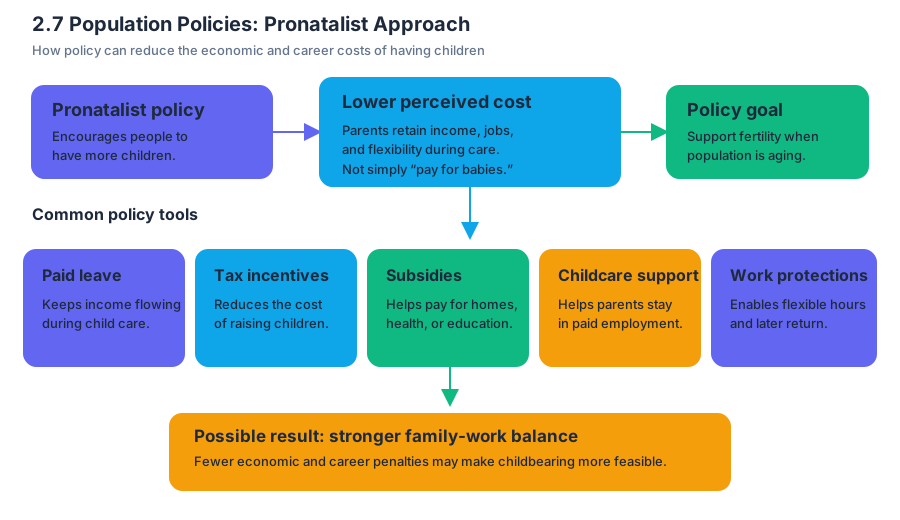
A pronatalist population policy encourages people to have more children. Governments may adopt these policies when low fertility, population aging, or population decline threatens the future labor force, tax base, consumer market, or ability to support older adults.
Common pronatalist tools include:
| Policy tool | How it may influence fertility |
|---|---|
| Paid parental leave | Allows parents to keep receiving income while caring for a child. |
| Tax incentives | Reduces the financial cost of raising children. |
| Government subsidies | Helps cover housing, medical care, or education expenses. |
| Childcare support | Makes it easier for parents to remain employed. |
| Family-friendly employment laws | Allows parents to delay returning to work or adjust work schedules. |
The central mechanism is not simply “pay people to have babies.” A more complete explanation is that parental leave, subsidized childcare, and employment protections reduce the economic and career penalties associated with childbearing. If parents can retain their jobs, receive pay while caring for children, and return to work later, the perceived cost of having a child may decrease.
Antinatalist population policies
An antinatalist population policy encourages lower fertility. Governments may use such policies when rapid population growth places pressure on food supplies, housing, schools, healthcare, employment, or environmental resources. Policies can include access to contraception, family-planning programs, public education, or legal limits on births.
Pronatalist and antinatalist policies operate in opposite demographic directions, but neither automatically produces the government’s desired result. Fertility decisions are also shaped by social expectations, religious beliefs, household finances, environmental concerns, family structures, and individual preferences.
Key distinction: A policy can encourage a demographic behavior without fully controlling it.
Why population policies may have limited effects
A pronatalist policy can affect a country’s population growth rate to a moderate or high degree, especially when it improves access to childcare, income, housing, and employment security. However, its effects may remain limited if people continue to prefer smaller families, postpone childbearing, face high living costs, or view parenthood as incompatible with career goals.
Population change also depends on more than fertility. A country’s total population may decline because of:
- Declining fertility: Fewer children are born.
- Increasing mortality: Death rates rise.
- Out-migration or emigration: More people leave than enter.
- Social or cultural factors: Education and employment opportunities may lower fertility.
- Political factors: War, conflict, or restrictive immigration policies can reduce population.
- Medical factors: Epidemics or limited healthcare can increase mortality or reduce fertility.
- Environmental factors: Disasters, pollution, or resource scarcity can push people away.
- Economic factors: Unemployment, recession, high living costs, or weak social programs can discourage childbearing.
Worked example: Suppose Country A has low fertility, a large elderly population, and many young adults moving abroad. A strong answer would not say only “the country needs a pronatalist policy.” It would explain that paid parental leave and subsidized childcare could reduce the cost of raising children, while improved employment opportunities could make parenthood more compatible with work. Because out-migration is also reducing the population, the government might additionally revise immigration policies.
Population pyramids as policy evidence
A population pyramid displays a population’s age-sex structure. Its shape helps governments anticipate future needs. A wide base indicates many children and may signal future demand for schools, pediatric healthcare, and daycare centers. A narrow base combined with a wide upper section suggests low fertility and population aging, increasing demand for eldercare, healthcare, pensions, and accessible transportation.
Population pyramids have an important limitation: they do not distinguish people born in the country from migrants, show how many people migrated, or reveal migration’s effects on particular cities. They are usually national-scale representations, so a pyramid may hide substantial immigration into one metropolitan area.
Migration to cities, economic growth, industrialization, development, and expanded transportation or communication systems can reshape population change even when national fertility remains stable. Geographic scale therefore matters: a country may be aging overall while one city gains young adult migrants and continues to grow.
Misconception check
Misconception: “A population pyramid can increase only through births.”
Correction: Population pyramids reflect births, deaths, aging, and migration. A country can gain population through immigration even when its fertility rate is low.
AP skill focus
This topic most directly develops DAT-1.A: Identify information from geographic representations, DAT-1.B: Describe spatial patterns, DAT-1.C: Explain patterns and trends, CON-2.A: Describe spatial patterns and processes, and SCALE-1.A: Identify the scales of analysis presented by geographic data. On an exam, connect the pyramid’s visible pattern to a specific policy and explain the demographic mechanism rather than naming a policy alone.
Retrieval check
A country has a narrow population-pyramid base, a growing elderly population, and rapid youth out-migration. Name one pronatalist policy and one non-pronatalist policy that could respond to these conditions. For each, explain the population problem it addresses.
Source Materials
- AP Human Geography Course and Exam Description
- AP Human Geography Course and Exam Description Clarifications and Corrections
- AP Human Geography Course Overview
- AP Human Geography Course at a Glance
- AP Human Geography Course at a Glance Poster
- AP Human Geography
- AP Human Geography
- AP Human Geography Sample Syllabus 1
- Demographic Data for Selected Countries, 2019