From the free course AP Human Geography on Lykke
3.8 Effects of Diffusion
Key concepts: Diffusion · Effects of diffusion · Agriculture · Learning objectives · SPS-3.B · Enduring Understanding
Diffusion changes a cultural landscape when an idea, practice, technology, language, religion, or material object spreads from one place to another and is adopted, adapted, blended, or resisted.
3.8 Effects of Diffusion
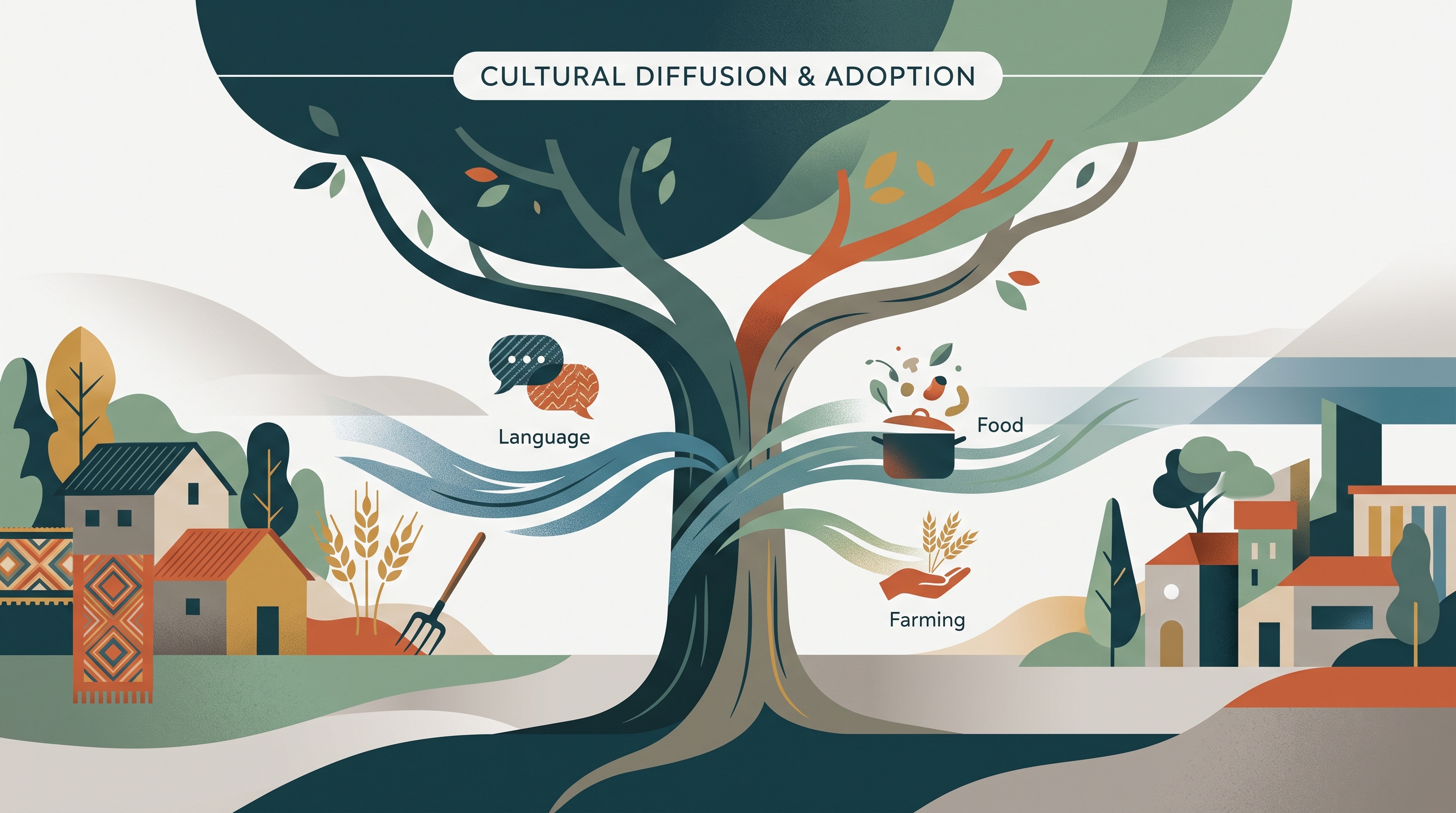
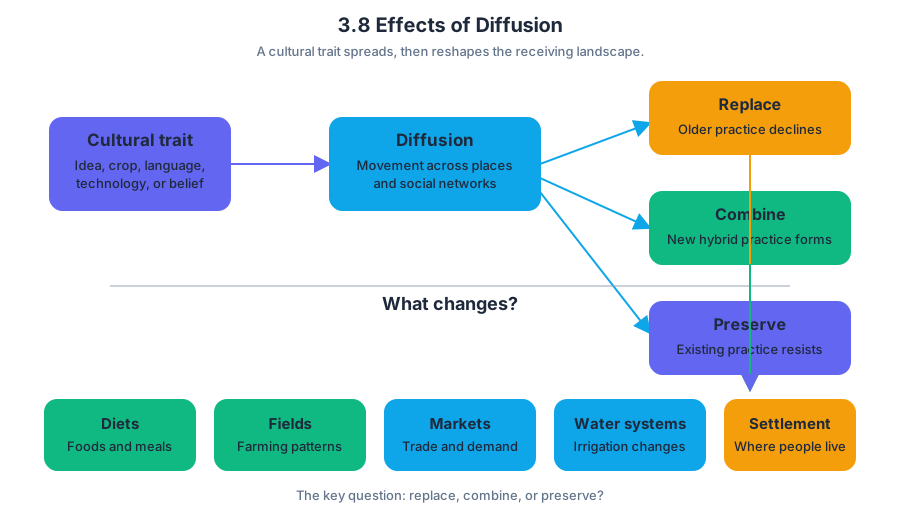
Diffusion changes a cultural landscape when an idea, practice, technology, language, religion, or material object spreads from one place to another and is adopted, adapted, blended, or resisted. A crop introduced into a new region, for example, can alter not only diets but also farm fields, markets, irrigation systems, settlement patterns, and the appearance of the landscape.
The key question is not simply where did a cultural trait spread? It is: What changed because the trait spread, and did the receiving society replace, combine, or preserve its existing practices?
From diffusion to landscape change
The cultural landscape is the visible imprint of human culture on Earth’s surface. It includes buildings, road patterns, religious structures, agricultural fields, clothing, signs, languages displayed in public, and land-use patterns. Diffusion affects this landscape when a cultural trait becomes visible in everyday spaces or changes how people organize and use places.
A useful cause-and-effect chain is:
- A cultural trait originates or becomes established in a source area.
- The trait spreads through relocation or expansion diffusion.
- People in the receiving area encounter the trait.
- The receiving society adopts, modifies, combines, or rejects it.
- The cultural landscape changes in response.
The result is not always cultural replacement. Diffusion can produce several different outcomes, and the same diffusion process may create different outcomes in different places.
Four effects of cultural diffusion
| Effect | Plain-language meaning | What may appear in the cultural landscape |
|---|---|---|
| Acculturation | The adoption of some traits from another culture while important elements of the original culture remain | New foods, clothing, technologies, or architectural styles alongside older traditions |
| Assimilation | The process by which a cultural group becomes absorbed into another culture, often losing many original traits | Reduced visibility of the original language, customs, or institutions |
| Syncretism | The blending of elements from different cultures into a new cultural practice | Hybrid religious practices, foods, music, art, or architectural forms |
| Multiculturalism | The coexistence of multiple cultural traditions within the same society or place | Multiple languages, religions, cuisines, festivals, and building styles existing together |
Acculturation is selective. A community may adopt a new agricultural technology but retain its traditional food preferences and social institutions. Assimilation is more extensive: the receiving or minority group adopts the dominant culture to such an extent that distinct cultural traits may become less visible.
Syncretism differs from simple borrowing because the result is a combination that creates something meaningfully new. Multiculturalism differs from assimilation because cultural differences remain visible and socially recognized rather than being absorbed into one dominant pattern.
Worked example: agricultural diffusion
Imagine that farmers in a region begin cultivating a crop introduced from another cultural hearth. At first, the crop may be added to existing fields without eliminating local crops. This is an example of acculturation: farmers adopt one useful trait while preserving much of the original agricultural system.
If the new crop becomes dominant, local food traditions and farming practices may decline. The landscape could shift toward larger areas planted with the introduced crop, new storage facilities, specialized markets, and transportation routes. If farmers combine the introduced crop with local cultivation methods, the result demonstrates syncretism rather than complete replacement.
A region may also maintain several agricultural traditions at once. Different communities could grow the introduced crop, preserve older crops, and use distinct farming techniques in nearby areas. That visible coexistence illustrates multiculturalism.
Misconception check: diffusion is not automatic assimilation
Common misconception: Every cultural trait that spreads causes the receiving culture to become like the source culture.
Correction: Diffusion produces changes, but the changes may involve selective adoption, blending, coexistence, or loss. To identify the effect, examine what happened to the original cultural traits: did they remain, combine with incoming traits, coexist with them, or largely disappear?
CED alignment
The broader Enduring Understanding connects cultural patterns to spatial processes and societal change. Under Learning Objective SPS-3.B, students must “Explain how the process of diffusion results in changes to the cultural landscape.” The required knowledge is identified as Essential Knowledge SPS-3.B.1: “Acculturation, assimilation, syncretism, and multiculturalism are effects of the diffusion of culture.”
For an AP-style explanation, name the diffusion-related change, identify the cultural trait involved, and connect that change to a visible or organized feature of the cultural landscape. “A crop spread” is incomplete; “the introduced crop changed field patterns, markets, and food practices while local methods remained” explains the effect.
Retrieval check
A language, food, or farming practice spreads into a new region. Residents adopt it but retain many original traditions, while some communities blend it with local practices. Which two effects are most directly represented, and what evidence would distinguish them?
Source Materials
- AP Human Geography Course and Exam Description
- AP Human Geography Course and Exam Description Clarifications and Corrections
- AP Human Geography Course Overview
- AP Human Geography Course at a Glance
- AP Human Geography Course at a Glance Poster
- AP Human Geography
- AP Human Geography
- AP Human Geography Sample Syllabus 1