From the free course AP Human Geography on Lykke
2.11 Forced and Voluntary Migration
Key concepts: Forced migration · Voluntary migration · Refugees · Internally displaced persons (IDPs) · Asylum seekers · Slavery · Chain migration · Family migration · Guest workers · Brain drain
Migration is not one uniform process: some people move because they choose or are able to pursue a different opportunity, while others move because remaining where they are has become impossible or unsafe.
2.11 Forced and Voluntary Migration
Migration is not one uniform process: some people move because they choose or are able to pursue a different opportunity, while others move because remaining where they are has become impossible or unsafe. That distinction—forced migration versus voluntary migration—helps explain who moves, where they go, and how migration networks form.
Learning Objective IMP-2.D: Describe types of forced and voluntary migration.
Essential Knowledge IMP-2.D.1: Forced migrations include slavery and events that produce refugees, internally displaced persons, and asylum seekers.
Essential Knowledge IMP-2.D.2: Types of voluntary migrations include transnational, transhumance, internal, chain, step, guest worker, and rural-to-urban migration.
Forced migration: movement under compulsion
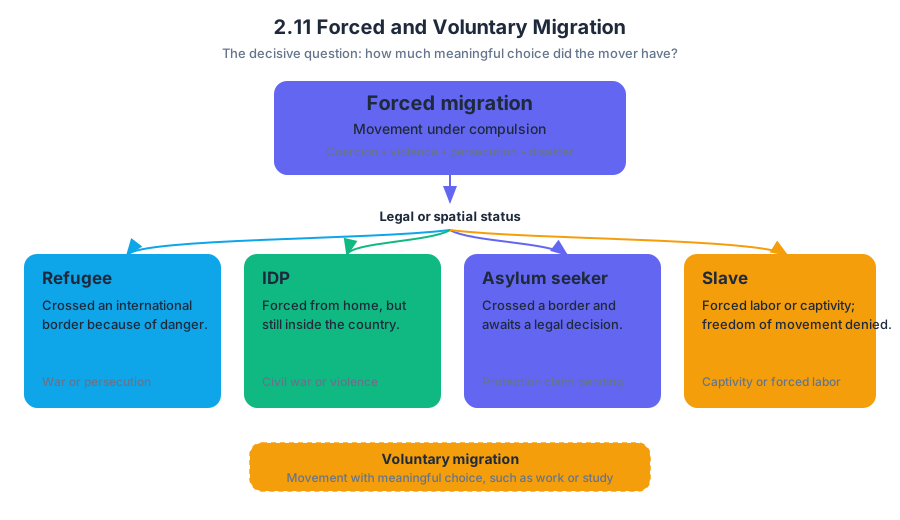
Forced migration occurs when people must leave because of coercion, violence, persecution, disaster, or another circumstance that removes meaningful choice. The key geographic question is not simply Did the person cross a border? but What conditions compelled the movement, and what legal or spatial status followed?
| Term | Meaning | Border crossed? | Typical circumstance |
|---|---|---|---|
| Refugee | A person forced to leave their country because of conflict, persecution, or comparable danger | Yes | War or political persecution |
| Internally displaced person (IDP) | A person forced from home but still within the country of origin | No | Civil war or internal violence |
| Asylum seeker | A person who has crossed an international border and requested protection, but whose claim has not yet been legally decided | Yes | Seeking refuge from persecution |
| Slave | A person compelled into forced labor or captivity and denied freedom of movement | Not required | Trafficking, conquest, or an institutionalized system of slavery |
The categories can change as a person moves. Someone displaced by violence may first become an IDP after fleeing to another region of the same country. If that person later crosses an international boundary, they may seek asylum; while the claim is being evaluated, the person is an asylum seeker, and if protection is granted, the person may be recognized as a refugee.
The Lost Boys of Sudan: a spatial sequence
The experience of the Lost Boys of Sudan demonstrates how forced migration can unfold across multiple scales. During the Sudanese civil war, many young boys were separated from their families and fled violence. They traveled on foot in large groups through parts of Africa, often spending years in refugee camps before some were eventually resettled in the United States.
The pattern can be represented as a movement chain:
Sudan → neighboring regions of Africa → refugee camps → United States
This sequence matters because it distinguishes origin, intermediate locations, and final destination. The boys did not simply make a single voluntary relocation for a better job; violence produced displacement, neighboring regions became temporary destinations, and international resettlement created a later migration step.
Misconception check — “Every forced migrant is a refugee.” Not necessarily. A person displaced within national borders is an IDP, not a refugee. A person who crosses a border and requests protection is an asylum seeker until the claim receives a legal determination. Slavery is also forced migration or forced movement, but it is not accurately described as ordinary relocation chosen by the migrant.
Voluntary migration: movement through choice or opportunity
Voluntary migration occurs when people move by choice, even though economic pressure, family responsibilities, or limited opportunities may strongly influence that choice. “Voluntary” does not mean equally free or easy; it means the movement is not directly compelled by captivity, persecution, or immediate physical coercion.
| Type | Geographic pattern | Example |
|---|---|---|
| Transnational migration | Movement across an international boundary | A worker moving from Nepal to Qatar |
| Transhumance | Seasonal movement between ecological or climate zones | Herders moving livestock between summer and winter pastures |
| Internal migration | Movement within a country | A household moving from one province to another |
| Chain migration | Movement facilitated by connections to people who migrated earlier | Relatives joining an established community abroad |
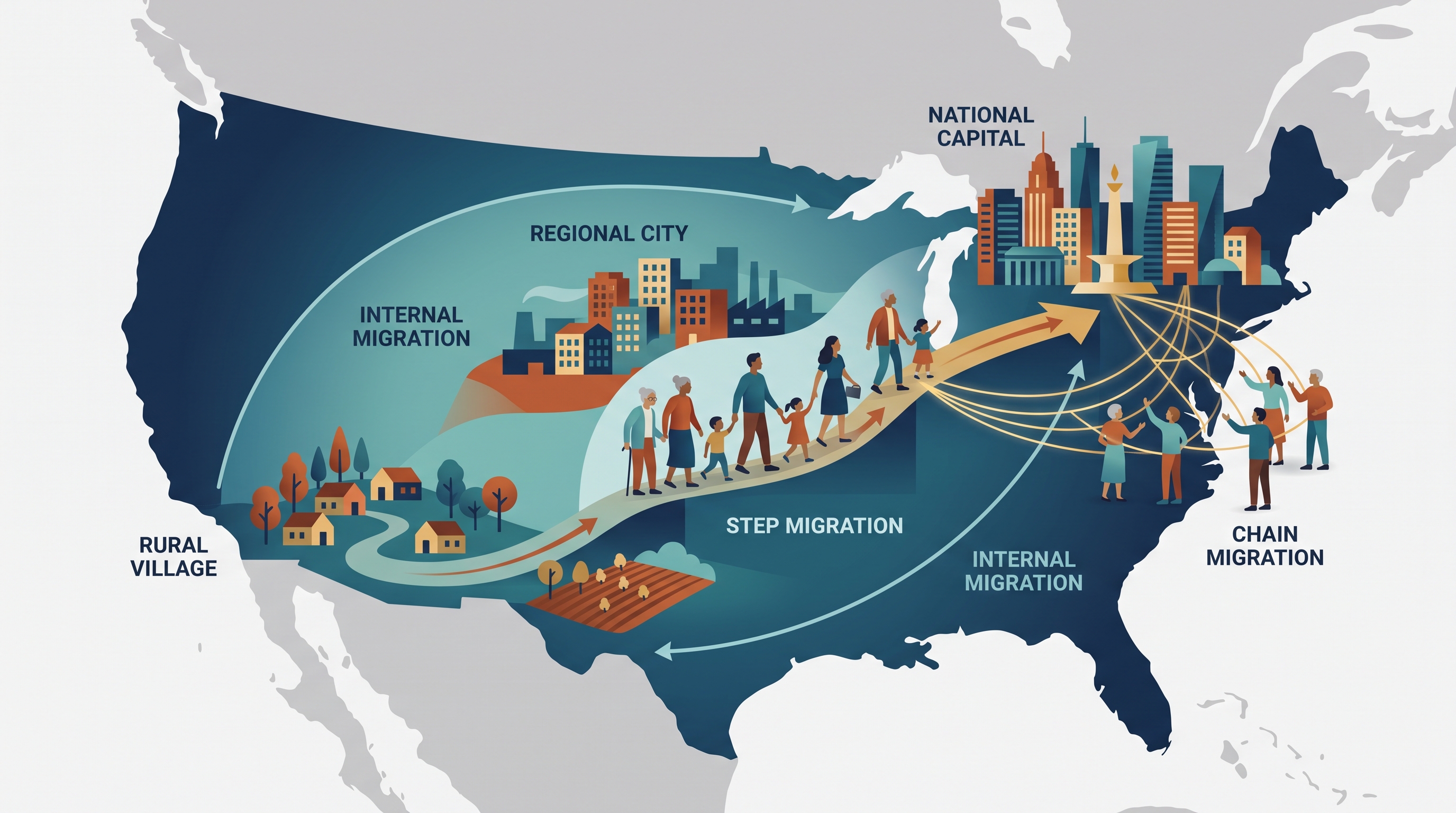
| Step migration | Movement through a series of intermediate destinations | Village to small town to regional city to national capital |
| Guest-worker migration | Temporary movement for employment | A foreign worker recruited for a construction project |
| Rural-to-urban migration | Movement from rural areas to cities | Farmers relocating to a metropolitan area for factory or service work |
Networks, families, and labor
Chain migration is migration facilitated by connections to people who previously migrated. Earlier migrants reduce information costs by sharing knowledge about jobs, housing, transportation, language, and legal procedures. As a result, migration often produces a spatial cluster: one destination attracts additional migrants from the same village, region, family, or ethnic community.
Family migration is movement intended to connect or reunify separated family members. It may overlap with chain migration, but the concepts emphasize different mechanisms: chain migration highlights the network effect, while family migration highlights the purpose of reunification.
Guest workers migrate for economic opportunities, usually under temporary or conditional arrangements. By contrast, brain drain is the migration of people with technological or specialized skills from one country or region to another. A country may lose trained doctors, engineers, or researchers even while receiving remittances from migrants abroad.
Applying spatial relationships
AP Skill 1.B — Explain spatial relationships: Connect a migration pattern to the relationships among places. For example, a guest-worker flow from South Asia to the Persian Gulf reflects a relationship between labor supply in the origin region and employment demand in the destination. Chain migration adds another relationship: existing migrant networks make particular destinations more accessible.
AP Skill 2.B — Explain spatial patterns: Use the arrangement of migration flows to infer a process. A step-migration pattern suggests movement through an urban hierarchy; a concentrated cluster of migrants suggests chain migration; movement across several countries followed by resettlement suggests forced displacement followed by refugee protection or asylum.
Retrieval check: A family leaves its village, spends two years in a regional city, and then settles in the national capital after relatives help them find housing. Identify the voluntary migration types present.
Answer: The movement is step migration because it occurs through intermediate destinations, internal migration because it remains within one country, and chain migration because relatives facilitated the final settlement.
Source Materials
- AP Human Geography Course and Exam Description
- AP Human Geography Course and Exam Description Clarifications and Corrections
- AP Human Geography Course Overview
- AP Human Geography Course at a Glance
- AP Human Geography Course at a Glance Poster
- AP Human Geography
- AP Human Geography
- AP Human Geography Sample Syllabus 1