From the free course AP Human Geography on Lykke
5.1 Introduction to Agriculture
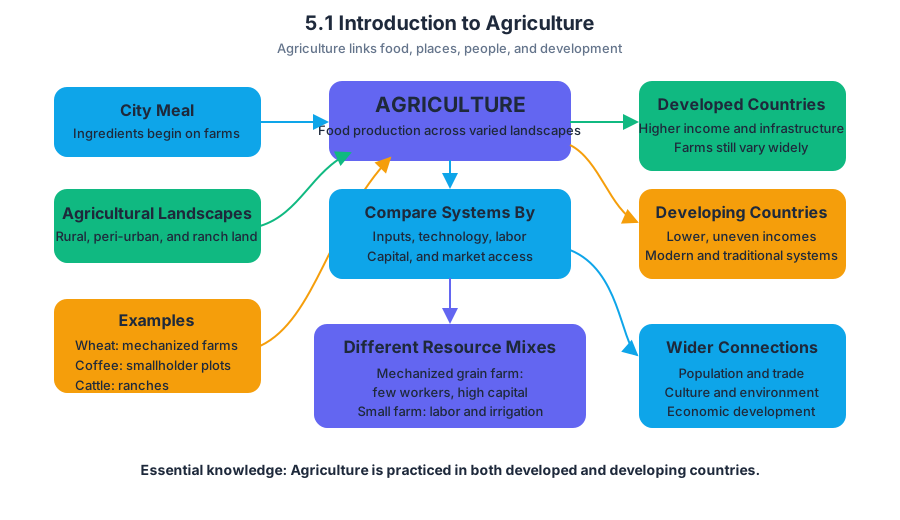
Agriculture is the deliberate cultivation of plants and the raising of animals to produce food, fiber, fuel, and other goods. It is both an environmental activity and a human system: climate and soil set possibilities, while technology, markets, culture, government policy, and transportation shape what people…
5.1 Introduction to Agriculture
Agriculture is the deliberate cultivation of plants and the raising of animals to produce food, fiber, fuel, and other goods. It is both an environmental activity and a human system: climate and soil set possibilities, while technology, markets, culture, government policy, and transportation shape what people actually produce.
Why agriculture matters
A city meal may seem disconnected from farming, but nearly every ingredient begins in an agricultural landscape. Wheat may be grown on large mechanized farms, coffee on smallholder plots, cattle on ranches, and vegetables near an urban market. Agriculture therefore connects rural land use to population, trade, culture, environmental change, and economic development.
Agriculture occurs in both developed countries—countries with relatively high levels of industrialization, income, infrastructure, and access to technology—and developing countries, where industrialization and average incomes are generally lower and unevenly distributed. This distinction does not mean that developed countries lack farms or that developing countries use only traditional methods. Both groups contain highly varied agricultural systems.
Essential Knowledge AGR-5.A.1: Agriculture is practiced in both developed and developing countries.
A useful comparison is not “modern versus traditional,” but rather the combination of inputs, technology, labor, capital, and market access used in a particular place. A highly mechanized grain farm may use few workers but substantial capital, while an intensively cultivated small farm may produce a large harvest from limited land through careful labor and irrigation.
Physical and human influences
Physical factors are environmental conditions that influence agricultural possibilities. Important examples include temperature, precipitation, length of the growing season, soil fertility, terrain, and water availability. Rice generally requires abundant water and warm growing conditions, while wheat can be cultivated across broad temperate regions with less standing water.
Human factors are social, economic, political, and technological forces that influence agricultural decisions. These include land ownership, labor costs, consumer demand, government subsidies, transportation networks, irrigation, access to machinery, cultural preferences, and the distance to markets.
Essential Knowledge AGR-5.A.2: Agricultural production and consumption patterns are influenced by physical and human factors.
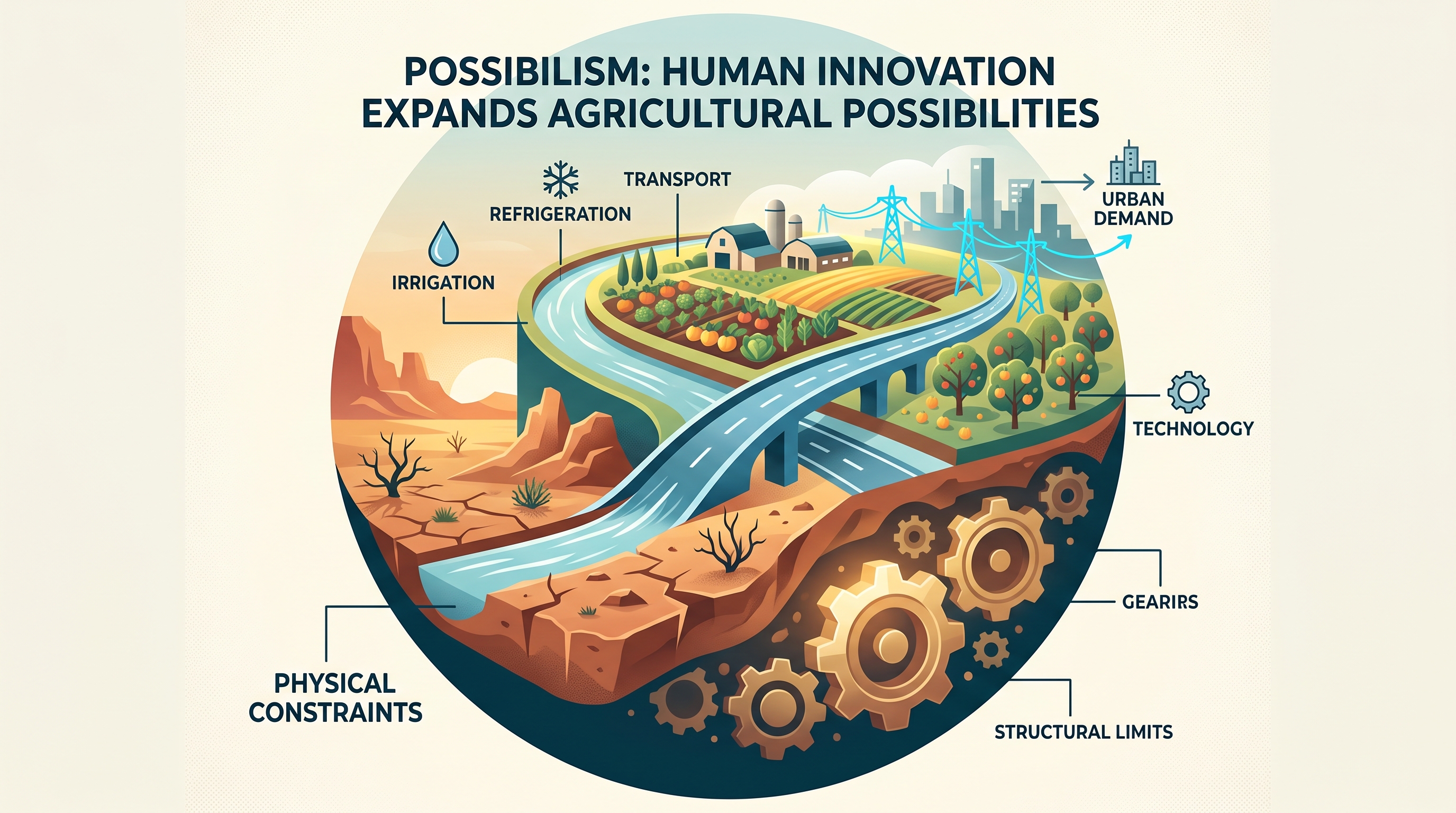
The key geographic idea is that physical conditions create opportunities and constraints, not a single unavoidable outcome. Greenhouses can extend growing seasons; irrigation can bring water to dry regions; terracing can make steep slopes usable; refrigeration can move perishable foods over long distances. At the same time, these adaptations require money, labor, infrastructure, and knowledge.
Worked example: choosing a crop
Imagine two farming regions. Region A has warm temperatures, abundant rainfall, and steep hillsides. Region B is relatively flat, drier, and connected to a major highway.
- Physical assessment: Region A favors water-demanding crops but presents erosion and mechanization challenges because of its slopes. Region B requires irrigation but is easier to cultivate with machines.
- Human assessment: If Region A has abundant labor and nearby consumers who prefer a particular staple crop, intensive small-scale farming may be practical. If Region B has substantial capital, irrigation, machinery, and highway access, large-scale commercial production becomes more feasible.
- Geographic conclusion: Neither region has one inevitable agricultural future. The observed pattern results from the interaction of environmental conditions with human choices and resources.
Skills in action
This topic is assessed through the course’s geographic reasoning skills:
- Skill 1. Concepts and Processes: Apply the concepts of physical factors, human factors, agricultural production, and consumption to a real location.
- Skill 2. Spatial Relationships: Explain why agricultural activities are distributed differently across places.
- Skill 3. Data Analysis: Interpret a map, graph, table, or infographic showing crop production, food consumption, climate, or land use.
- Skill 4. Source Analysis: Use a photograph, satellite image, or landscape to identify evidence of an agricultural system and infer the factors shaping it.
- Skill 5. Scale Analysis: Explain how a farming decision affects a field, region, country, or global food system differently.
For example, a map showing high wheat production does not by itself prove that wheat grows naturally everywhere in those regions. A strong explanation connects the pattern to growing conditions, farm technology, transportation, markets, and policy—and distinguishes what the map directly shows from what must be inferred.
Misconception check: “Agriculture is only rural”
Agriculture is usually associated with rural land, but its effects are not confined there. Urban consumers, food-processing companies, global trading networks, supermarkets, and government policies influence what farmers produce. Conversely, agricultural change can affect urban food prices, employment, migration, and environmental quality.
Retrieval check
A dry, flat region begins producing vegetables for a distant city after installing irrigation and building a refrigerated highway. Which factor is physical, which factors are human, and why does this example demonstrate possibilism rather than environmental determinism?
Answer: Dryness is a physical constraint. Irrigation, refrigeration, transportation, investment, and urban demand are human factors. The region’s environment limits some choices but does not determine one inevitable land use; human actions create additional possibilities.
Source Materials
- AP Human Geography Course and Exam Description
- AP Human Geography Course and Exam Description Clarifications and Corrections
- AP Human Geography Course Overview
- AP Human Geography Course at a Glance
- AP Human Geography Course at a Glance Poster
- AP Human Geography
- AP Human Geography
- AP Human Geography Sample Syllabus 1
- AP Human Geography-AP Students-College board
- AP Human Geography Units: Complete Breakdown
- AP Human Geography-National Council for Geographic Foundation
- Free AP Human Geography Resources for 2026-Knowt