From the free course AP Human Geography on Lykke
6.6 Density and Land Use
Key concepts: Population density measurement: arithmetic, physiological, and agricultural density · Impacts of different methods used to calculate population density · Carrying capacity and how it changes · Mechanization and irrigation increasing agricultural carrying capacity · High-yield seeds increasing agricultural productivity · Urban sprawl and land-use change · Habitat loss, fragmentation, and decreased biodiversity · Transportation networks, pollution, and urban heat islands · Land-use conflicts involving local food production, open space, and conservation · Irrigation expansion and conflicts with nomadic herders
A city can feel crowded while the surrounding region still contains enormous amounts of open land. Population density resolves this apparent contradiction by measuring how many people, farmers, or resources are associated with a given amount of space—but the result depends entirely on what land area and population…
6.6 Density and Land Use
A city can feel crowded while the surrounding region still contains enormous amounts of open land. Population density resolves this apparent contradiction by measuring how many people, farmers, or resources are associated with a given amount of space—but the result depends entirely on what land area and population group are counted.
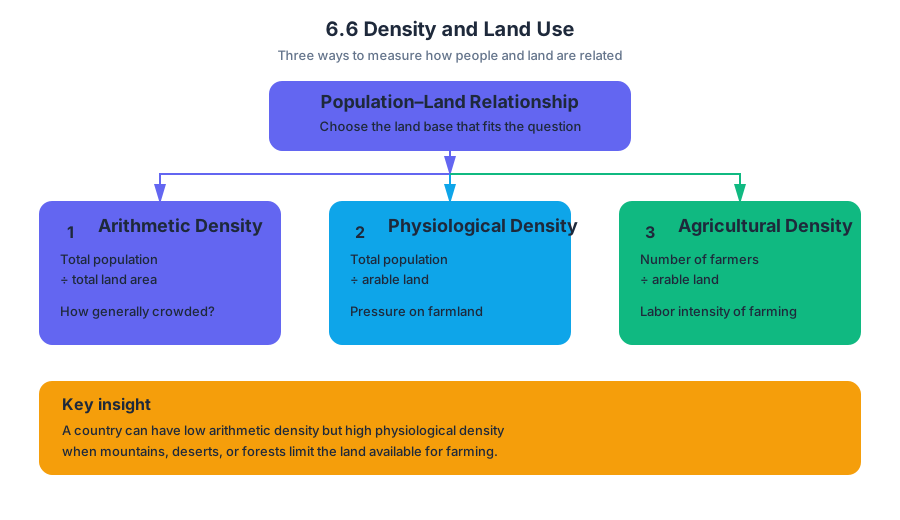
Three ways to measure density
Arithmetic density is the simplest measure: total population divided by total land area. It answers, “How many people occupy each unit of land, on average?” If a region has $2{,}000{,}000$ people and $10{,}000\ \text{km}^2$ of land, its arithmetic density is:
$$ \text{Arithmetic density}=\frac{2{,}000{,}000\ \text{people}}{10{,}000\ \text{km}^2}=200\ \text{people/km}^2 $$
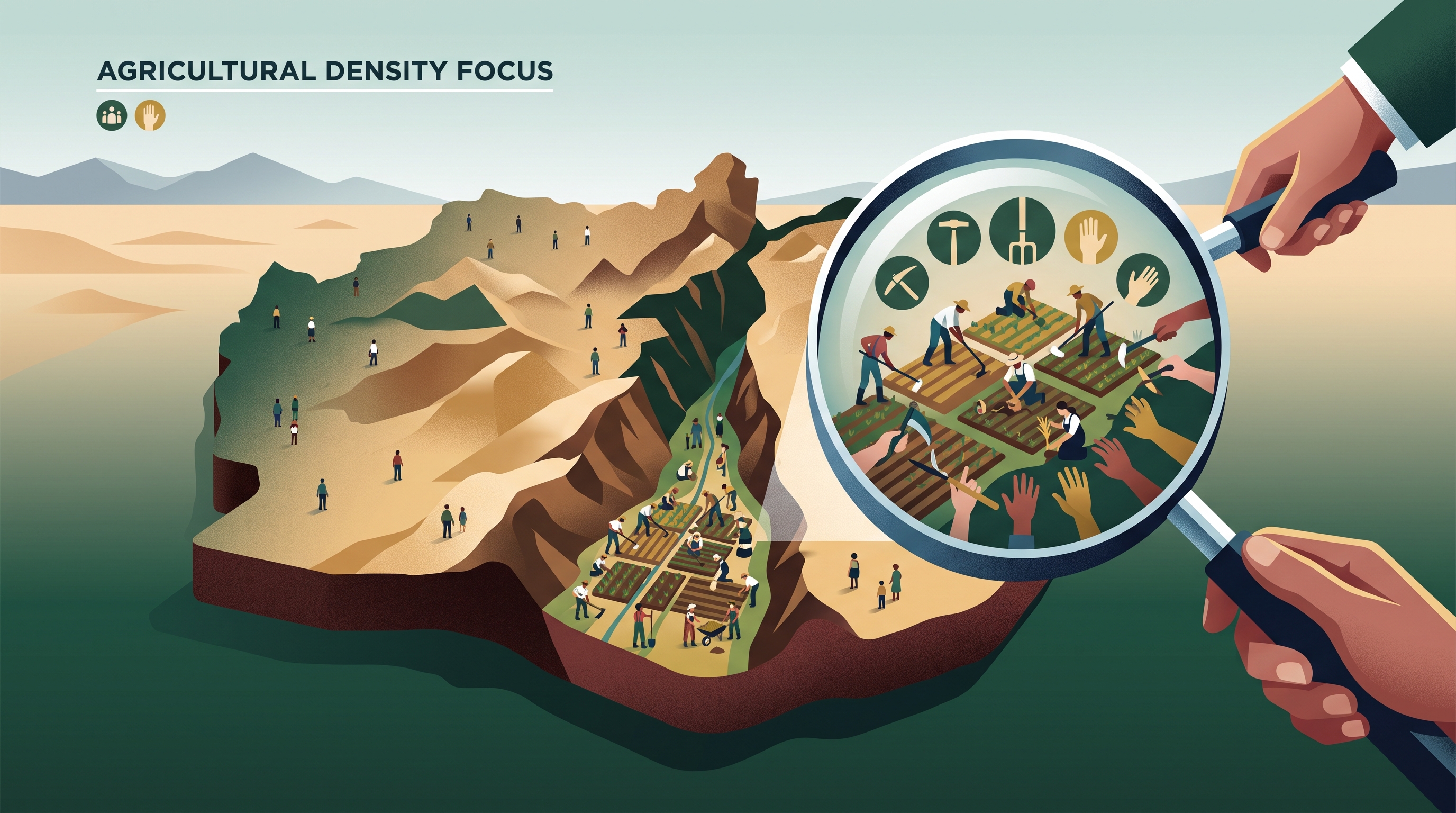
Physiological density measures total population relative to arable land, or land suitable for growing crops. It reveals pressure on the land that can actually produce food. Agricultural density measures the number of farmers relative to arable land, indicating how intensively human labor is used in food production.
| Measure | Numerator | Denominator | Main geographic question |
|---|---|---|---|
| Arithmetic density | Total population | Total land area | How generally crowded is the territory? |
| Physiological density | Total population | Arable land | How much pressure is placed on farmland? |
| Agricultural density | Number of farmers | Arable land | How intensively is farmland worked by people? |
The same country may have a low arithmetic density but a high physiological density if mountains, deserts, forests, or other areas cannot support large-scale farming. A high agricultural density often indicates labor-intensive agriculture, whereas a lower agricultural density may reflect mechanization, larger farms, or highly productive technology.
Worked comparison: why the denominator matters
Imagine two regions, each with $1{,}000{,}000$ people and $20{,}000\ \text{km}^2$ of total land. Region A has $10{,}000\ \text{km}^2$ of arable land; Region B has only $2{,}000\ \text{km}^2$.
$$ \text{Arithmetic density}=\frac{1{,}000{,}000}{20{,}000}=50\ \text{people/km}^2 $$
Both regions have the same arithmetic density. Their physiological densities, however, differ sharply:
$$ \text{Region A}=\frac{1{,}000{,}000}{10{,}000}=100\ \text{people/km}^2\text{ of arable land} $$
$$ \text{Region B}=\frac{1{,}000{,}000}{2{,}000}=500\ \text{people/km}^2\text{ of arable land} $$
Region B places much greater population pressure on its farmland. A planner studying food security would therefore learn more from physiological density than arithmetic density. If Region A has $100{,}000$ farmers and Region B has $20{,}000$ farmers, their agricultural densities are $10$ and $10$ farmers per square kilometer of arable land, respectively—showing that similar farming intensity can coexist with very different population pressure.
Key insight: A density statistic is not “the” density of a place. It is a measurement produced by a particular numerator and denominator.
Carrying capacity and agricultural technology
Carrying capacity is the largest population an area can support with the resources and technology available at a particular time. It is not a permanent physical limit. Mechanization—including tractors, vehicles, irrigation, and processing equipment—can increase the amount of food produced from land and therefore allow that land to support a larger population.
High-yield seeds can also raise carrying capacity by producing more resources on the same area of land. Precision agriculture, GPS-guided equipment, and improved growing practices may further increase output by applying water, fertilizer, or labor more efficiently. Irrigation can even bring areas with low population density into agricultural production, although it may create new environmental and political pressures.
For example, expanding irrigation in a dry grassland may increase cultivated land and food production. But irrigation infrastructure can also block traditional migration routes, contributing to conflicts between farmers and nomadic herders who depend on seasonal movement. A technological increase in carrying capacity can therefore produce both greater food security and sharper competition over land and water.
Urban sprawl as land-use change
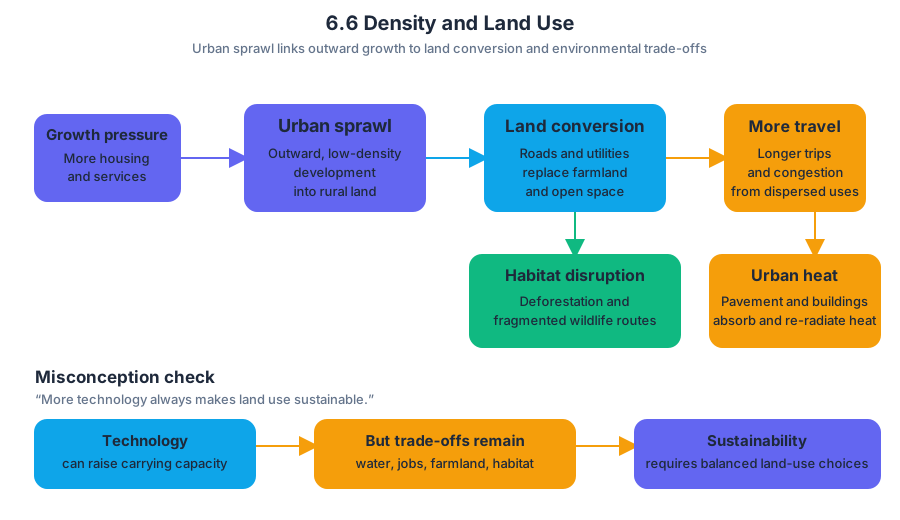
Urban sprawl is the outward expansion of low-density urban development into formerly rural or undeveloped land. As roads, housing, shopping areas, and utilities spread outward, arable land may be converted to buildings, reducing space for local food production, open space, conservation, greenbelts, and preservation efforts.
Sprawl also changes land cover. Deforestation and habitat fragmentation can reduce biodiversity and disrupt wildlife movement. Transportation expansion associated with sprawl can increase traffic, congestion, pollution, inefficient energy use, and urban heat islands—areas that become warmer because pavement and buildings absorb and re-radiate heat.
Named misconception check — “More technology always makes land use sustainable.” Technology can increase carrying capacity, but it does not eliminate trade-offs. Irrigation may expand farming while intensifying water disputes; mechanization may raise output while reducing agricultural employment; and sprawl may create more housing while consuming farmland and habitat.
Retrieval check
A region has low arithmetic density but very high physiological density. What does that combination suggest? It suggests that much of the region is not arable, so the population is concentrated relative to a small agricultural base. Which measure would best reveal whether farming relies heavily on human labor: arithmetic, physiological, or agricultural density? Agricultural density, because it compares farmers with arable land.
Source Materials
- AP Human Geography Course and Exam Description
- AP Human Geography Course and Exam Description Clarifications and Corrections
- AP Human Geography Course Overview
- AP Human Geography Course at a Glance
- AP Human Geography Course at a Glance Poster
- AP Human Geography
- AP Human Geography
- AP Human Geography Sample Syllabus 1