From the free course AP Human Geography on Lykke
2.1 Population Distribution
Key concepts: Population distribution · Population density · Societal effects of population distribution and density · Environmental effects of population distribution and density · Global cultural patterns · Global political patterns · Global economic patterns · AP Human Geography learning objectives · Chief Reader Report on Student Responses · AP Human Geography Set 1 (2025)
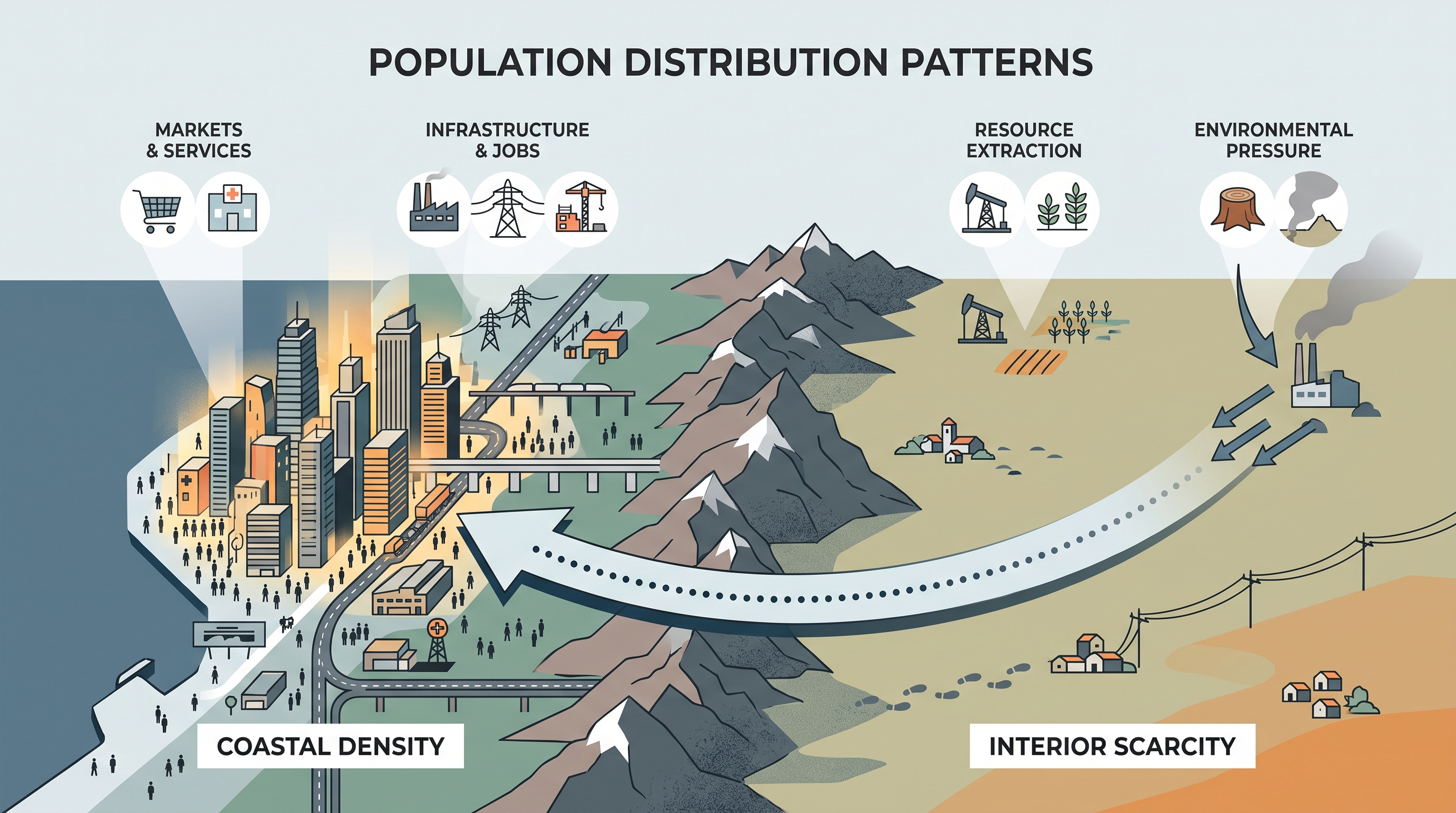
Population distribution is uneven because people choose, or are compelled, to live where environmental conditions, economic opportunities, transportation, political stability, and historical settlement patterns make life more feasible.
2.1 Population Distribution
Population distribution is uneven because people choose, or are compelled, to live where environmental conditions, economic opportunities, transportation, political stability, and historical settlement patterns make life more feasible. A map of population is therefore more than a map of where people are: it helps explain where cultures develop, governments concentrate services, businesses invest, and environmental pressures intensify.
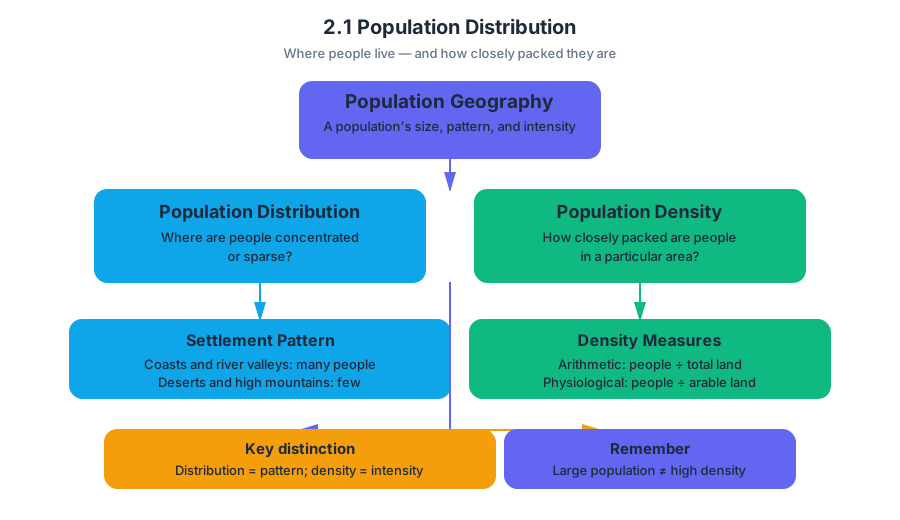
Population distribution is the arrangement of people across Earth’s surface. Population density is the number of people living in a given unit of area, commonly expressed as people per square kilometer or people per square mile.
Distribution and density: two different questions
Distribution asks, “Where are people located?” Density asks, “How closely packed are they there?” A country can have a large population but low overall density if its people are spread across a large territory. Conversely, a small city can have extremely high density even though its total population is much smaller.
| Concept | Question it answers | Example |
|---|---|---|
| Population distribution | Where are people concentrated or sparse? | Many people live along coastlines and river valleys, while few live in deserts or high mountains. |
| Population density | How many people occupy a particular area? | A crowded urban district has high density; a sparsely settled rural region has low density. |
| Arithmetic density | What is the average number of people per unit of total land area? | Total population divided by total land area. |
| Physiological density | How many people depend on each unit of arable land? | A useful indicator of pressure on farmland and food-producing capacity. |
Common misconception — “distribution and density mean the same thing.” They do not. Distribution describes the pattern of settlement; density measures its intensity. Two regions may have similar population totals but very different densities if one is much larger, or if one concentrates its residents in a few urban centers.
Why people cluster
Population clusters often form near coasts, navigable rivers, fertile plains, transportation corridors, and established cities. These locations can combine access to water, food, trade, employment, infrastructure, and political institutions. Physical geography matters, but it does not determine settlement by itself: technology, economic systems, historical migration, and government decisions can make otherwise difficult environments habitable.
A useful geographic explanation connects location to process:
$$ \text{favorable site} \rightarrow \text{settlement} \rightarrow \text{infrastructure and jobs} \rightarrow \text{further population concentration} $$
This feedback loop explains why major population concentrations frequently become even larger. A port attracts factories and warehouses; those industries attract workers; workers support shops, schools, and services; improved infrastructure then attracts additional firms and migrants.
Effects on society and the environment
Under PSO-2.D, the required relationship is that population distribution and density affect society and the environment. The essential knowledge is PSO-2.D.1, which states that population distribution and density affect political, economic, and social processes, including the provision of services such as medical care.
High-density areas can support specialized hospitals, public transit, universities, and large markets because many people live close enough to use them. They can also create congestion, housing shortages, unequal access, and intense competition for land. Low-density areas may have more open space but face higher per-person costs for roads, schools, electricity, emergency response, and health care.
Population patterns also shape global economic patterns. Labor, consumers, ports, financial institutions, and transportation networks cluster in major urban and coastal regions. For example, a densely settled coastal metropolitan region may combine a large workforce, nearby consumers, container terminals, airports, and connections to global supply chains. Investment follows these advantages, reinforcing the concentration of manufacturing, services, trade, and capital.
Worked example: A company comparing an inland rural location with a large coastal city considers more than land price. The city may offer a deeper labor pool, suppliers, consumer markets, port access, and established digital and transportation infrastructure. The rural site may have cheaper land and lower congestion, but the company may face greater shipping distances and difficulty recruiting specialized workers. Population concentration therefore influences the geography of production, trade, and investment at a global scale.
The environmental relationship is expressed in PSO-2.D.2: population distribution and density affect the environment and natural resources; this is known as carrying capacity. Carrying capacity is the level of population that an environment can support over time with available technology, resources, and management practices.
High density does not automatically mean environmental destruction. Compact settlement can reduce travel distances and make public transit, shared infrastructure, and efficient utility systems practical. However, dense populations can also increase demand for water, energy, food, land, and waste disposal, producing pollution or resource depletion when demand exceeds local capacity.
Common misconception — “carrying capacity is a fixed population limit.” Carrying capacity changes with technology, consumption patterns, infrastructure, and resource management. A city may expand its effective water supply through conservation or imports, while drought, pollution, or climate change may reduce the population its local environment can support.
Cultural and political patterns
Where people live helps produce global cultural patterns. Dense cities bring together languages, religions, cuisines, media, and cultural practices from many regions. Coastal trade routes and migration corridors can spread cultural traits across continents, while isolated or sparsely populated areas may preserve distinctive local patterns.
Population distribution also influences global political patterns. Governments tend to prioritize densely populated regions because these areas contain large electorates, economic assets, and strategically important infrastructure. Population concentrations can strengthen urban political influence, shape the placement of administrative centers, and create disputes over representation, resource allocation, and service provision.
The paired AP skill is Skill 2.A: Describe spatial patterns, networks, and relationships. A strong response does not merely identify a cluster. It describes the pattern precisely—such as concentration along coasts or rivers—and then explains a relationship, such as how that concentration supports trade while increasing pressure on water and land.
Retrieval check
A region contains a densely populated coastal city and a sparsely populated interior plateau. Identify one distributional pattern, distinguish density from distribution, and explain one economic effect and one environmental effect of the pattern. A complete answer should name the spatial relationship and connect each effect to population concentration, resources, services, labor, markets, or infrastructure.
Source Materials
- AP Human Geography Course and Exam Description
- AP Human Geography Course and Exam Description Clarifications and Corrections
- AP Human Geography Course Overview
- AP Human Geography Course at a Glance
- AP Human Geography Course at a Glance Poster
- AP Human Geography
- AP Human Geography
- AP Human Geography Sample Syllabus 1
- Based on your experience at the AP® Reading with student responses, what advice would you offer teachers to help them improve the student performance on the exam?
- Based on your experience at the AP® Reading with student responses, what advice would you offer teachers to help them improve the student performance on the exam?
- Based on your experience at the AP® Reading with student responses, what advice would you offer teachers to help them improve the student performance on the exam?
- Based on your experience at the AP® Reading with student responses, what advice would you offer teachers to help them improve the student performance on the exam?