From the free course AP Human Geography on Lykke
AP Practice 1
Key concepts: Centripetal forces · Centrifugal forces · Devolution · Multinational states · Autonomous regions · Unitary states · Uneven development · Urban infrastructure challenges · Population density · Absolute and relative distance
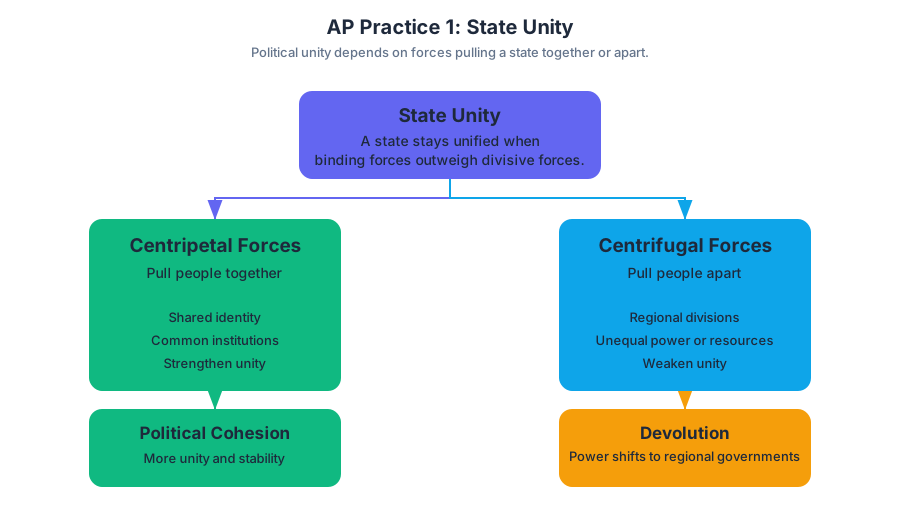
A state stays politically unified when forces pulling people together outweigh forces pulling them apart. Centripetal forces strengthen unity, while centrifugal forces weaken it; devolution occurs when power or authority shifts from a central government toward regional or local governments.
AP Practice 1
A state stays politically unified when forces pulling people together outweigh forces pulling them apart. Centripetal forces strengthen unity, while centrifugal forces weaken it; devolution occurs when power or authority shifts from a central government toward regional or local governments.
Core distinction: Centripetal forces bind a state together; centrifugal forces fragment it.
The political-geography toolkit
A multinational state contains two or more nations—groups with distinct cultural, ethnic, or historical identities—within one political territory. Such a state may experience devolution when a regional group seeks greater control over its own affairs, especially if it believes the central government ignores its identity, language, territory, or economic interests.
An autonomous region is a subnational area granted meaningful self-government while remaining inside the larger state. A unitary state, by contrast, concentrates governing authority primarily in the national government, even though it may delegate limited responsibilities to local administrations.
| Concept | Main effect | Political example |
|---|---|---|
| Centripetal force | Promotes unity | National symbols, shared holidays, political nationalism |
| Centrifugal force | Promotes division | Uneven regional development or ethnic separatism |
| Devolution | Transfers authority downward | Regional demands for self-government |
| Autonomous region | Accommodates regional difference | Limited or substantial self-rule |
| Unitary state | Preserves centralized authority | National government retains primary control |
| Multinational state | Contains several nations | A state with multiple strong regional identities |
How to earn explanation points
AP prompts distinguish among define, describe, and explain. A definition identifies a concept. A description states a relevant characteristic. An explanation connects a cause to an effect using geographic reasoning.
For example, “A government promotes a national flag” is a description of a centripetal force. A stronger explanation adds the mechanism: “A government promotes a national flag to create a shared political identity, encouraging people from different ethnic or regional groups to identify with the state as a nation.”
Original no-stimulus practice
Practice prompt — 7 points
A multinational state contains a wealthy coastal region and a poorer interior region. The coastal region has a distinct language and has begun demanding greater control over education, taxation, and cultural policy.
(A) Define the concept of a multinational state.
(B) Describe one centripetal force a government could use to promote the state as a nation.
(C) Explain how uneven development could act as a centrifugal force.
(D) Explain why the government might create an autonomous region rather than maintain a unitary state.
(E) Explain why the government might instead maintain a unitary state.
Worked reasoning
(A) Definition: A multinational state is a state containing two or more nations or culturally distinct national groups within its borders. The answer earns credit because it identifies multiple nations inside one political territory, not merely because it mentions ethnic diversity.
(B) Centripetal force: The government could promote shared national holidays, symbols, or patriotic traditions. These practices create a common political identity that may unite residents who otherwise identify primarily with different regions or ethnic groups.
(C) Uneven development: If the coastal region receives better infrastructure, higher-paying employment, and greater public investment than the interior, residents of the interior may view the state as unfair or exploitative. That resentment can strengthen regional identity and support demands to separate or gain control over local resources, making uneven development a centrifugal force.
(D) Autonomous region: The government might grant autonomy to reduce conflict by allowing the coastal region to control culturally sensitive policies such as language and education. This arrangement can address regional grievances while preserving the state’s territorial integrity.
(E) Unitary state: The government might maintain centralized authority to preserve consistent laws, taxation, infrastructure planning, and national security. Leaders may fear that regional autonomy would encourage additional regions to demand similar powers or eventually seek independence.
Examiner-rewarded logic: claim → geographic mechanism → political consequence.
Misconception check
Misconception: “Centripetal always means positive, and centrifugal always means negative.” These terms describe political effects, not moral judgments. Regional autonomy may reduce violence and stabilize a state, even though it responds to a centrifugal pressure. Likewise, a government’s centripetal nationalism can unite people but may marginalize minority identities.
Misconception: “A multinational state is automatically unstable.” Multiple national identities create potential centrifugal pressure, but governments can reduce that pressure through equitable development, inclusive national identity, or negotiated autonomy.
Timing and error review
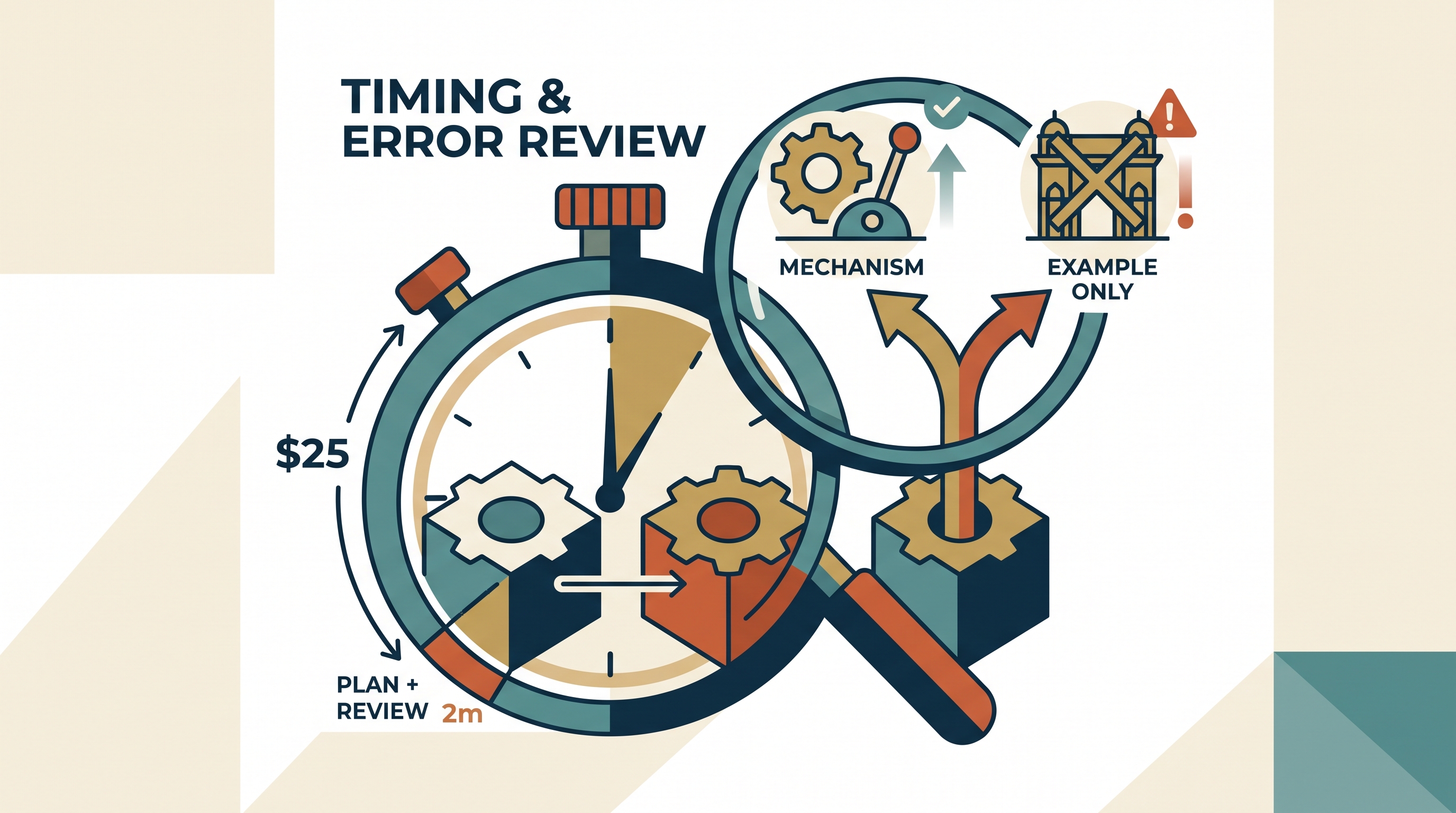
For a multipart no-stimulus FRQ, reserve about $25$ minutes, including planning. Spend roughly $2$ minutes identifying the political process, then answer each part directly. Afterward, label each response as definition, description, or explanation and ask: Did I name a mechanism, or did I merely name an example?
Transfer check: Delhi’s high population density can produce inadequate sanitation, water supply, waste disposal, wastewater treatment, and housing—especially for lower-income residents. That is an urban-geography application; do not substitute it for a political explanation unless a prompt specifically asks about infrastructure or density.


Source Materials
- AP Human Geography Course and Exam Description
- AP Human Geography Course and Exam Description Clarifications and Corrections
- AP Human Geography Course Overview
- AP Human Geography Course at a Glance
- AP Human Geography Course at a Glance Poster
- AP Human Geography
- AP Human Geography
- AP Human Geography Sample Syllabus 1
- Figure — Scoring Statistics – Set 1 (p. 1)
- Accept one of the following:
- Accept one of the following:
- AP Human Geography-AP Students-College board