From the free course AP Human Geography on Lykke
7.5 Theories of Development
A country can export valuable commodities and still remain vulnerable to poverty, debt, and unstable growth. Theories of development are explanations of why some places achieve higher levels of economic and social well-being than others—and why development does not follow one universal path.
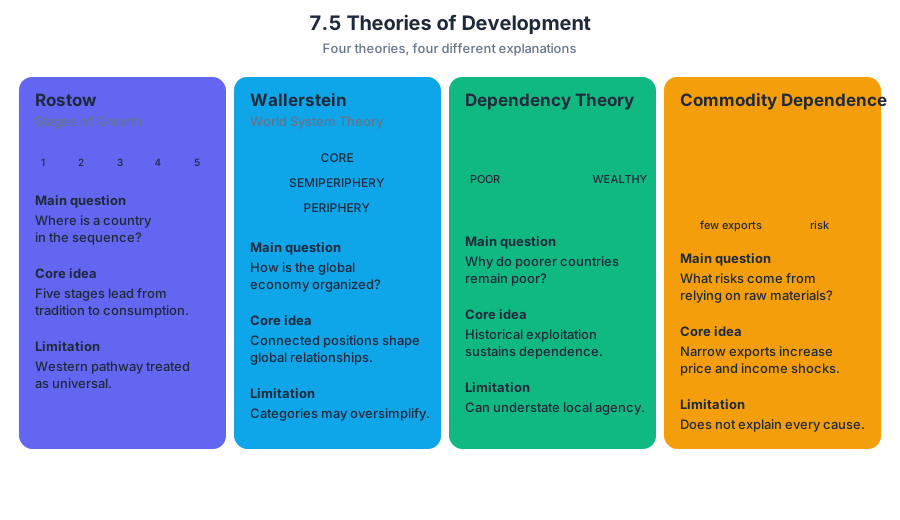
Four theories, four different explanations
The major theories in 7.5.A disagree about the causes of development. Rostow’s Stages of Economic Growth presents development as a sequence that countries move through. Wallerstein’s World System Theory emphasizes a global economic structure organized around unequal relationships. Dependency theory argues that historical exploitation keeps some countries dependent on wealthier countries. Commodity dependence focuses on the risks created when a country relies heavily on a small number of exported raw materials.
| Theory | Main question | Basic explanation | Typical limitation |
|---|---|---|---|
| Rostow’s Stages of Economic Growth | Where is a country in the development sequence? | Countries progress through five stages from traditional society to high mass consumption. | Treats Western industrialization as a universal pathway. |
| Wallerstein’s World System Theory | How is the global economy organized? | Countries occupy core, semiperiphery, or periphery positions in a connected system. | Categories can oversimplify changing and internally diverse economies. |
| Dependency theory | Why do poorer countries remain poor? | Wealthy countries and institutions benefit from economic relationships that constrain poorer countries. | Can understate domestic policies, innovation, and successful development strategies. |
| Commodity dependence | Why is an export economy vulnerable? | Reliance on a few primary commodities exposes a country to price swings and weak bargaining power. | Describes a major vulnerability but does not explain every cause of underdevelopment. |
Rostow’s Stages of Economic Growth
Rostow’s Stages of Economic Growth describes five stages: traditional society; preconditions for takeoff; takeoff; drive to maturity; and the age of high mass consumption. The model connects development to industrialization, investment, technological change, and expanding consumer markets.
A country in the traditional society stage depends mainly on subsistence agriculture and has limited technology. During preconditions for takeoff, infrastructure, education, financial institutions, and political changes begin supporting growth. Takeoff occurs when investment and industrial production increase rapidly. In the drive to maturity, technology spreads through more sectors. Finally, the age of high mass consumption features widespread consumer goods, advanced services, and high incomes.
Worked example: Imagine Country A, where most workers farm with hand tools. The government builds roads, expands schools, and establishes banks. A textile industry then attracts investment and employs large numbers of workers. If manufacturing diversifies into machinery, communications, and services, Rostow would interpret this as movement from preconditions for takeoff through takeoff toward maturity.
Misconception check — “Rostow is a prediction.” Rostow’s model is a model, not a guarantee. Countries may skip, repeat, combine, or resist stages; war, colonial history, environmental constraints, political choices, and unequal trade can alter the sequence. Its strength is organizing broad patterns of industrial change. Its weakness is assuming that every country should follow the same path taken by early industrializing Western states.
Wallerstein’s World System Theory
Wallerstein’s World System Theory explains development through a single global economic system divided into core, semiperiphery, and periphery regions. Core countries generally control advanced technology, finance, high-value production, and powerful institutions. Periphery countries often supply labor, agricultural products, fuels, or minerals. Semiperiphery countries occupy an intermediate position and may combine both core-like and peripheral economic activities.
The model is relational: a country’s position depends partly on how it interacts with other countries. A peripheral country may export inexpensive coffee beans while a core country processes, brands, transports, and sells the finished product at a much higher value. The unequal distribution of profit helps explain why economic growth in one place can coexist with limited development in another.
Dependency theory and commodity dependence
Dependency theory argues that poverty is not simply an earlier stage on a shared ladder. Instead, poorer countries may be structurally dependent on wealthier countries for investment, technology, markets, loans, or manufactured goods. Colonial extraction, unequal trade relationships, and debt can reinforce this dependence.
Commodity dependence occurs when a country relies heavily on exporting one or a few primary commodities, such as copper, oil, cocoa, or coffee. Primary commodities are vulnerable because their prices can fluctuate, they often receive less value than processed goods, and production may be controlled by foreign firms or affected by weather and political instability.
Worked comparison: Suppose Country B earns most of its export revenue from copper. When copper prices rise, government revenue and employment increase. When prices fall, the country may face budget cuts, currency instability, and difficulty repaying loans. Rostow might ask whether Country B is industrializing; Wallerstein would examine its peripheral position; dependency theory would investigate who controls mining, finance, and markets; commodity-dependence analysis would identify the danger of relying on copper.
Skill focus: 1.E Explain the strengths, weaknesses, and limitations of geographic models
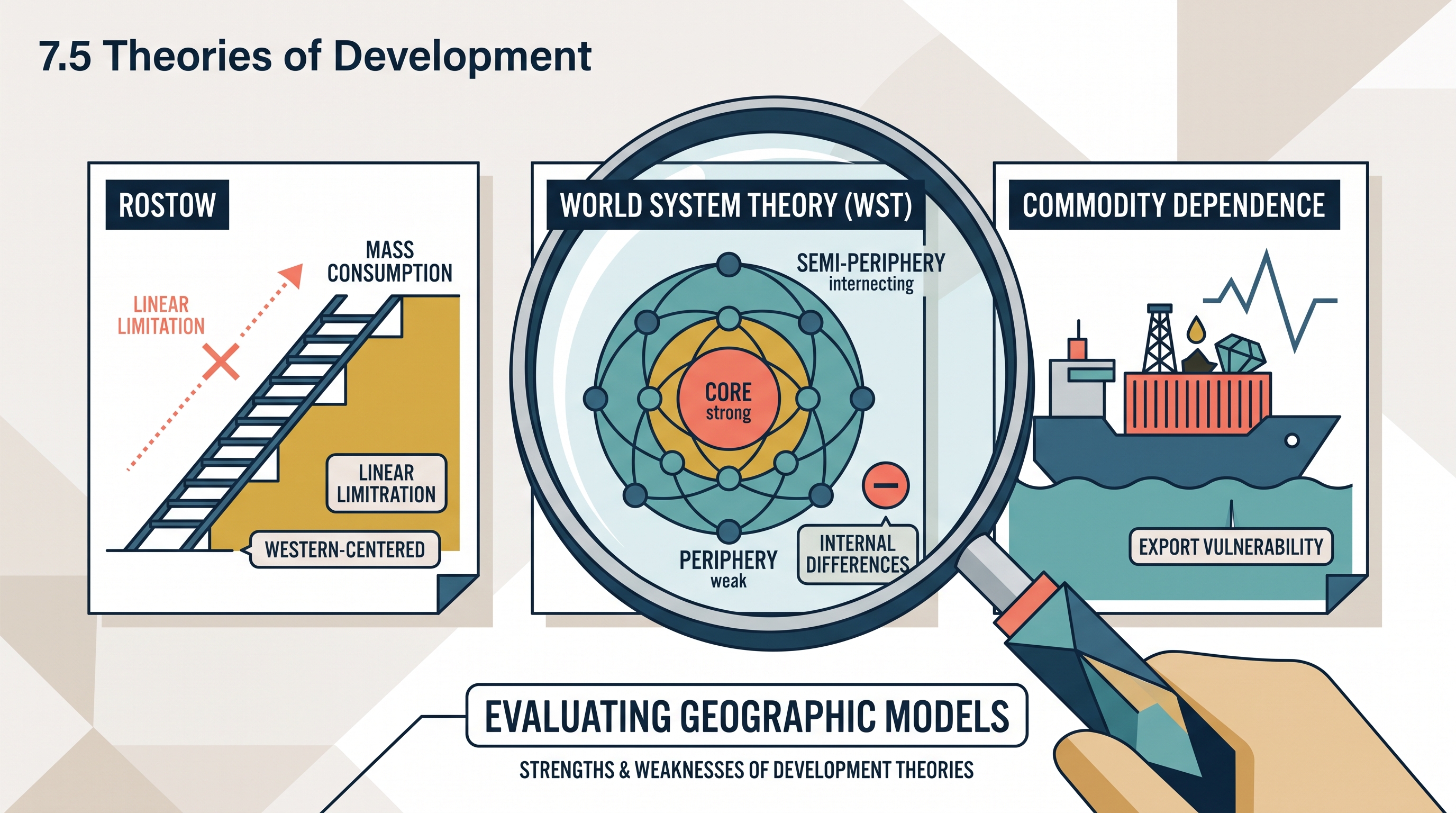
Topic 7.5 is assessed especially through Skill 1.E Explain the strengths, weaknesses, and limitations of geographic models. A strong response does more than name a theory: it applies the theory to a place, identifies what the theory explains well, and states what it leaves out.
For example, Rostow is useful for identifying industrialization patterns, but it is limited by its linear, Western-centered sequence. World System Theory is useful for revealing global inequality and economic relationships, but its broad categories may hide differences within countries. Dependency theory highlights historical power relationships, while commodity dependence clarifies export vulnerability; neither alone explains every domestic political or geographic factor.
Retrieval check: A country exports raw petroleum, imports expensive manufactured products, and experiences severe budget problems when oil prices fall. Which theory most directly identifies its export vulnerability, and which theory would most directly analyze its position in the global economic system?
Answer: Commodity dependence most directly identifies the vulnerability created by reliance on petroleum. Wallerstein’s World System Theory would most directly analyze whether the country occupies a peripheral, semiperipheral, or core position in the global system.
Source Materials
- AP Human Geography Course and Exam Description
- AP Human Geography Course and Exam Description Clarifications and Corrections
- AP Human Geography Course Overview
- AP Human Geography Course at a Glance
- AP Human Geography Course at a Glance Poster
- AP Human Geography
- AP Human Geography
- AP Human Geography Sample Syllabus 1