From the free course AP United States Government and Politics on Lykke
5.9 Congressional Elections
A congressional election can change national policy even when the president remains in office, because voters choose the legislators who write, amend, fund, and investigate federal policy.
5.9 Congressional Elections
A congressional election can change national policy even when the president remains in office, because voters choose the legislators who write, amend, fund, and investigate federal policy. The central question is not simply who wins a district or state, but how electoral rules, district boundaries, incumbency, turnout, and national political conditions shape the composition of Congress.
Investigative question: Why do congressional elections often produce a different political result from a presidential election?
What makes congressional elections distinctive?
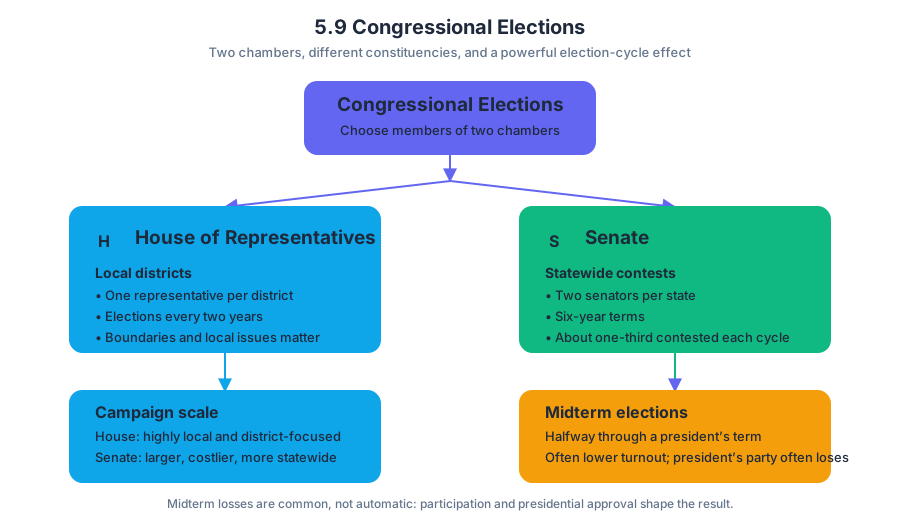
Congressional elections select members of the House of Representatives and the Senate, but the two contests operate differently. House members run in individual geographic districts every two years. Senators represent entire states and serve six-year terms, with approximately one-third of Senate seats contested in any one election cycle.
House elections are therefore highly local: district boundaries, the incumbent’s record, local economic conditions, and the partisan balance of the district matter greatly. Senate elections are statewide and usually involve larger, more expensive campaigns in which national issues and the candidates’ public profiles can matter more.
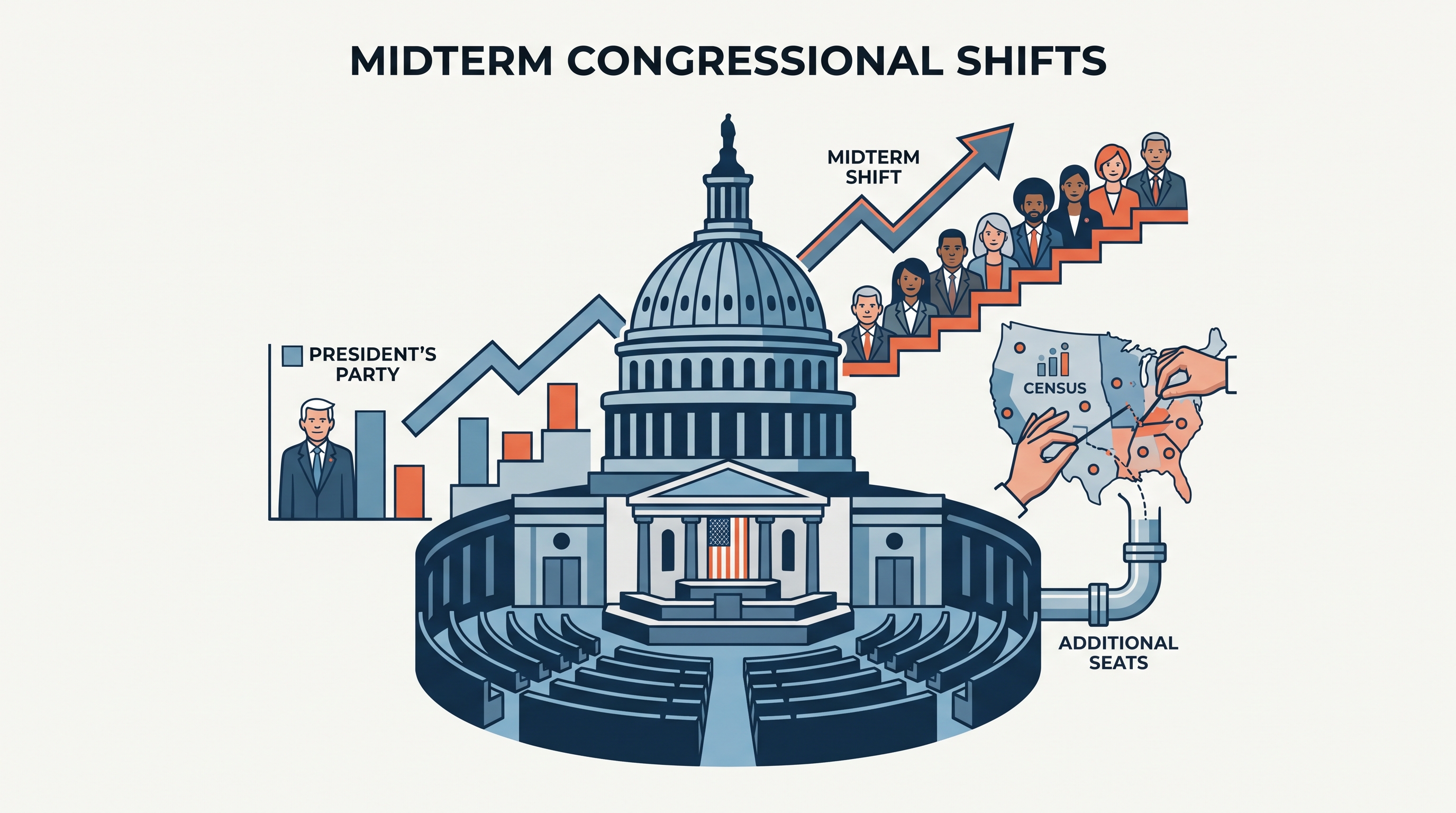
The timing of congressional elections also matters. Midterm elections occur halfway through a president’s four-year term. Because no presidential candidate appears at the top of the ballot, turnout is often lower than in presidential years, and the president’s party commonly loses congressional seats. This pattern is not automatic, but it reflects weaker participation among some groups and the tendency of voters to use midterms to express approval or disapproval of the president.
Incumbency and the electoral advantage
An incumbent is the officeholder seeking reelection. Incumbents often possess an incumbency advantage because they have greater name recognition, established fundraising networks, experience with constituent service, and a record that can be presented to voters. House incumbents may also benefit from districts designed to be politically safe for their party.
This advantage does not make reelection guaranteed. Scandals, unpopular votes, strong challengers, major national events, or changes in district boundaries can weaken it. An open-seat election, in which no incumbent is running, is usually more competitive because neither candidate begins with the same institutional advantages.
Misconception check: Incumbency advantage does not mean voters automatically support incumbents. It means incumbents begin with structural benefits that challengers must overcome.
District boundaries, reapportionment, and redistricting
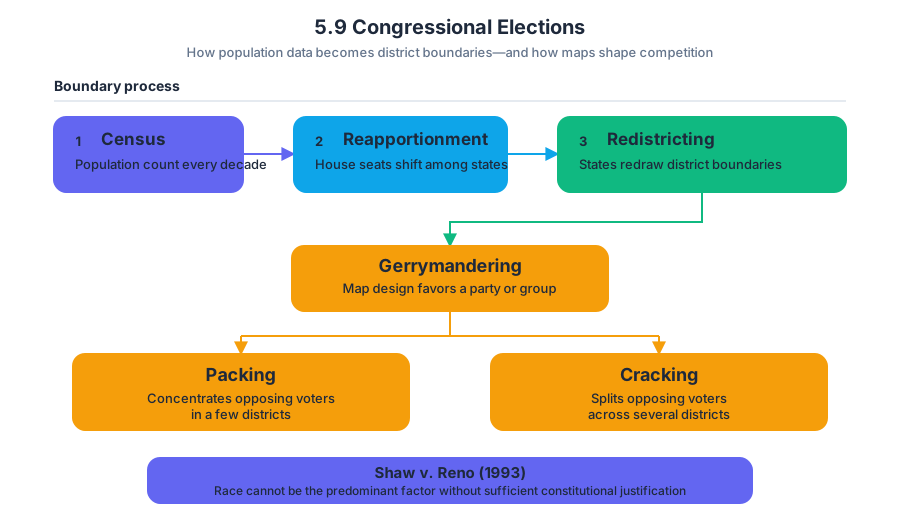
Every ten years, the national census supplies population data used for reapportionment, the redistribution of House seats among the states. A state that gains population may gain House seats; a state that grows more slowly may lose seats. After reapportionment, states redraw district boundaries through redistricting.
When political actors draw boundaries to advantage a party, incumbent, or group of voters, the practice may become gerrymandering. Packing concentrates opposing voters into a small number of districts, while cracking divides them among several districts so that they form a minority in each. These techniques can produce many safe seats and reduce the number of genuinely competitive general elections.
The Supreme Court case Shaw v. Reno (1993) established that racial classifications in redistricting can violate the Equal Protection Clause when race becomes the predominant factor without sufficient constitutional justification. The case does not prohibit every district that considers race; it requires courts to scrutinize districts whose shapes and design reveal excessive racial sorting.
Congressional elections and policymaking
Electoral outcomes influence policymaking through party control of Congress. If one party controls both chambers, it may find it easier to organize committees, schedule legislation, and pass bills. If control is divided between parties, bargaining, oversight, and gridlock become more likely. Even when the president’s party loses seats, the president may still negotiate with the new congressional majority to advance legislation.
Congressional elections can also produce split-ticket voting, in which a voter supports candidates from different parties for different offices. For example, a voter might choose one party’s presidential candidate but support the other party’s House member because of the local candidate’s record or district concerns. Split-ticket voting shows why congressional elections cannot be predicted solely from presidential results.
Worked contextual example
Imagine that a president’s party wins the presidency but loses several House seats in the same election. The president’s party still controls the executive branch, but the opposing party now holds a House majority.
Reason through the consequences:
- The new House majority selects its speaker, controls committee leadership, and gains greater power over the legislative agenda.
- It may refuse to advance the president’s preferred bills or attach conditions to them.
- It can conduct investigations and use oversight hearings to examine executive-branch actions.
- The president may veto bills passed by Congress, creating a policy stalemate unless the House and Senate override the veto with sufficient votes.
- The election therefore changes policymaking even though the presidency has not changed hands.
This example illustrates Skill 5.B: Argumentation—Support an argument using specific and relevant evidence. A strong claim would connect the election result to institutional consequences: The congressional election increases the opposition party’s influence because control of the House gives it agenda-setting and oversight authority. The evidence must identify those powers, not merely state that the election was “important.”
Retrieval check
A state gains population after the census, receives additional House seats, and redraws its districts. Identify the process that redistributed seats, the process that redrew boundaries, and one way a party could manipulate those boundaries. Then explain why a midterm election can produce a different congressional majority from the president’s party.
Source Materials
- AP U.S. Government and Politics Course and Exam Description
- Learn More (.pdf)
- AP U.S. Government and Politics Course Overview
- AP U.S. Government and Politics Course at a Glance
- AP United States Government and Politics Course at a Glance Poster
- AP United States Government and Politics
- AP United States Government and Politics
- United States Government and Politics Sample Syllabus 1