From the free course AP United States Government and Politics on Lykke
5.8 Electing a President
A presidential election is not one nationwide vote for the candidate with the most individual votes; it is a state-based process in which voters help choose members of the Electoral College, the body that formally selects the president.
5.8 Electing a President
A presidential election is not one nationwide vote for the candidate with the most individual votes; it is a state-based process in which voters help choose members of the Electoral College, the body that formally selects the president. The central question is therefore: How can a candidate win the presidency without winning the national popular vote?
CED alignment: Topic 5.8 Electing a President; assessed through Skill 5.A: Make a claim. The topic connects constitutional design, party nomination, campaign strategy, federalism, and the difference between popular support and institutional victory.
The election has two linked stages
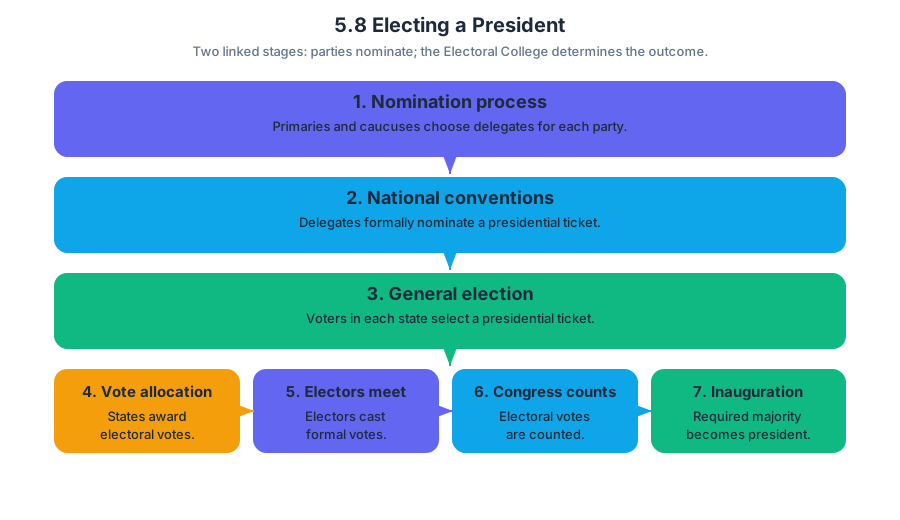
Presidential elections combine a nomination process with a general election. First, political parties select nominees through state-level primaries and caucuses. Then, the party nominees compete in the general election, where the Electoral College determines the outcome.
A simplified sequence looks like this:
- Primaries and caucuses: voters or party participants help choose delegates.
- National party conventions: delegates formally nominate a presidential and vice-presidential ticket.
- General election: voters in each state select a presidential ticket.
- Electoral vote allocation: each state awards electoral votes according to its election rules.
- Electoral College meeting: electors cast the formal votes.
- Congressional counting: Congress counts the electoral votes.
- Inauguration: the candidate who receives the required electoral majority becomes president.
Primaries, caucuses, and conventions
A primary is a state election in which voters choose among candidates or select delegates pledged to those candidates. A caucus is a party meeting in which participants discuss candidates and express their preferences through a party-controlled process. States may use open, closed, or partly open primary systems, so the people eligible to participate can differ from one state to another.
The process is decentralized: states set many of their own election rules, while national parties establish broader requirements. Early contests receive disproportionate attention because they can generate media coverage, donations, endorsements, and a perception of momentum. A candidate who performs poorly may lose financial support even before most states vote.
At the national convention, delegates formally nominate the party’s presidential candidate. The convention also presents the party platform and confirms the ticket, but modern conventions usually ratify a contest whose decisive stages occurred during the state contests.
The Electoral College
The Electoral College is the constitutional mechanism through which the president is elected. Each state receives electoral votes equal to its total representation in Congress: its number of representatives in the House plus its two senators. The District of Columbia receives electoral votes under the Twenty-Third Amendment, although it is not a state.
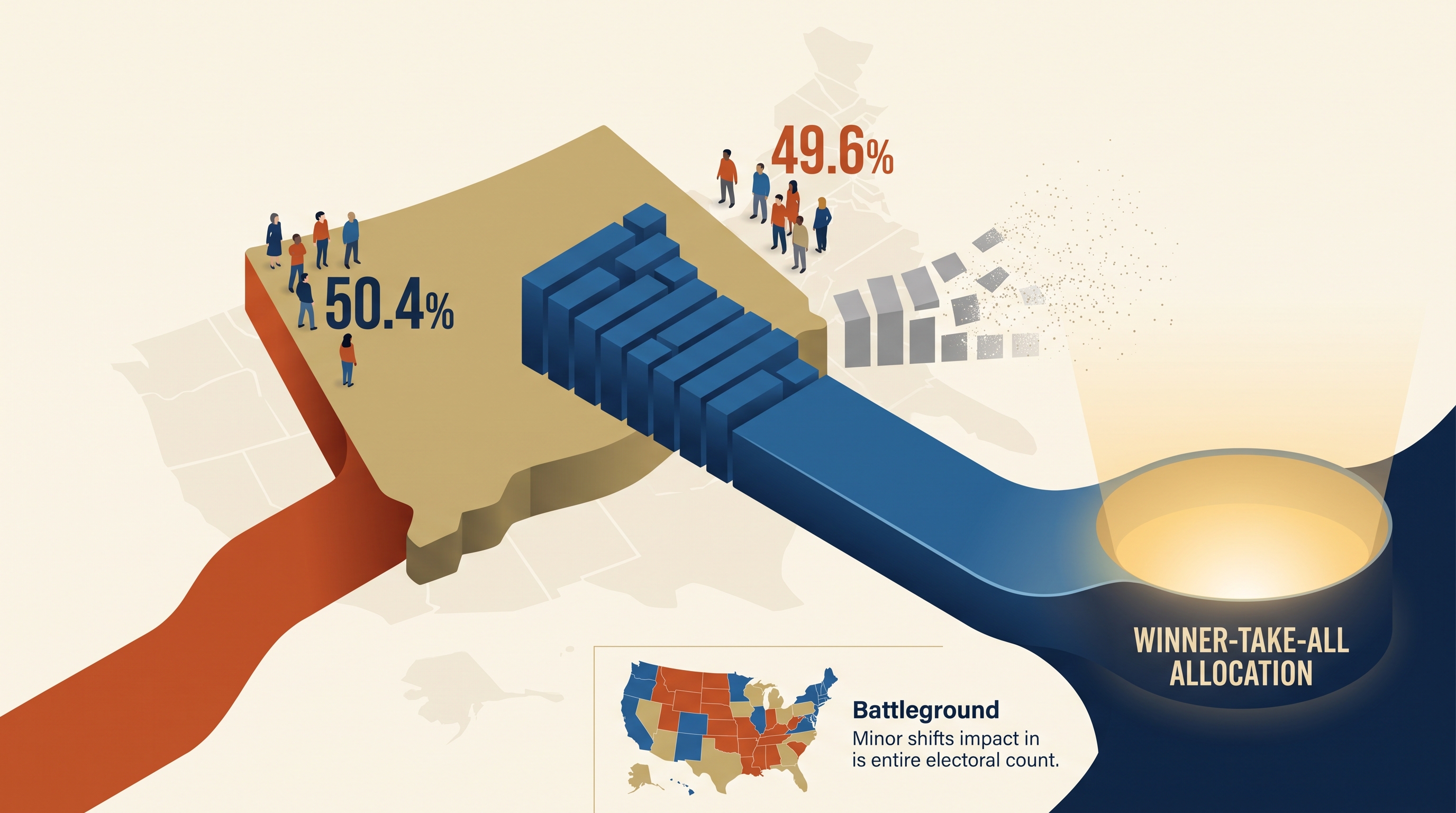
Most states use a winner-take-all rule: the candidate who wins the state’s popular vote receives nearly all of that state’s electoral votes. Maine and Nebraska use a district-based variation, awarding some electors by congressional district and others based on the statewide result.
The system rewards geographic distribution rather than simply national vote totals. A candidate can win large margins in some states but receive no additional electoral votes for votes beyond what was needed to win those states. Meanwhile, a candidate may narrowly win several competitive states and collect their entire electoral-vote totals.
Worked example: popular votes versus electoral votes
Imagine a country with three states:
| State | Electoral votes | Candidate A | Candidate B | Winner |
|---|---|---|---|---|
| Redwood | 20 | 60% | 40% | A |
| Lakeside | 18 | 49% | 51% | B |
| Prairie | 12 | 49% | 51% | B |
Candidate A wins Redwood by a large margin and receives $20$ electoral votes. Candidate B wins Lakeside and Prairie narrowly and receives $30$ electoral votes. Candidate A may have many more individual votes in Redwood, but Candidate B wins the presidency because the Electoral College result is $30$ to $20$.
This is why campaigns focus heavily on battleground states, states in which the major-party candidates have relatively similar levels of support. A candidate has little incentive to spend additional resources in a state that is safely secured or nearly impossible to win, while a narrow shift in a competitive state can change the national result.
Making an AP argument
For Skill 5.A: Make a claim, an effective claim must answer the prompt directly and establish a defensible position. For example:
The Electoral College encourages presidential candidates to prioritize competitive states because winner-take-all allocation converts narrow state victories into large electoral advantages.
That claim is stronger than “the Electoral College affects campaigns” because it identifies the mechanism: winner-take-all allocation. Evidence should then identify a campaign pattern, and reasoning should explain why concentrating resources in competitive states follows from that institutional rule.
Misconception check
Misconception: “The candidate with the most votes nationwide automatically wins.”
The national popular vote measures total individual votes across all states, but the presidency is decided through electoral votes. The two totals often point in the same direction, but they measure different things: one aggregates voters nationally, while the other aggregates state-based electoral outcomes.
Retrieval check
A candidate wins a state by $50.4%$ to $49.6%$ and receives all of its electoral votes. Which feature of presidential elections explains this result, and why does it make the state strategically important?
Answer: The state’s winner-take-all allocation gives the victor the full electoral-vote bloc despite the narrow margin. If the state is competitive, a small change in voter preference can transfer all of those electoral votes to the other candidate, making it a battleground state.
Source Materials
- AP U.S. Government and Politics Course and Exam Description
- Learn More (.pdf)
- AP U.S. Government and Politics Course Overview
- AP U.S. Government and Politics Course at a Glance
- AP United States Government and Politics Course at a Glance Poster
- AP United States Government and Politics
- AP United States Government and Politics
- United States Government and Politics Sample Syllabus 1