From the free course AP United States Government and Politics on Lykke
5.7 Groups Influencing Policy Outcomes
Key concepts: Groups influencing policy outcomes · Group membership · Dues-paying members · Selective benefits · Exclusive goods and services · Group funding · Group resources · Political influence · Elections · Political parties
A group’s political influence depends not only on the strength of its ideas but also on the resources it can organize, maintain, and deploy. Two groups may support opposite policies, yet the group with more members, reliable funding, specialized information, or stronger organizational capacity may have a greater…
5.7 Groups Influencing Policy Outcomes
A group’s political influence depends not only on the strength of its ideas but also on the resources it can organize, maintain, and deploy. Two groups may support opposite policies, yet the group with more members, reliable funding, specialized information, or stronger organizational capacity may have a greater ability to shape what government does.
The resource problem: why membership matters
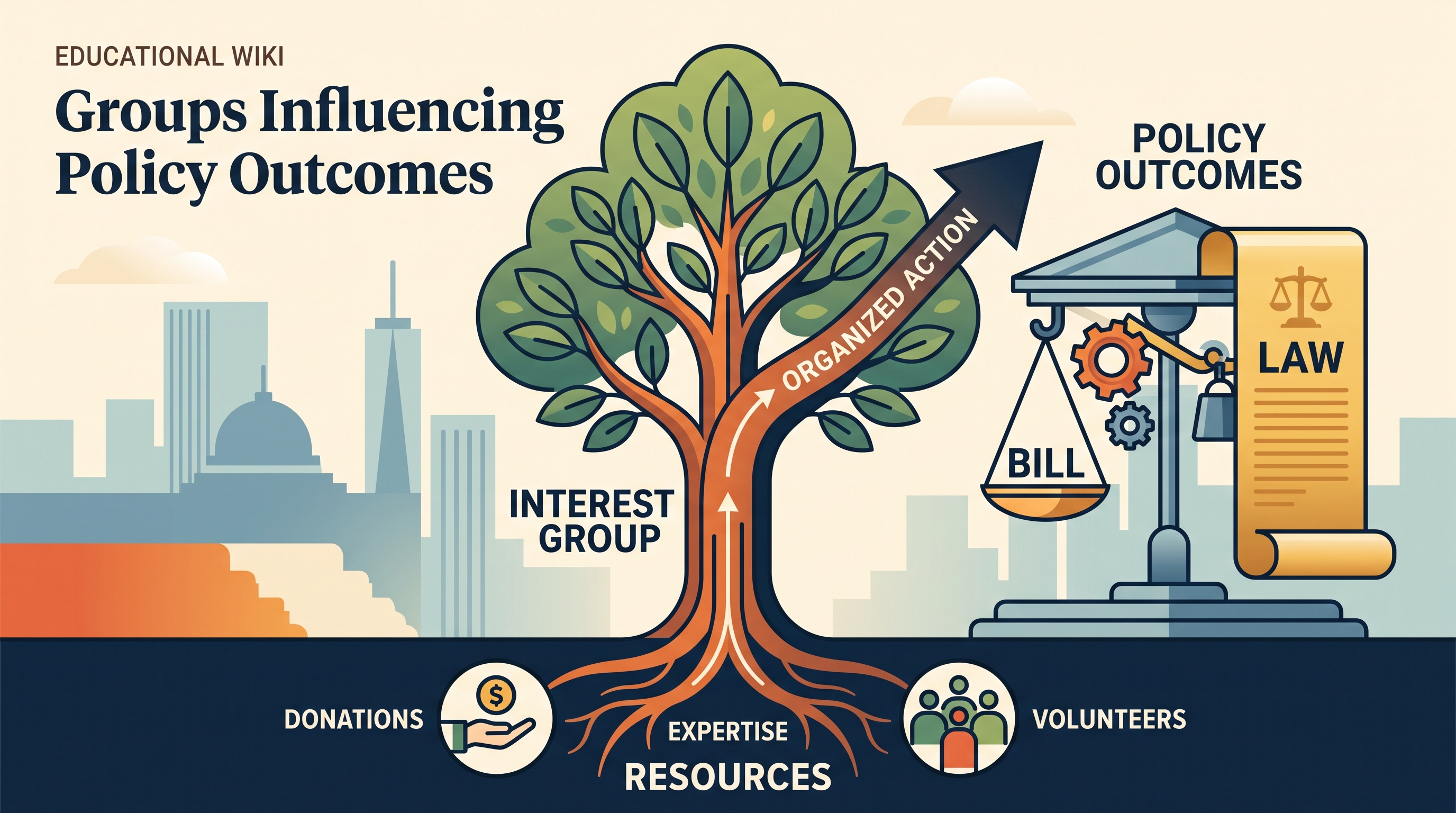
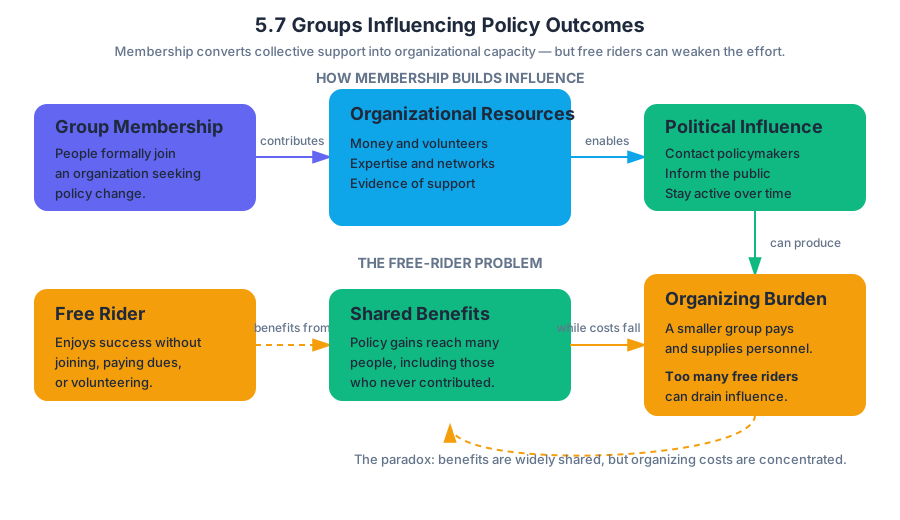
Group membership means formally joining an organization that seeks to affect public policy or political outcomes. Membership can provide a group with money, volunteers, expertise, communication networks, and evidence that many people support its position. These resources make it easier for a group to contact policymakers, communicate with the public, and remain active over time.
The central organizational difficulty is the free-rider problem. A free rider benefits from an interest group’s success without joining the group or contributing financially. For example, if an organization successfully supports cleaner air regulations, many people may enjoy cleaner air even though they never paid dues or volunteered.
This creates a paradox: the benefits of political action may be widely shared, but the costs of organizing that action fall on a smaller number of participants. If too many people remain free riders, the group may lack the funding and personnel necessary to sustain its influence.
Selective benefits: turning shared goals into organized support
Groups address free riding by offering selective benefits, which are goods or services available only to members. Examples include magazines, discounts, specialized information, legal assistance, professional training, or access to members-only events. Unlike a general policy victory, a selective benefit can be withheld from people who do not officially join.
Dues-paying members therefore receive two kinds of returns: they may benefit from the group’s broader policy goals, and they receive an exclusive benefit immediately because they joined. This gives people a practical incentive to contribute rather than simply wait for others to pay for the group’s work.
| Organizational resource | How it can affect policy influence |
|---|---|
| Dues-paying members | Provide recurring funding and demonstrate organized support |
| Selective benefits | Encourage people to join and reduce free riding |
| Specialized information | Help a group make credible policy arguments |
| Volunteers and staff | Sustain communication, research, and advocacy |
| Funding | Supports offices, outreach, research, and political activity |
A group’s resources affect its ability to maintain influence, but resources do not guarantee success. Policymakers may face competing actors, constitutional limits, public opposition, or electoral pressure. Influence is best understood as capacity: resources increase what a group can do, while political circumstances affect whether those efforts produce a particular policy outcome.
Worked contextual example: Club for Growth
Consider the illustrative example of the Club for Growth supporting limits on taxation. The group’s policy position alone does not create influence. To affect outcomes, it must attract members who support that position, collect dues or other funding, produce specialized information, communicate with policymakers and voters, and maintain its activity across political campaigns and policy debates.
The causal chain is:
$$ \text{Selective benefits} \rightarrow \text{More members} \rightarrow \text{More dues and organizational resources} \rightarrow \text{Greater capacity to influence policy} $$
The example does not mean that every dues-paying member personally determines tax policy. It shows how membership incentives can transform a broad policy preference into an organized institution with resources capable of sustaining political action.
Elections, parties, and policy shifts
Interest groups operate within larger political processes. Elections and political parties are related to major policy shifts or initiatives, and changes in electoral coalitions can alter which groups receive access or which policies become feasible. In some cases, these changes produce political realignments, meaning lasting shifts in the voting constituencies that support political parties.
A group may therefore gain or lose influence when party coalitions change, even if its membership and funding remain stable. Policy outcomes reflect interaction among organized groups, elected officials, political parties, voters, and the institutional rules governing decision-making.
Essential Knowledge connection — EK 5.7.A.2 and EK 5.7.A.3: Resources and membership incentives help groups sustain influence, while elections and political parties can contribute to major policy shifts and, occasionally, political realignments.
AP skill: Concept Application (1.E)
Concept Application (1.E) requires explaining how political principles, institutions, processes, policies, and behaviors apply to different scenarios in context. For a scenario about a group, do not merely identify “interest-group influence.” Explain the mechanism: identify the group’s resource, show how it supports organized action, and connect that action to a possible policy outcome.
Named misconception check — “A large number of beneficiaries automatically creates a large interest group.” False. A policy may benefit millions of people, but those people may have little incentive to join or pay dues. Selective benefits help solve this problem by giving individuals an exclusive reason to become official members.
Retrieval check: A national organization provides members with a monthly policy magazine and discounted legal services. What problem are these benefits designed to reduce, and how could the resulting increase in dues-paying members affect the organization’s policy influence? Answer: They reduce free riding by giving people exclusive incentives to join. More dues-paying members can increase funding, staff capacity, information production, and sustained political activity.
Source Materials
- AP U.S. Government and Politics Course and Exam Description
- Learn More (.pdf)
- AP U.S. Government and Politics Course Overview
- AP U.S. Government and Politics Course at a Glance
- AP United States Government and Politics Course at a Glance Poster
- AP United States Government and Politics
- AP United States Government and Politics
- United States Government and Politics Sample Syllabus 1