From the free course AP United States Government and Politics on Lykke
5.10 Modern Campaigns
Modern campaigns are increasingly candidate-centered: voters often respond more to an individual candidate’s image, message, personal biography, and media strategy than to a detailed party platform.
5.10 Modern Campaigns
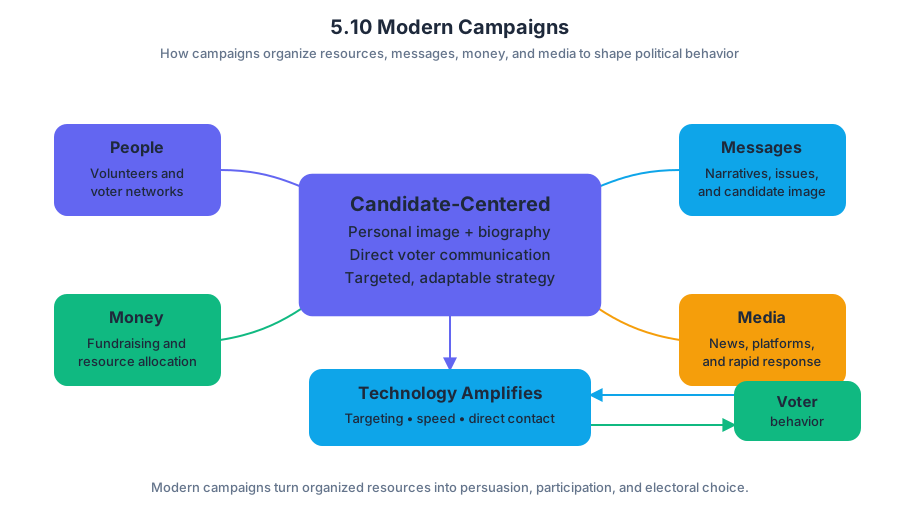
Modern campaigns are increasingly candidate-centered: voters often respond more to an individual candidate’s image, message, personal biography, and media strategy than to a detailed party platform. Technology has intensified this shift by allowing candidates to communicate directly with voters, target particular groups, and react rapidly to political events.
The central question is not simply who wins an election? It is: How do modern campaigns organize people, messages, money, and media to persuade voters and shape political behavior?
From party-centered politics to candidate-centered campaigns
In a party-centered campaign, the political party supplies much of the candidate’s identity, organization, platform, and campaign structure. The party label helps voters predict what the candidate stands for. In a candidate-centered campaign, the individual candidate becomes the main political brand. The campaign emphasizes personal leadership, biography, public image, and a small number of memorable issues.
This change does not mean that parties have disappeared. Parties still provide fundraising networks, voter lists, volunteers, endorsements, policy ideas, and election infrastructure. Instead, the balance of attention has shifted: the party remains an important organizational engine, while the candidate often controls the public-facing message.
| Campaign emphasis | Party-centered campaign | Candidate-centered campaign |
|---|---|---|
| Main political identity | Party platform and label | Candidate’s image and message |
| Communication | Party organizations and traditional media | Candidate-controlled and targeted media |
| Voter appeal | Broad party coalition | Personal biography, issues, and targeted groups |
| Major risk | Party brand may become unpopular | Candidate may lack durable party support |
Why technology changes campaigns
Modern communication reduces the distance between candidates and voters. Television made visual performance and campaign advertising central to elections; websites and email allowed campaigns to distribute information quickly; social media now permits candidates to publish messages immediately, mobilize supporters, respond to opponents, and encourage participation without waiting for journalists or party organizations.
Technology also makes campaigns more precisely targeted. A campaign may send different messages to younger voters, suburban voters, rural voters, or occasional voters. The same candidate can therefore present different issue emphases to different audiences while maintaining a broader public identity.
This produces a political trade-off. Direct communication can increase participation by making it easier to volunteer, donate, attend events, or share political information. However, highly targeted communication can fragment the electorate: different voters may encounter different claims, priorities, and interpretations of the same campaign.
Campaigns as persuasion and mobilization systems
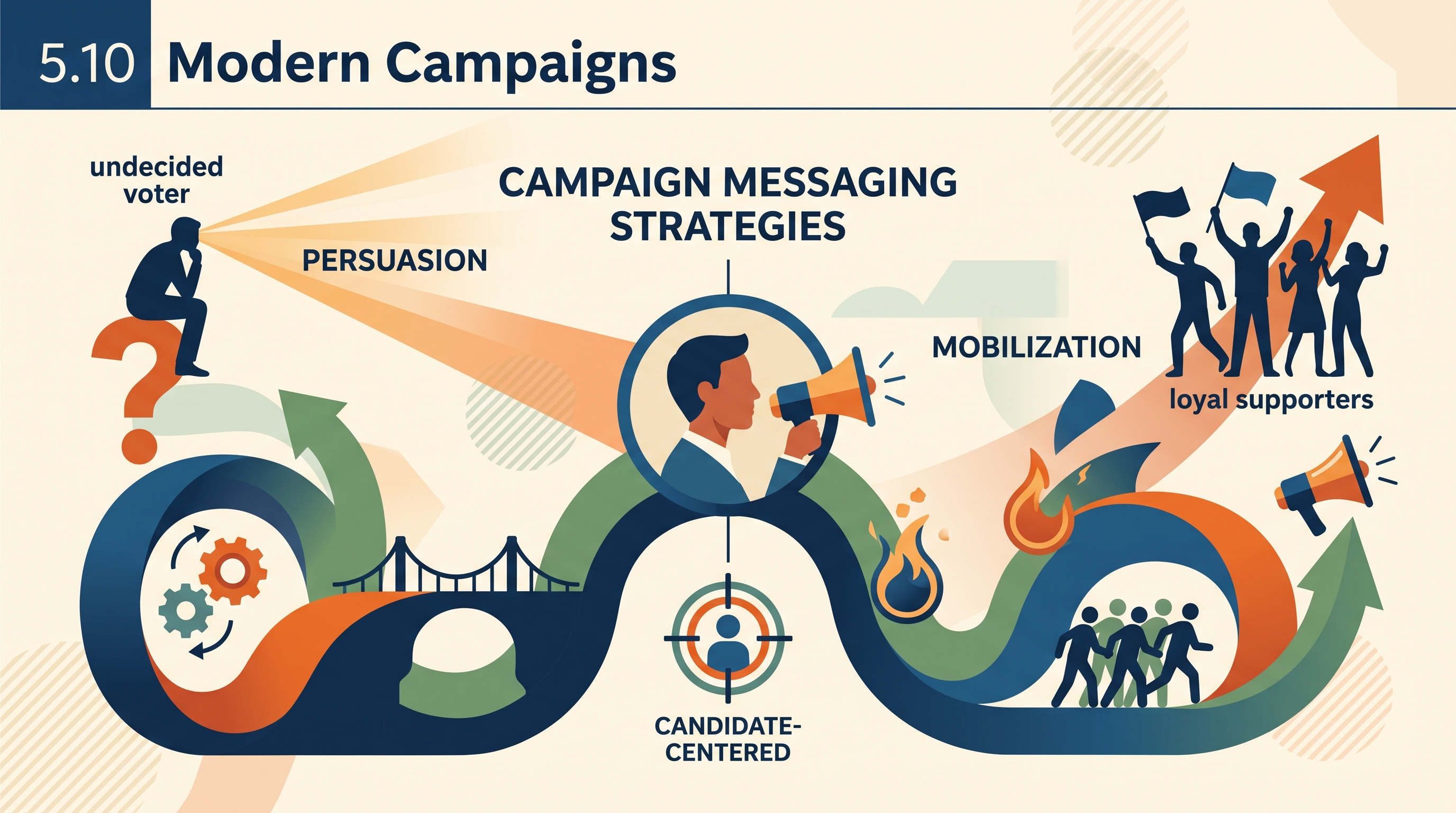
A campaign performs two connected tasks. Persuasion attempts to change a voter’s preference, while mobilization attempts to motivate a person who is already sympathetic to actually participate. A campaign message praising a candidate’s education policy may persuade an undecided voter; a text reminding a supporter to vote early is primarily mobilization.
Campaigns also use polling, voter-contact records, public events, advertising, debates, endorsements, and social-media communication to decide where to concentrate limited attention. A candidate does not need to communicate equally with every voter at every moment. Campaign strategy usually prioritizes voters, geographic areas, and issues that could affect the result.
Worked contextual example: evaluating a campaign strategy
Imagine Candidate Rivera is running a statewide campaign. Rivera begins with a broad television advertisement describing experience in public service. The campaign then uses digital messages: one highlights transportation for urban voters, another emphasizes agricultural markets for rural voters, and a third urges previously supportive young voters to register and participate.
Step 1: Identify the campaign model. The strategy is primarily candidate-centered because Rivera’s personal experience is the central brand, even though the campaign adapts its issue messages for different audiences.
Step 2: Explain the role of technology. Digital communication allows the campaign to send targeted messages quickly and to distinguish persuasion from mobilization. The transportation message may persuade; the registration reminder primarily mobilizes.
Step 3: Analyze the consequence. The strategy may increase efficiency because each audience receives a relevant appeal. Its weakness is that voters may receive unequal or inconsistent information, making it harder for the public to evaluate the candidate using a shared set of claims.
Step 4: Construct an argument. A defensible claim would be: Modern technology strengthens candidate-centered campaigns because it allows candidates to bypass traditional intermediaries and tailor appeals to specific voters, although that same targeting can make public accountability more difficult.
Skill 5.C: Use reasoning to organize and analyze evidence
Topic 5.10 is assessed through Skill 5.C: Use reasoning to organize and analyze evidence, explaining its significance to justify an argument or claim/thesis. This skill requires more than listing facts. The response must connect evidence to a claim and explain why that evidence proves, supports, qualifies, or complicates the claim.
A strong chain of reasoning looks like this:
Claim → Evidence → Explanation of significance → Qualification or consequence
For example, “campaigns use social media” is evidence but not yet analysis. The reasoning appears when the writer explains that direct, targeted communication can increase mobilization and reduce dependence on party organizations, thereby strengthening the candidate’s independent public identity.
Misconception check
Misconception: Technology automatically makes elections more democratic. Technology can lower communication barriers and expand participation, but access, misinformation, selective targeting, and unequal digital engagement can also distort political understanding. Its political effect depends on how campaigns and voters use it.
Retrieval check
A campaign sends one message to undecided voters and a different reminder to loyal supporters. Identify which message is primarily persuasion, which is primarily mobilization, and explain one way this strategy reflects a candidate-centered campaign. Then write one sentence explaining the significance of the evidence, as required by Skill 5.C.
Source Materials
- AP U.S. Government and Politics Course and Exam Description
- Learn More (.pdf)
- AP U.S. Government and Politics Course Overview
- AP U.S. Government and Politics Course at a Glance
- AP United States Government and Politics Course at a Glance Poster
- AP United States Government and Politics
- AP United States Government and Politics
- United States Government and Politics Sample Syllabus 1