From the free course AP United States Government and Politics on Lykke
5.3 Political Parties
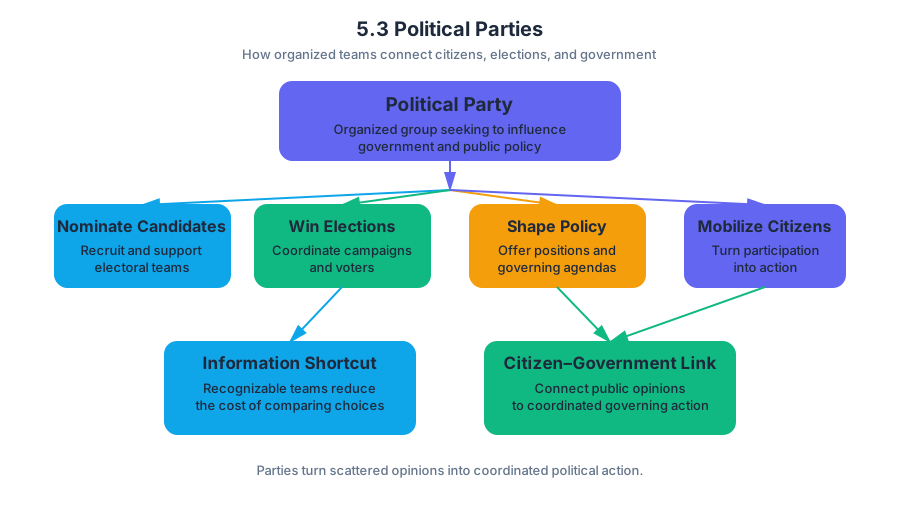
A political party is an organized group that seeks to influence government by nominating candidates, winning elections, shaping public policy, and mobilizing citizens. Parties do more than label candidates “Democrat” or “Republican”: they connect citizens to government and help turn scattered opinions into…
5.3 Political Parties
A political party is an organized group that seeks to influence government by nominating candidates, winning elections, shaping public policy, and mobilizing citizens. Parties do more than label candidates “Democrat” or “Republican”: they connect citizens to government and help turn scattered opinions into coordinated political action.
In a large representative democracy, most citizens cannot personally evaluate every candidate, bill, and policy proposal. Political parties reduce that information problem by offering recognizable teams, policy positions, campaign organizations, and governing agendas.
The three faces of a political party
Political parties operate simultaneously in three connected arenas. Confusing these arenas is one of the most common sources of incorrect reasoning about parties.
| Party component | What it includes | Main political work |
|---|---|---|
| Party in the electorate | Citizens who identify with or regularly support a party | Voting, donating, volunteering, persuading others |
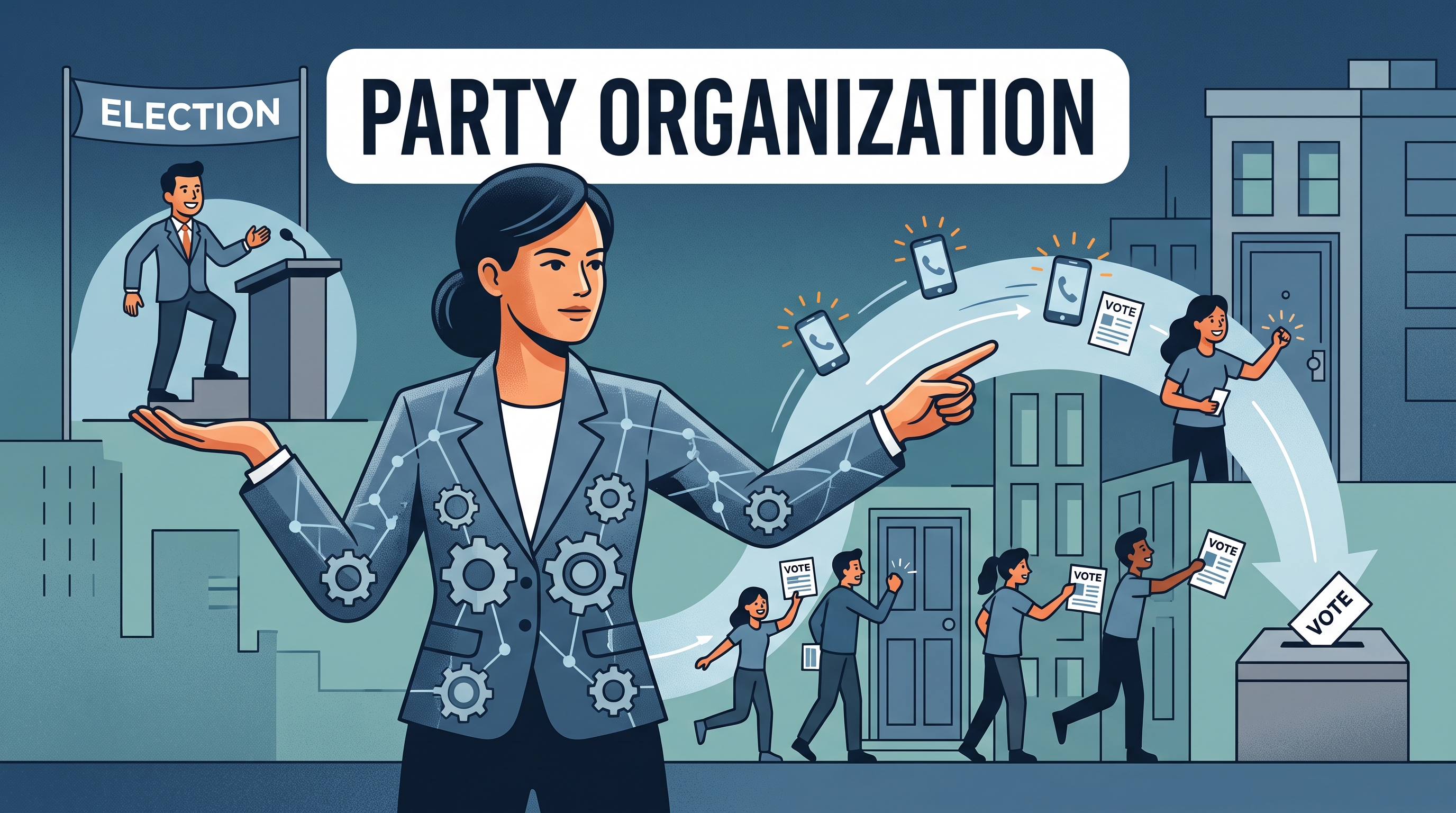
| Party organization | National, state, and local party committees and officials | Recruiting candidates, raising money, coordinating campaigns, and mobilizing voters |
| Party in government | Elected officials who belong to the party | Organizing legislative action, selecting leaders, and pursuing the party’s policy goals |
The three components overlap but are not identical. A voter may identify with a party without belonging to its formal organization, and an elected official may disagree with the party’s national position on a particular issue.
Parties as linkage institutions
A linkage institution is a structure that connects people to government and communicates public preferences to policymakers. Political parties perform this role by translating individual concerns—such as housing costs, health care, taxes, or public safety—into platforms, candidates, campaign messages, and legislative priorities.
Parties also help citizens interpret politics. A party label supplies a shortcut: voters may use a candidate’s party affiliation as evidence about likely policy positions. This shortcut is useful, but it can also encourage voters to rely on party identity rather than examining a candidate’s actual record.
What parties do
The core functions of political parties include recruiting candidates, organizing elections, mobilizing voters, presenting alternative policy positions, and coordinating government. Parties identify people willing to seek office, help them campaign, assemble volunteers and donors, communicate with voters, and organize elected officials after the election.
A party platform is a public statement of the party’s policy priorities. Platforms can help voters compare parties and give candidates a common message, although elected officials are not legally required to follow every platform promise.
The party in government performs an especially important coordinating function. In Congress, party members choose leaders, distribute committee assignments, develop legislative priorities, and try to assemble the votes necessary to pass bills. In the executive branch, a president often relies on party networks and shared goals to build support for an administrative agenda.
Worked example: turning an issue into political action
Suppose residents become concerned about the rising cost of home insurance after repeated storms. The issue begins as an individual problem: each household experiences higher premiums. Political parties can transform it into a broader political process.
- Party in the electorate: Residents discuss the issue, join advocacy efforts, donate, volunteer, and vote for candidates who address insurance costs.
- Party organization: Local and state party committees recruit candidates, arrange meetings, distribute campaign materials, and target likely supporters.
- Candidates and platforms: Candidates propose policies such as insurance regulation, disaster assistance, or incentives for stronger construction.
- Party in government: Winning legislators introduce bills, use committee hearings to develop them, and coordinate with party leaders to seek passage.
- Accountability: At the next election, voters evaluate whether the party’s officials acted on the issue.
This example shows why parties are more than campaign machines. They connect public concerns to candidates, elections, institutions, and policy outcomes.
Skill focus: Skill 1.B — Describe political concepts and processes
Topic 5.3 Political Parties is associated with Skill 1.B: Describe political concepts and processes. To apply this skill, identify the political concept precisely and explain how it operates in context. A strong response does not merely state that parties “help elections”; it describes the mechanism—candidate recruitment, voter mobilization, policy coordination, or linkage between citizens and government.
For example, if a prompt describes a state party recruiting volunteers, creating campaign materials, and coordinating election-day transportation, the best description identifies the party organization, not simply “the party.” If it describes citizens who consistently support one party but hold no formal party position, the relevant component is the party in the electorate.
Precision rule: Name both what the party is doing and which part of the party system is doing it.
Misconception check
Misconception: “A political party is just the people who hold office under its label.” The party in government is only one component. Parties also include ordinary voters and the formal organizations that recruit, fund, coordinate, and mobilize political activity.
Misconception: “Party identification means a voter agrees with every party position.” Party identification is a durable political attachment, not a complete checklist of opinions. Individuals may support a party generally while disagreeing with it on particular policies or candidates.
Retrieval check
A local party committee recruits a candidate, organizes volunteers, and sends targeted reminders to likely supporters. Which party component is acting, and which party function is most directly illustrated? Answer: the party organization is acting, primarily performing candidate recruitment and voter mobilization.
Source Materials
- AP U.S. Government and Politics Course and Exam Description
- Learn More (.pdf)
- AP U.S. Government and Politics Course Overview
- AP U.S. Government and Politics Course at a Glance
- AP United States Government and Politics Course at a Glance Poster
- AP United States Government and Politics
- AP United States Government and Politics
- United States Government and Politics Sample Syllabus 1