From the free course AP United States Government and Politics on Lykke
2.15 Policy and the Branches of Government
Key concepts: The role of Congress in the public policy process · Enumerated and implied congressional powers · The legislative process in both chambers of Congress · The influence of public support for legislation · The interaction between Congress and the president in policymaking · The role of executive communication in shaping policy · The Supreme Court’s role in establishing or rejecting legal precedents · The effects of communication technology on presidential communication · The relationship between government branches, bureaucratic agencies, and budgets · Federalist perspectives on government institutions and processes
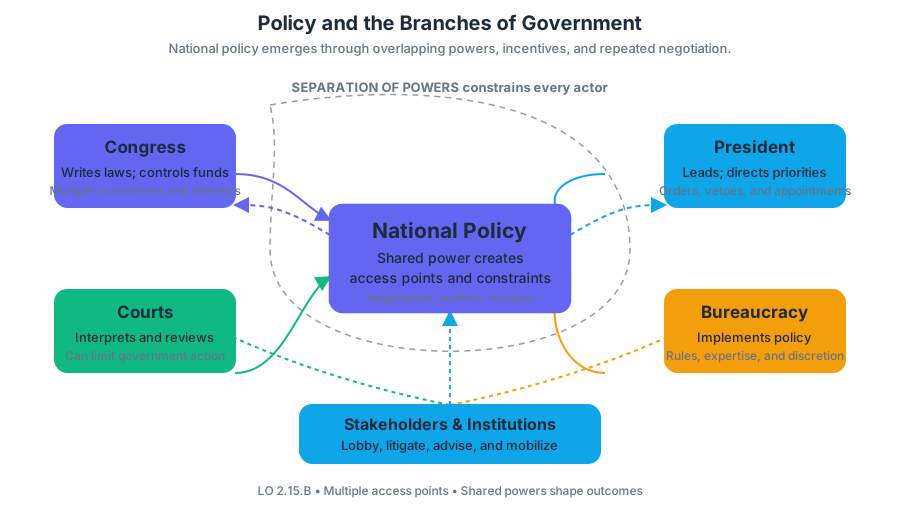
Congress, the president, the courts, and the bureaucracy rarely act in a neat sequence; national policy emerges from their overlapping powers, competing incentives, and repeated negotiations.
2.15 Policy and the Branches of Government
Congress, the president, the courts, and the bureaucracy rarely act in a neat sequence; national policy emerges from their overlapping powers, competing incentives, and repeated negotiations.
LO 2.15.B: Explain how the distribution of powers among the three branches of government impacts policymaking.
EK 2.15.B.1: The allocation of powers among the three branches of government creates multiple access points for stakeholders and institutions to influence public policy.
EK 2.15.B.2: National policymaking is constrained by the sharing of powers between the three branches.
Congress: the lawmaking center of policymaking
The Constitution gives Congress enumerated powers, meaning powers specifically listed in Article I, Section 8. These include taxing, spending, regulating interstate commerce, declaring war, and raising and maintaining the armed forces. Congress may also exercise implied powers, which are not written word-for-word but are reasonably connected to an enumerated power through the Necessary and Proper Clause.
For example, Congress’s authority to maintain the armed forces permits more than simply voting to create an army or navy. Congress may enact laws establishing military departments, setting rules for military organization, funding defense programs, and creating administrative systems needed to carry out that constitutional responsibility.
A president may propose an agenda, persuade lawmakers, and ask Congress to act, but the president does not formally introduce legislation in Congress. A member of the House or Senate must sponsor a bill. The bill must then pass both chambers in identical form before it can reach the president.
The legislative process in two chambers
The House and Senate are not interchangeable. The House has stricter debate rules and gives considerable control to the Rules Committee, while the Senate permits extended debate. A senator may use a filibuster to delay or prevent a final vote; the Senate can generally end debate through cloture, which ordinarily requires a three-fifths vote, or at least $60$ senators when all $100$ seats are filled.
Support for a bill affects every stage: whether party leaders schedule it, whether committees report it, whether members remain unified, and whether the bill can survive debate and voting. Public opinion, interest-group pressure, lobbying, campaign considerations, and presidential persuasion can all change the coalition needed for passage.
Worked example: Suppose Congress considers a bill funding a new national emergency communications system. A House committee may hold hearings and revise the bill; House leaders may limit debate to secure a vote. In the Senate, opponents may prolong debate, forcing supporters to seek enough votes for cloture. If both chambers pass different versions, a compromise must be approved by both. The president can then sign the bill, allow it to become law without signing under applicable constitutional rules, or veto it. Congress may override the veto with a two-thirds vote in both chambers.
Misconception check — “The president makes laws.” The president strongly influences policy, but Congress performs the central lawmaking function. Presidential influence cannot substitute for congressional passage when a new statute is required.
Shared powers and competing access points
LO 2.15.A: Explain the extent to which governmental branches can hold the bureaucracy accountable given the competing interests of Congress, the president, and the federal courts.
EK 2.15.A.1: Formal and informal powers of Congress, the president, and the courts over the bureaucracy are used to maintain its accountability.
Policy is shaped through legislation, executive approval or implementation, and possible judicial review—but not every policy passes through each step. Congress can shape outcomes through statutory language and agency budgets; the president can direct executive priorities and influence implementation; courts can determine whether governmental action is consistent with the Constitution or with federal law.
Budgets are especially powerful. Even when Congress does not repeal a program, it can restrict or expand the money available to an agency. An agency may possess legal authority to act, yet lack the personnel, equipment, or funding to carry out every possible policy choice.
The branches therefore create multiple access points for stakeholders. A group seeking a policy change might lobby Congress for a statute, encourage the president to issue an executive directive, participate in an agency rulemaking process, or bring a lawsuit. The same policy dispute can move among institutions rather than ending when one branch acts.
Presidential communication and policymaking
Presidential communication has had an increasing impact as communication technology has advanced. Television, digital media, social platforms, and direct public addresses allow presidents to shape the public agenda rapidly. This informal influence is often called the bully pulpit: the president’s ability to use public attention and persuasion to pressure Congress, mobilize supporters, and define a policy problem.
Communication does not guarantee legislative success. A president who publicly advocates a bill may increase constituent pressure on legislators, but lawmakers still respond to party strategy, district interests, Senate procedure, interest groups, and electoral incentives. The president’s message becomes one force inside a larger bargaining system.
Courts, precedents, and constitutional conflict
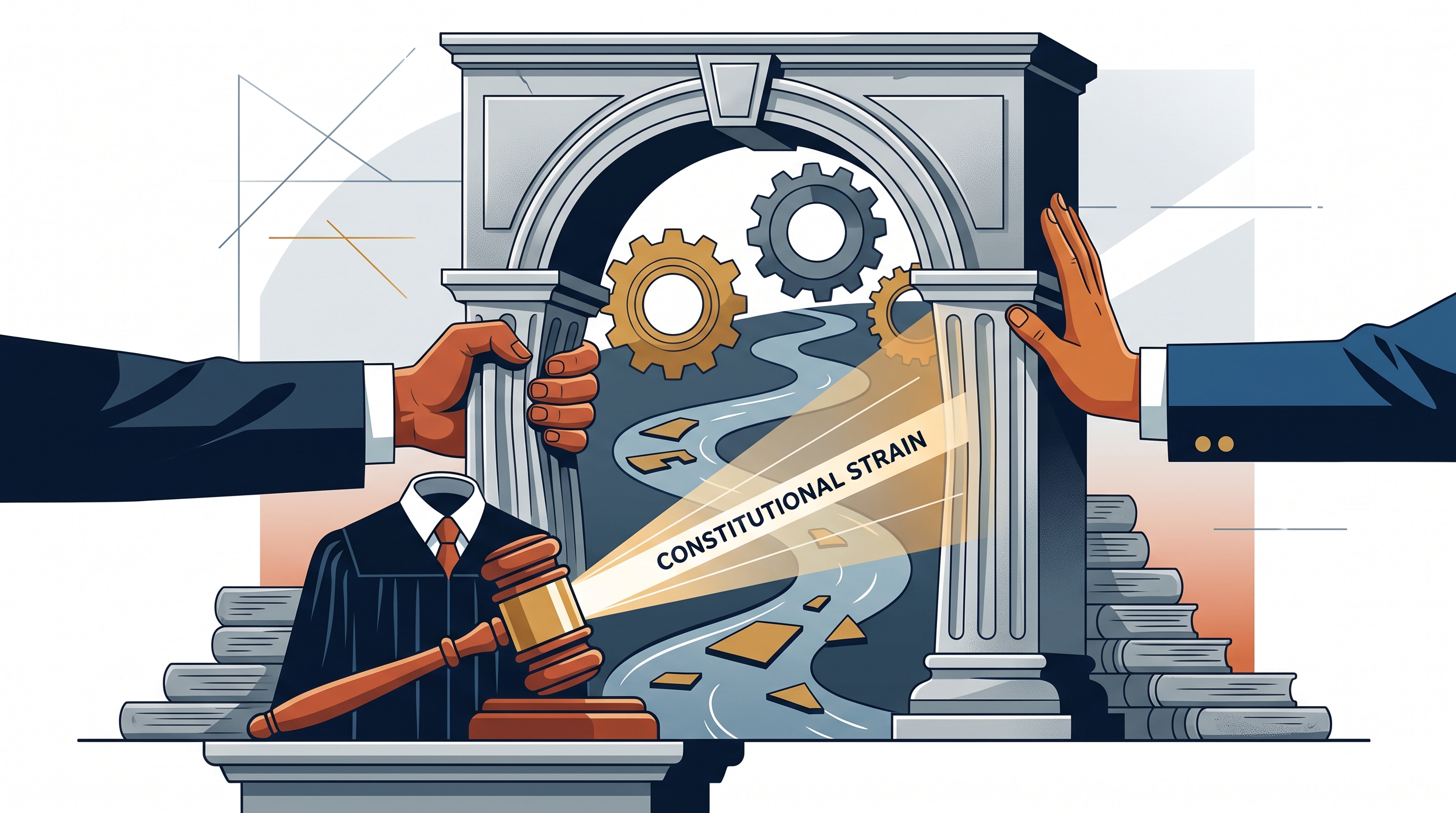
The judiciary adds another possible policymaking arena. Supreme Court cases can establish new precedents or reject existing precedents, changing how constitutional principles and federal statutes apply. Judicial review may therefore alter the legal boundaries within which Congress, the president, and agencies operate.
Federalist No. 51 captures the logic of this arrangement: because people and institutions possess competing ambitions, dividing power among branches can make each branch check the others. The competing concern expressed by Antifederalists such as the author of Brutus No. 1 is that a powerful national government might use those powers to threaten individual liberty. Federalist No. 70 adds the opposing argument that an energetic, unified executive can act with speed and decisiveness.
Retrieval check: A bill passes the House and Senate, but the president vetoes it. Identify one constitutional route by which it could still become law, and explain one way Congress could later influence how the resulting policy is carried out.
Source Materials
- AP U.S. Government and Politics Course and Exam Description
- Learn More (.pdf)
- AP U.S. Government and Politics Course Overview
- AP U.S. Government and Politics Course at a Glance
- AP United States Government and Politics Course at a Glance Poster
- AP United States Government and Politics
- AP United States Government and Politics
- United States Government and Politics Sample Syllabus 1