From the free course AP United States Government and Politics on Lykke
4.1 American Attitudes About Government and Politics
Key concepts: Popular sovereignty · Representative democracy · American political attitudes, behaviors, and ideologies · Competing interests in policymaking · The relationship between governmental institutions, processes, and policies · Constitutional balancing of liberty and order · Civic participation · Evidence-based analysis of political data and sources
A representative democracy depends on a demanding idea: popular sovereignty, the principle that governmental authority ultimately comes from the people. Citizens do not vote on every law directly, so they express sovereignty through elections, public debate, organized advocacy, protest, media use, and other forms…
4.1 American Attitudes About Government and Politics
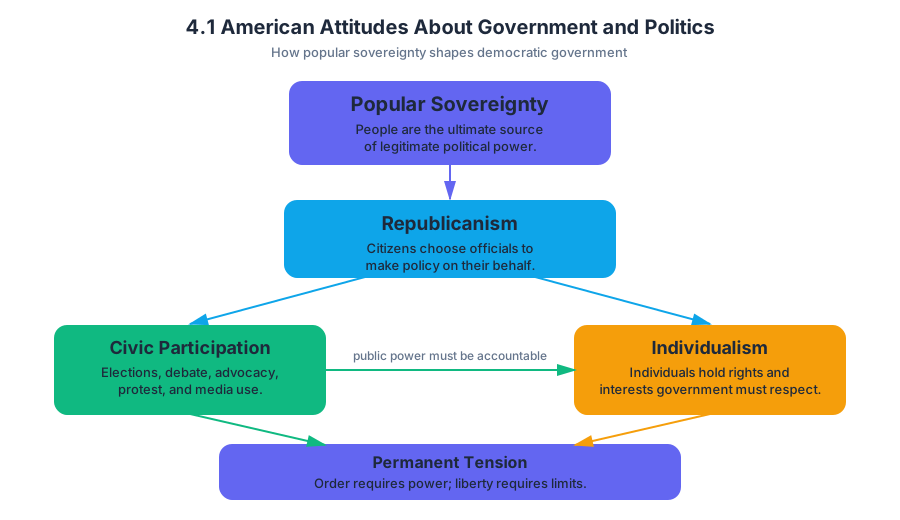
A representative democracy depends on a demanding idea: popular sovereignty, the principle that governmental authority ultimately comes from the people. Citizens do not vote on every law directly, so they express sovereignty through elections, public debate, organized advocacy, protest, media use, and other forms of participation.
Popular sovereignty means that the people are the ultimate source of legitimate political power.
The Constitution connects popular sovereignty to republicanism, or representative democracy: citizens choose officials who make policy on their behalf. It also reflects individualism, the belief that individuals possess rights and interests that government must respect. These principles create a permanent tension: government must be powerful enough to maintain order, but limited enough to preserve liberty.
The political-attitude system
Political outcomes do not come from institutions alone. Political attitudes are evaluations or feelings about government, leaders, issues, and political groups. Political behaviors are actions such as voting, contacting officials, joining an interest group, donating, protesting, or choosing not to participate. Political ideologies are organized sets of beliefs about the proper role of government and the policies it should pursue.
These elements interact over time. A person who believes that government should actively reduce economic inequality may support candidates who favor expanded social programs; that attitude can produce a behavior such as voting, campaigning, or contacting a representative. Institutions then translate those preferences unevenly into policies because different actors possess different resources and access.
| Political element | Meaning | Possible expression |
|---|---|---|
| Attitude | Evaluation or belief about politics | Trust or distrust in government |
| Behavior | Political action or nonaction | Voting, protesting, contacting officials |
| Ideology | Connected beliefs about government and policy | Liberal, conservative, or another policy orientation |
| Institution | Formal structure exercising public authority | Congress, presidency, courts, bureaucracy |
A crucial distinction is that attitudes do not mechanically determine behavior. Someone may strongly support an environmental policy but not vote, perhaps because of registration barriers, weak political efficacy, competing demands, or the belief that one vote will not affect the outcome. Conversely, a person may participate because a group, candidate, or major event activates an otherwise weak preference.
Worked example: from belief to policy
Imagine that residents of a coastal state increasingly favor stronger protections against flooding. Their attitudes may lead them to vote for candidates supporting infrastructure spending, join a coastal-residents association, attend public hearings, or contact legislators. Businesses concerned about construction costs may organize in opposition.
The resulting policy is not simply “what the public wants.” Multiple actors and institutions compete: voters select representatives; legislators write and negotiate a bill; the executive branch implements it; agencies interpret statutory language; courts may review constitutional challenges; and organized interests provide information, pressure, and campaign support. The final policy reflects both public preferences and the institutional process through which those preferences travel.
Liberty, order, and constitutional interpretation
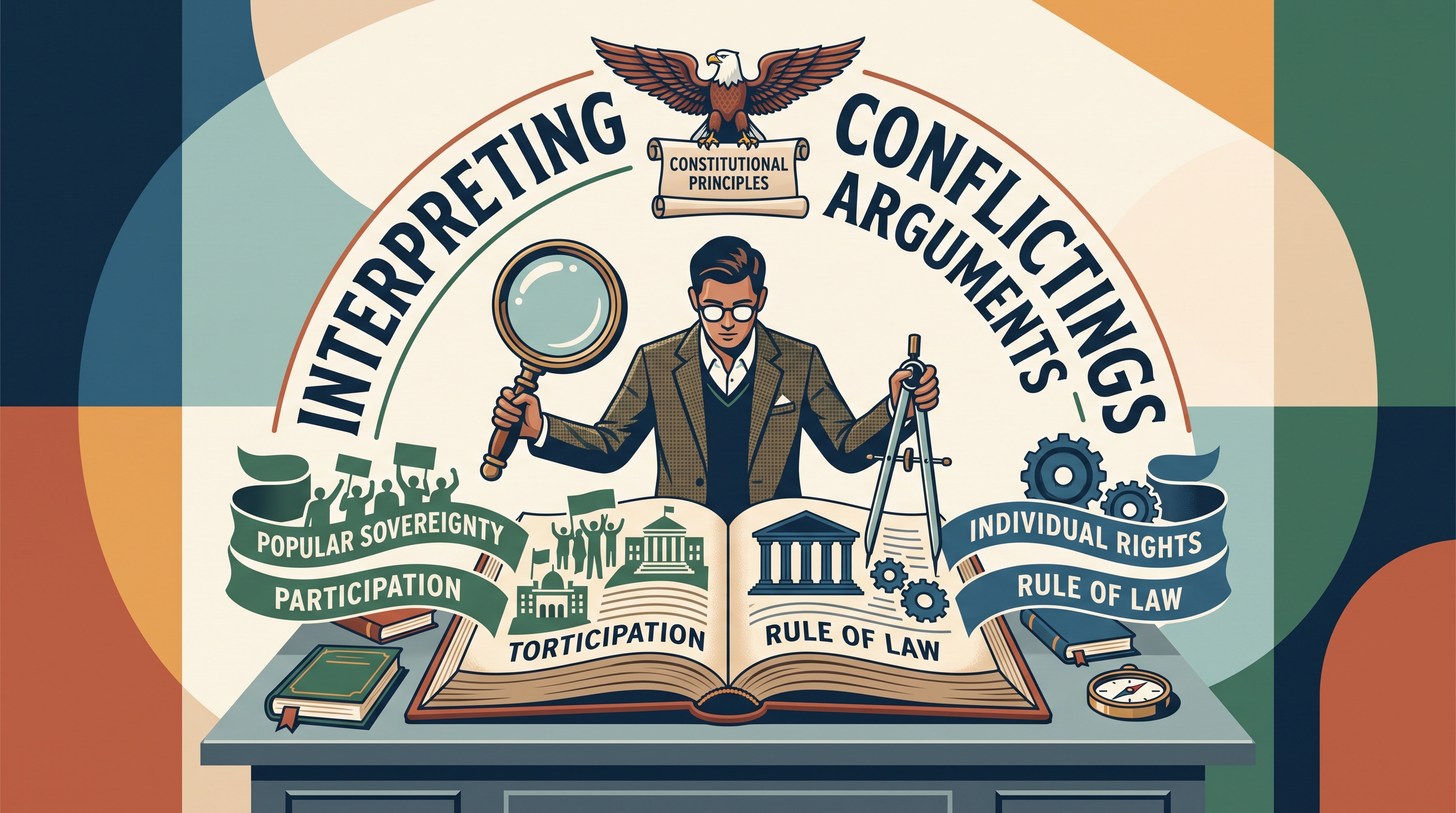
Governmental laws and policies that balance liberty and order are based on the U.S. Constitution. Liberty protects individual freedom; order refers to public safety, stability, and the government’s capacity to enforce laws. Constitutional principles and policies have been interpreted differently over time, so the same broad principle can generate different conclusions in different historical circumstances.
For example, a government may defend a public-safety regulation as necessary for order while critics argue that it burdens individual liberty. Constitutional analysis asks which governmental power is being used, which right or principle is affected, whether the government’s action is justified, and how courts or political institutions have interpreted the Constitution in that context.
Constitutional balancing is not a permanent declaration that liberty always wins or order always wins. It is an argument about how constitutional principles apply to a particular policy and historical setting.
Named misconception check
Misconception: “Popular sovereignty means the majority may do anything it wants.”
Correction: Majority rule operates within constitutional limits. The Constitution structures government power, protects individual rights, and creates checks and balances that can prevent a temporary majority—or any single institution—from exercising unlimited authority.
Reading politics as evidence
Political analysis requires more than identifying a position. Students must read and interpret data, compare perspectives, apply concepts to scenarios, and develop evidence-based arguments. A source supporting expanded government action and a source warning against government overreach may describe the same policy conflict from different political perspectives; strong analysis identifies each perspective and connects it to constitutional principles, institutions, processes, policies, or behaviors.
The principal suggested skill for Topic 4.1 is 1.D: Describe political principles, institutions, processes, policies, and behaviors illustrated in different scenarios in context. To use 1.D, first identify the political concept, then explain how the surrounding facts activate it. Do not merely label a scenario “popular sovereignty”; show how citizens’ participation gives the policy its democratic justification.
Retrieval check: A city council adopts a curfew after public safety concerns, while residents challenge it as an unnecessary restriction. Identify the two competing constitutional values, explain why the policy involves constitutional interpretation, and name one political behavior citizens could use to influence the result.
Source Materials
- AP U.S. Government and Politics Course and Exam Description
- Learn More (.pdf)
- AP U.S. Government and Politics Course Overview
- AP U.S. Government and Politics Course at a Glance
- AP United States Government and Politics Course at a Glance Poster
- AP United States Government and Politics
- AP United States Government and Politics
- United States Government and Politics Sample Syllabus 1
- 00762-115-AP-CED-CAAG-US-GoPo.indd All Pages 3/25/19 9:49 PM
- 00762-115-AP-CED-CAAG-US-GoPo.indd All Pages 3/25/19 9:49 PM
- AP US Gov Past Exam Questions — AP Central
- Khan Academy — AP US Government and Politics