From the free course AP United States Government and Politics on Lykke
3.12 Balancing Minority and Majority Rights
Key concepts: Equal Protection Clause of the Fourteenth Amendment · Supreme Court decisions on school segregation · Race-based school segregation · Balancing minority and majority rights · Supreme Court protection of majority rights
A constitutional democracy must solve a difficult problem: How can government protect a minority from majority rule without allowing race to determine political representation? The answer has changed across U.S.
3.12 Balancing Minority and Majority Rights
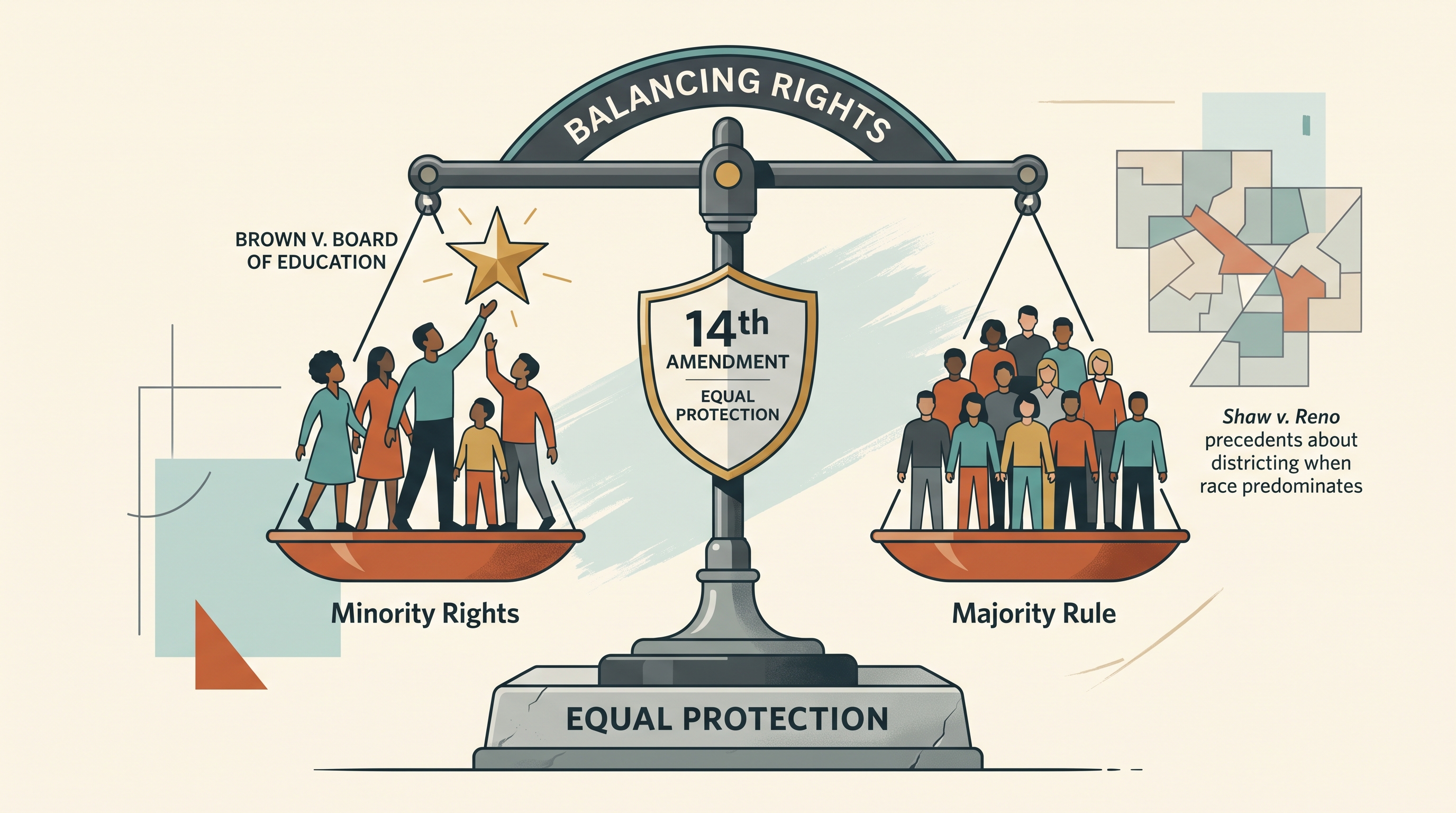
A constitutional democracy must solve a difficult problem: How can government protect a minority from majority rule without allowing race to determine political representation? The answer has changed across U.S. history. Government has sometimes restricted minority rights, sometimes expanded them, and sometimes limited race-conscious policies in the name of protecting the rights of the majority.
LO 3.12.A: Explain how the government has at times allowed the restriction of the civil rights of minority groups and at other times has protected those rights.
The Equal Protection Clause
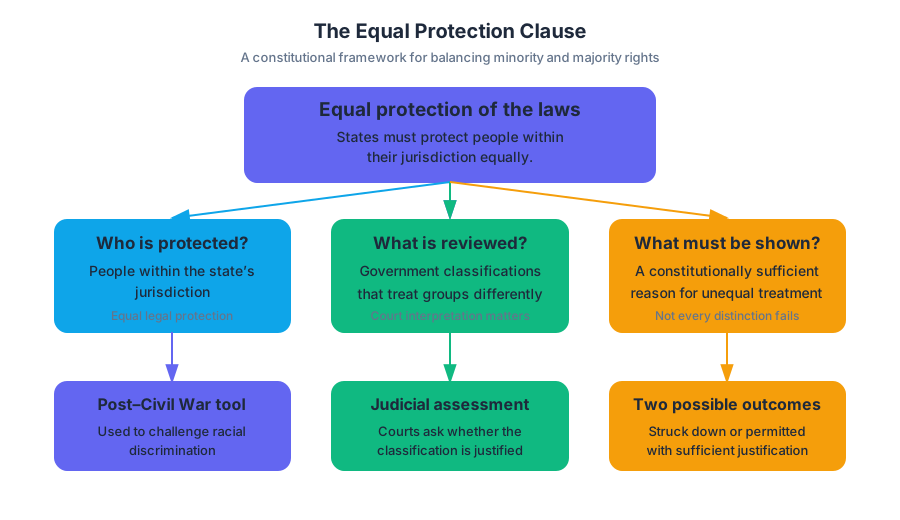
The Fourteenth Amendment’s Equal Protection Clause requires states to provide equal protection of the laws to people within their jurisdiction. In plain language, a state may not enforce laws in a way that denies a class of people equal legal protection without sufficient constitutional justification.
The clause became a constitutional tool for challenging racial discrimination after the Civil War. Its meaning, however, has depended on how courts interpreted government classifications: some classifications have been struck down as unconstitutional discrimination, while others have been permitted when the government offered a constitutionally sufficient reason.
From legalized segregation to constitutional protection
The government’s record is not a straight line toward equality. The Emancipation Proclamation freed enslaved people in the states rebelling against the United States, and the subsequent ratification of the Thirteenth Amendment permanently abolished slavery. These actions marked a major shift away from legally sanctioned racial subordination, but abolition did not immediately produce equal treatment in public institutions.
For decades, states and local governments maintained race-based school segregation and separated people in public facilities such as transportation, restaurants, and hotels. In Plessy v. Ferguson, the Supreme Court permitted racial segregation under the “separate but equal” doctrine. That decision illustrates how the Court can allow a restriction of minority rights even when the Constitution contains a promise of equality.
The Supreme Court later rejected that constitutional interpretation in Brown v. Board of Education. The Court held that state-sponsored racial segregation in public schools violated the Fourteenth Amendment’s Equal Protection Clause because separate schools were inherently unequal. The decision demonstrates the judiciary’s role in addressing school segregation: courts can invalidate state policies when those policies conflict with constitutional rights.
The constitutional conflict can be visualized as a change in the Court’s interpretation:
| Constitutional question | Earlier interpretation | Later interpretation |
|---|---|---|
| May a state separate students by race? | Plessy: Yes, if facilities are supposedly equal | Brown: No; state-enforced separation itself denies equality |
| Constitutional principle at issue | “Separate but equal” | Equal protection under the Fourteenth Amendment |
| Effect on minority rights | Permitted racial segregation | Protected students from government-imposed segregation |
When protecting majority rights limits race-conscious representation
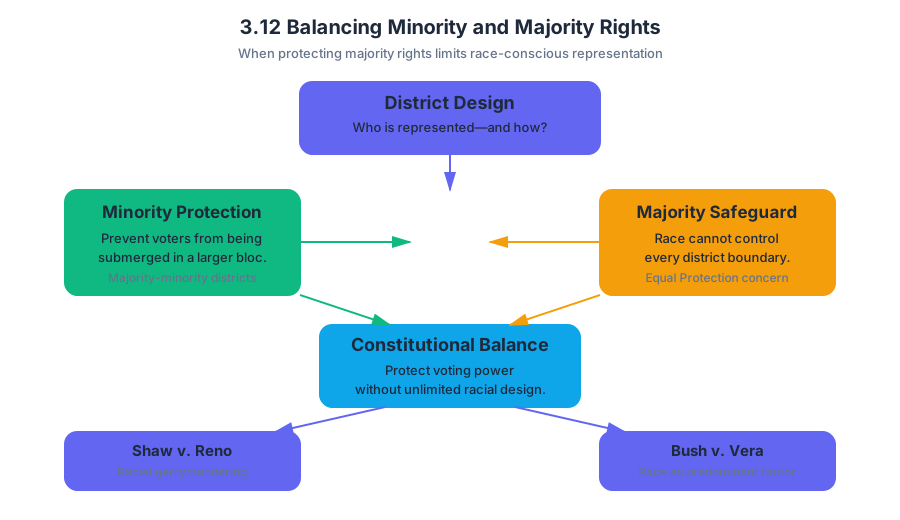
The Court has also upheld the rights of the majority in cases involving majority-minority districting—electoral districts drawn so that a racial or ethnic minority is likely to elect a preferred candidate. Such districts may be designed to prevent minority voters from being submerged within a larger voting population, but race cannot automatically become the controlling principle in drawing every district.
In Shaw v. Reno and Bush v. Vera, the Supreme Court addressed racial gerrymandering through the Equal Protection Clause. The central issue was not whether racial discrimination in schools was being challenged; it was whether the government had relied too heavily on race when designing legislative districts. The Court therefore recognized that a policy intended to help minority voters can still raise constitutional concerns if race is used as the predominant factor without adequate justification.
This creates an important distinction: protecting minority voting power is not identical to permitting unlimited race-based districting. A court may protect minority voters from discriminatory electoral arrangements while also limiting district designs that treat voters primarily as members of racial categories.
Misconception check
Misconception: “Equal protection always requires identical treatment.” Equal protection does not mean that every government policy must treat every person identically in every circumstance. It means that government classifications must satisfy constitutional standards, and racial classifications receive especially demanding judicial review. The constitutional question is whether the government’s classification and its purpose can be justified under the Equal Protection Clause.
Skill 2.C: SCOTUS Application
Skill 2.C: “Explain how the facts, issue, holding, reasoning, decision, and majority opinion of a required Supreme Court case compare to a non-required Supreme Court case.” A strong comparison identifies a shared constitutional principle and then explains the difference in application. For example, Brown v. Board of Education and Shaw v. Reno both involve the Equal Protection Clause, but Brown prohibited state-enforced racial school segregation, whereas Shaw limited the government’s use of race as the predominant factor in drawing electoral districts.
Retrieval check
A state assigns students to separate public schools solely by race. Which constitutional provision is most directly implicated, and which Supreme Court decision provides the strongest precedent against the policy? Answer: The Fourteenth Amendment’s Equal Protection Clause; Brown v. Board of Education. A districting plan designed to increase minority representation may still be challenged when race predominates in its design, as shown by Shaw v. Reno.
Source Materials
- AP U.S. Government and Politics Course and Exam Description
- Learn More (.pdf)
- AP U.S. Government and Politics Course Overview
- AP U.S. Government and Politics Course at a Glance
- AP United States Government and Politics Course at a Glance Poster
- AP United States Government and Politics
- AP United States Government and Politics
- United States Government and Politics Sample Syllabus 1