From the free course AP United States Government and Politics on Lykke
4.3 Changes in Ideology
Political ideology changes when people’s beliefs about government, society, and public policy shift across generations, across the life cycle, or in response to broad changes affecting an entire population.
4.3 Changes in Ideology
Political ideology changes when people’s beliefs about government, society, and public policy shift across generations, across the life cycle, or in response to broad changes affecting an entire population. The important question is not simply whether Americans are “more liberal” or “more conservative,” but which groups changed, in what direction, and over what period of time.
Learning Objective 4.3.A: Explain how political ideologies change over time.
Essential Knowledge 4.3.A.1: Political ideology can change because of generational differences, life-cycle effects, and period effects.
Three ways ideology changes
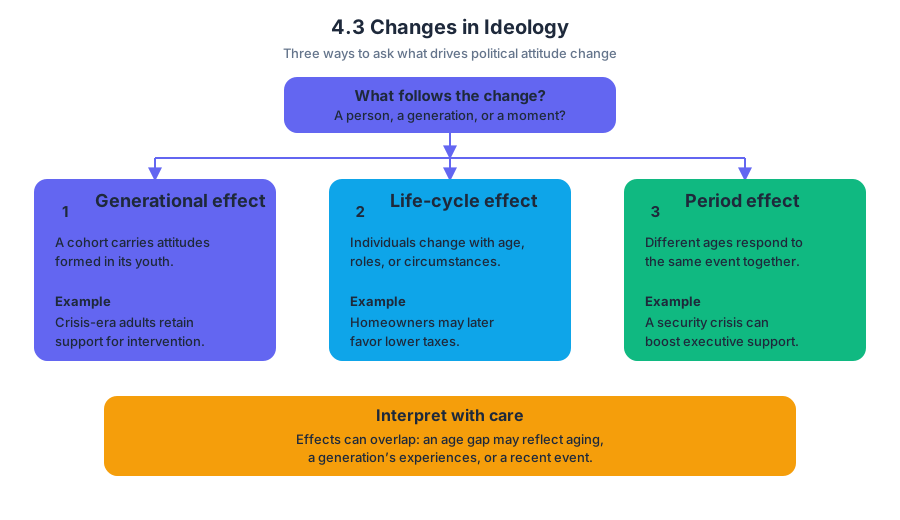
A useful way to separate these explanations is to ask whether the change follows a person, a generation, or a historical moment.
| Pattern | What changes? | Example |
|---|---|---|
| Generational effect | A group carries political attitudes formed during its formative years | People who came of age during a major economic crisis may retain stronger support for government economic intervention |
| Life-cycle effect | Individuals change as they age, take on new responsibilities, or experience new economic circumstances | A young adult may favor expanded public services, while later supporting lower taxes after becoming a homeowner or business owner |
| Period effect | People of different ages respond to the same event or condition at roughly the same time | A national security crisis may temporarily increase support for executive power across several age groups |
These effects can overlap. If older Americans are more likely than younger Americans to favor a particular policy, the difference might reflect aging, the distinctive experiences of that older generation, or the influence of a recent event. A single survey showing an age gap cannot automatically identify which explanation is correct.
What drives ideological change?
Political ideology is influenced by changing social and economic conditions. Shifts in racial and ethnic composition, education, religious affiliation, urbanization, family structure, income, and employment can alter the distribution of political attitudes. Political parties may also adapt their positions when the groups that form their coalitions change.
For example, suppose repeated national surveys show that younger respondents increasingly support government action on climate policy, while older respondents change very little. That pattern could indicate a generational difference, but it could also reflect differences in education, geographic residence, partisan identification, or exposure to environmental conditions. The evidence supports a description of the pattern before it supports an explanation of its cause.
Key distinction: A change in the public’s ideological distribution is not the same as a change in the ideology of every individual. The national average may move because existing groups change their views, because the measured population or survey sample changes, or because groups with different attitudes become larger or smaller.
Skill 3.B: Describe patterns and trends in data
Topic 4.3 is assessed through Skill 3.B: Describe patterns and trends in data. A strong response should identify the variables being compared, state the direction and size of the pattern when possible, compare groups or time periods, and avoid claiming that one variable caused another unless the evidence supports that conclusion.
Worked example: Imagine a survey reporting support for expanded public health programs:
- In 2005, support was $48%$ among adults ages $18$–$29$ and $44%$ among adults age $65$ and older.
- In 2025, support was $67%$ among adults ages $18$–$29$ and $51%$ among adults age $65$ and older.
The trend is that support increased in both groups, but the increase was larger among younger adults: $19$ percentage points compared with $7$ percentage points. The age gap therefore widened from $4$ percentage points to $16$ percentage points. A careful conclusion would say that support increased across both groups and increased more rapidly among younger adults; it would not conclude automatically that age caused the difference.
Misconception check: “Ideology changes only because people age”
Correction: Aging is only one possible explanation. A generation may retain attitudes formed during a distinctive historical period, or a major event may shift attitudes across the population. In addition, apparent survey changes may result from changes in who is included in the measured population or survey sample rather than from ideological conversion by individuals.
Another misconception is that political ideology moves permanently in one direction. In reality, attitudes can change unevenly: the public may become more supportive of government involvement in one policy area while becoming more skeptical of government authority in another. Ideology is multidimensional, so “liberal” and “conservative” labels do not predict every individual’s position on every issue.
Retrieval check
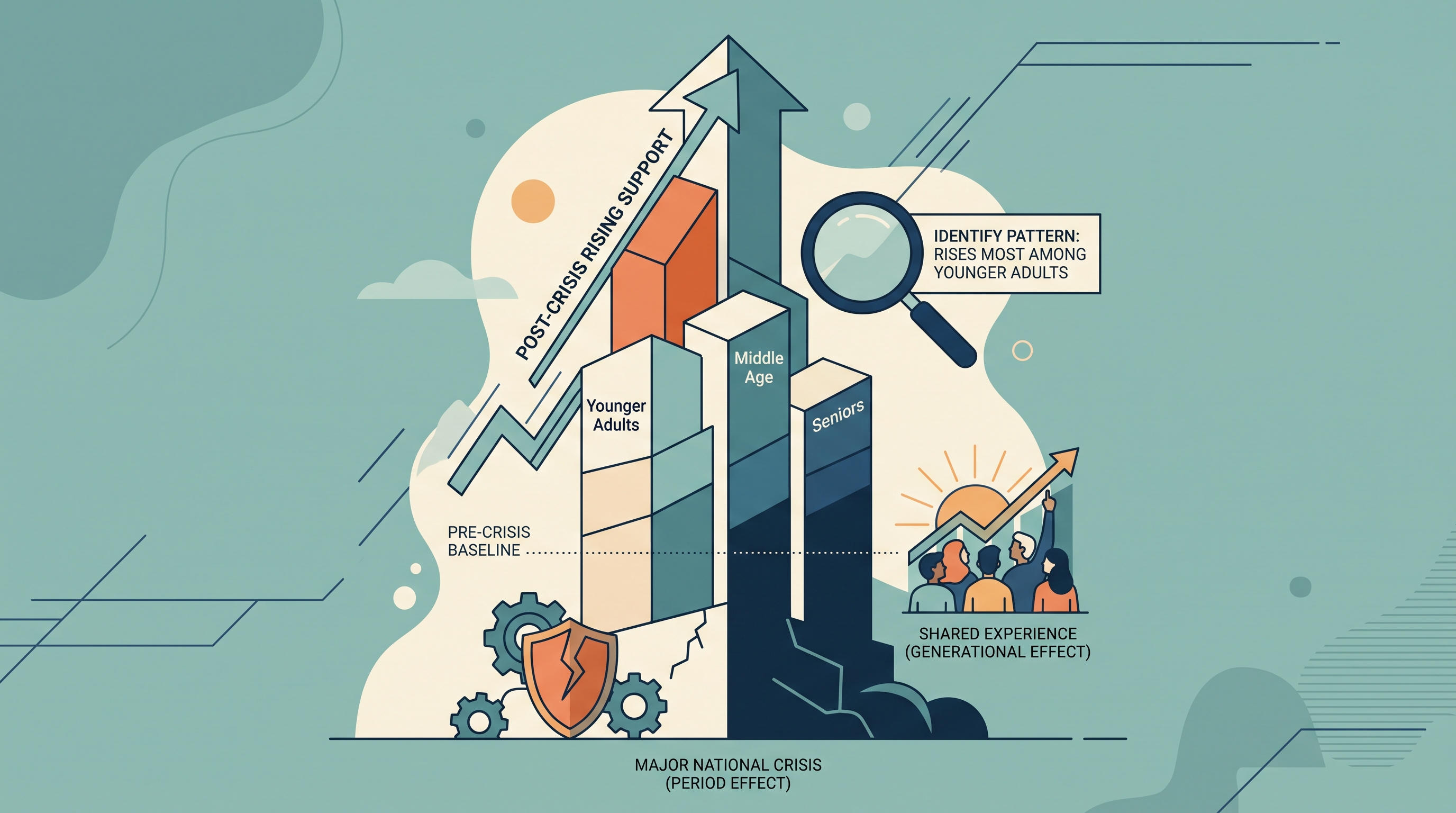
A survey finds that support for a policy rises among every age group after a major national crisis, but rises most among younger adults. Identify one period effect, one possible generational effect, and the data pattern that Skill 3.B: Describe patterns and trends in data requires you to report before making a causal claim.
Source Materials
- AP U.S. Government and Politics Course and Exam Description
- Learn More (.pdf)
- AP U.S. Government and Politics Course Overview
- AP U.S. Government and Politics Course at a Glance
- AP United States Government and Politics Course at a Glance Poster
- AP United States Government and Politics
- AP United States Government and Politics
- United States Government and Politics Sample Syllabus 1