From the free course AP United States Government and Politics on Lykke
2.8 The Judicial Branch
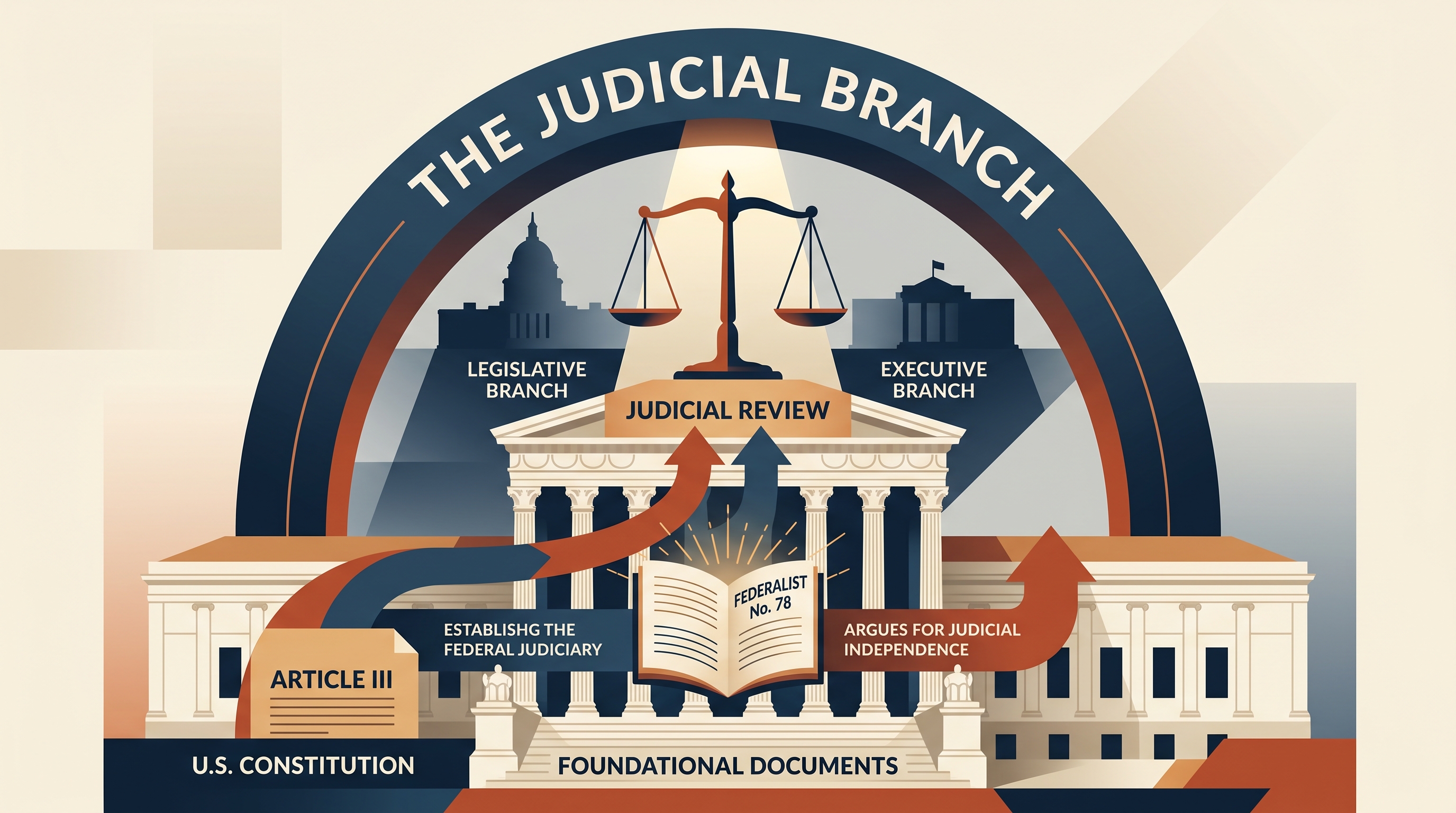
A law can pass Congress, receive presidential approval, and still be refused by the courts if it conflicts with the Constitution. That power—judicial review, the authority of courts to determine whether government action is constitutional—is the judiciary’s central check on the legislative and executive branches.
LO 2.8.A: Explain the principle of judicial review and how it checks the power of other branches.
The constitutional foundation: Article III
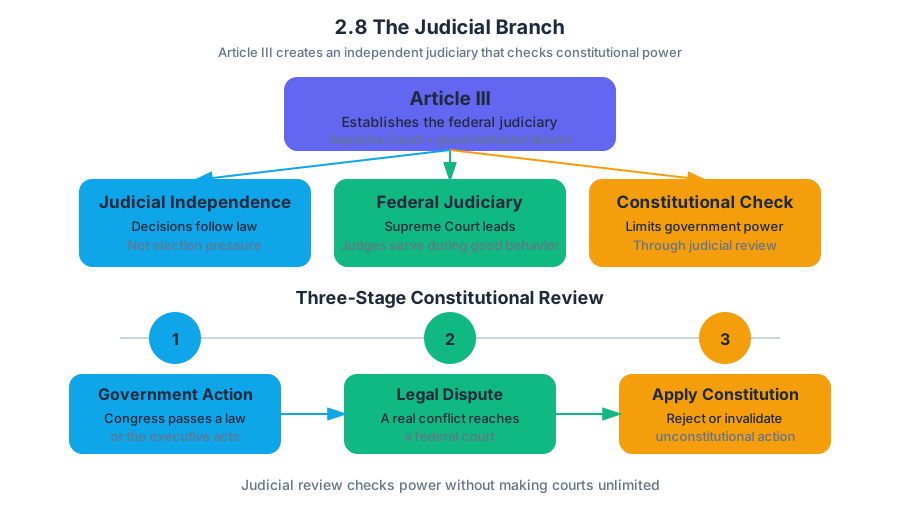
Article III of the Constitution establishes the judicial branch of the national government. It creates a federal judiciary headed by the Supreme Court and gives federal judges an important protection: they serve during “good behavior,” effectively giving them tenure that is not tied to election cycles.
This arrangement supports judicial independence, meaning that judges can decide cases without needing to satisfy voters, party leaders, or the president in order to remain in office. Independence does not mean that courts are unlimited or unaccountable; it means that decisions should be based on constitutional and legal reasoning rather than direct political pressure.
The constitutional checking relationship can be represented as a three-stage test:
- Congress or the president takes action. Congress passes a statute, or the executive branch enforces a policy.
- A constitutional conflict reaches a federal court. Courts generally evaluate government action through an actual legal dispute rather than issuing abstract advice.
- The court applies the Constitution. If the action conflicts with the Constitution, the judiciary may refuse to enforce it or invalidate the law as unconstitutional.
Judicial review therefore checks power by placing constitutional limits above ordinary government decisions. A majority in Congress cannot make an unconstitutional act valid merely by voting for it, and presidential enforcement cannot rescue a policy that violates constitutional protections.
Federalist No. 78: why an independent judiciary can check power
Federalist No. 78 provides the argument for why judicial independence helps preserve limited government. The judiciary is not elected in the same way as the legislative and executive branches, and federal judges hold office for life during good behavior. These features make courts less directly dependent on temporary popular or partisan pressures.
The point is not that judges should govern instead of elected officials. Rather, the judiciary acts as an interpreter and defender of the Constitution when ordinary political actors exceed their authority. Judicial review makes the Constitution an enforceable limit, not merely a statement of ideals.
Key distinction: Judicial review gives courts power to judge the constitutionality of government actions; judicial independence helps courts exercise that power without direct electoral retaliation.
Worked example: checking congressional power
Imagine that Congress passes a law allowing federal investigators to search every person’s private digital messages without a warrant or individualized suspicion. The president directs executive agencies to enforce the law, and an affected person challenges the search in federal court.
The court would reason through the dispute rather than simply asking whether the policy is popular:
| Step | Constitutional reasoning |
|---|---|
| Government action | Congress enacted the statute, and the executive branch began enforcing it. |
| Legal challenge | A person whose messages were searched claims that the law violates constitutional protections. |
| Judicial review | The court compares the statute and its enforcement with the Constitution. |
| Possible check | If the law is unconstitutional, the court can block its application to the plaintiff or invalidate the conflicting provision. |
The example shows why the branches interact rather than operate in isolation. Congress makes laws, the president executes them, and the judiciary determines whether the challenged action fits within constitutional boundaries. The court is not replacing the legislature’s policy judgment; it is enforcing the higher legal authority of the Constitution.
Misconception check: “Judicial review makes the Supreme Court more powerful than Congress”
Misconception: Because courts can invalidate laws, the Supreme Court is constitutionally superior to the elected branches in every respect.
Correction: Judicial review is a check, not a general power to create policy. Courts decide legal disputes within the judicial function, while Congress legislates and the president administers the laws. Judicial independence limits political control over judges, but the judiciary still depends on the other branches for implementation, funding, appointments, and compliance with decisions.
AP skill in action: SCOTUS Application 2.B
SCOTUS Application 2.B: Explain how a required Supreme Court case relates to a foundational document or to other primary or secondary sources.
For Topic 2.8, the strongest source connection is between a required Supreme Court case involving judicial review and the foundational documents Article III and Federalist No. 78. A complete explanation must do more than name the documents: it should connect Article III’s creation and protection of the federal judiciary to Federalist No. 78’s argument that an independent judiciary can restrain unconstitutional actions by the other branches.
Retrieval check: A student writes, “Article III establishes the judicial branch, while Federalist No. 78 explains why judges’ independence and life tenure allow courts to use judicial review to preserve limited government.” What makes this stronger than simply writing “the judiciary checks Congress”?
Answer: It identifies two specific pieces of evidence and explains their relationship to the claim: Article III supplies the constitutional foundation, while Federalist No. 78 explains how judicial independence enables the check.
Source Materials
- AP U.S. Government and Politics Course and Exam Description
- Learn More (.pdf)
- AP U.S. Government and Politics Course Overview
- AP U.S. Government and Politics Course at a Glance
- AP United States Government and Politics Course at a Glance Poster
- AP United States Government and Politics
- AP United States Government and Politics
- United States Government and Politics Sample Syllabus 1