From the free course AP United States Government and Politics on Lykke
3.8 Amendments: Due Process and the Rights of the Accused
Key concepts: Due process of law · Procedural due process · Fifth Amendment protections · Fourteenth Amendment protections · Life, liberty, and property rights · Incorporation of the Bill of Rights · Rights of the accused · Government limits on state regulation of civil liberties · Public safety exception to Miranda warnings · Limits on bulk collection of telecommunications metadata
Government cannot lawfully take a person’s life, liberty, or property simply because an official says so. Due process of law requires both constitutional authority and fair, nonarbitrary procedures before the government acts against a protected interest.
3.8 Amendments: Due Process and the Rights of the Accused
Government cannot lawfully take a person’s life, liberty, or property simply because an official says so. Due process of law requires both constitutional authority and fair, nonarbitrary procedures before the government acts against a protected interest.
LO 3.8.A — Explain the extent to which the government is limited by procedural due process from infringing upon individual rights.
The constitutional promise: fair government action
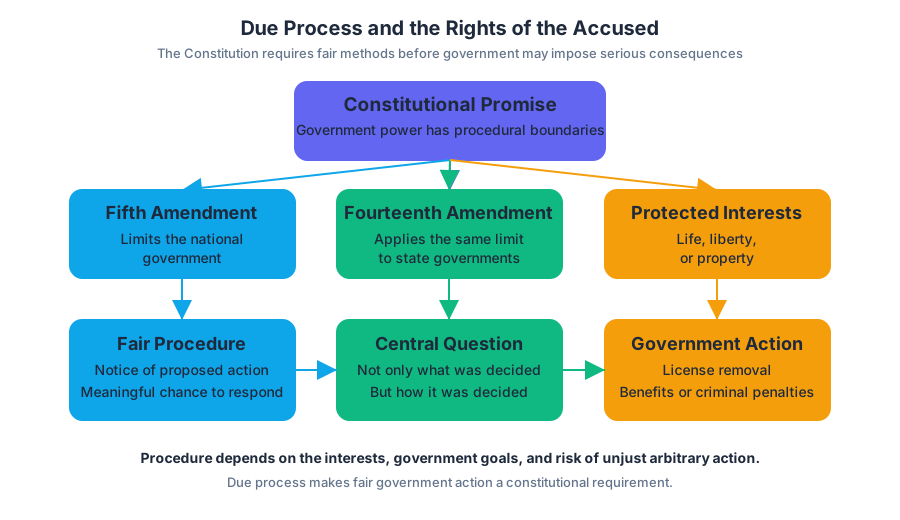
The Fifth Amendment limits the national government: it may not deprive a person of “life, liberty, or property, without due process of law.” The Fourteenth Amendment applies the same basic limitation to state governments. Together, these clauses establish that government power has procedural boundaries even when officials pursue legitimate public goals.
Procedural due process means that government officials must use methods that are not arbitrary when making and carrying out decisions affecting constitutionally protected interests. The central question is not only what the government decided, but also how it reached and implemented that decision.
A person’s protected interest may be concrete, such as physical property, or personal, such as liberty. For example, before the government removes a professional license, terminates a public benefit, or imposes a criminal penalty, due process may require notice of the proposed action and a meaningful opportunity to respond. The exact procedure depends on the government interest, the individual interest, and the risk that an arbitrary decision would produce an unjust result.
EK 3.8.A.1 — The Fifth and Fourteenth Amendments include clauses stating that the government may not infringe upon a person’s right to life, liberty, or property without due process of law.
Due process does not make every government action unconstitutional
Due process is a limitation on arbitrary methods, not an absolute ban on restricting individual rights. Government interests can justify restrictions when officials act through constitutionally acceptable procedures. Speech, for instance, may be limited when it presents a demonstrated danger to public safety; the government must still justify the restriction and apply its rules fairly rather than targeting people without a legitimate basis.
Common misconception: “Due process means the government can never restrict liberty.”
Correction: Due process requires lawful and fair procedures. It does not guarantee that every person will win a hearing or avoid every restriction.
Procedural protections for the accused
Procedural protections for accused people are reinforced by other provisions of the Bill of Rights and by Supreme Court doctrines. Miranda is a related constitutional protection, but it should not be treated as identical to procedural due process. Miranda warnings primarily implement the Fifth Amendment privilege against self-incrimination by requiring police to inform a person in custody, before custodial interrogation, of the right to remain silent and the right to an attorney.
The Sixth Amendment right to counsel is distinct. It protects the accused after formal criminal charges have begun and concerns the assistance of counsel in the prosecution. Thus, an AP response should distinguish the two doctrines: Miranda concerns warnings before custodial interrogation; the Sixth Amendment right to counsel attaches in the charged criminal case.
When state police give Miranda warnings, the result reflects incorporation of the Fifth Amendment protection against compelled self-incrimination through the Fourteenth Amendment. That application limits state as well as national officials, but Miranda protections are not absolute. The Supreme Court has recognized a public safety exception: in an urgent situation involving an immediate threat, some unwarned questioning may produce statements admissible in court when officers reasonably seek information needed to protect the public.
National security and limits on information gathering
Due process debates also arise when government gathers information in the name of security. The Patriot Act expanded federal investigative tools after the September 11 attacks, including authority related to telecommunications metadata. The USA Freedom Act later placed limitations on the government’s bulk collection of that metadata, illustrating how Congress can revise the scope of executive and intelligence authority.
These laws demonstrate the recurring constitutional tension between individual liberty and public safety. A strong analysis does not simply label one side “constitutional” and the other “unconstitutional”; it identifies the protected interest, the government’s purpose, the procedure used, and the legal limit placed on official power.
Worked application
Scenario: State officers arrest a person suspected of possessing explosives. Before giving Miranda warnings, officers ask where the explosives are because a crowded transit station may be at risk. The person answers, and prosecutors seek to use the statement.
Reasoning: The Fifth Amendment protects against compelled self-incrimination, and Miranda ordinarily requires warnings before custodial interrogation. However, the immediate threat to public safety may fit the recognized exception. The best conclusion is qualified: the statement may be admissible if the questioning was reasonably directed at neutralizing an urgent danger, but the exception does not create unlimited authority to interrogate without warnings.
AP skill connections
This topic most directly develops Concept Application, especially CON-1, by applying due process, protected interests, and government limitations to a new scenario. It also develops SCOTUS Application, especially SCOTUS-1, by explaining how Supreme Court doctrine distinguishes Miranda, the Sixth Amendment right to counsel, and the public safety exception.
A response can also require Source Analysis, especially SOUR-1, when a court opinion, statute, or constitutional passage supplies the evidence. Argumentation, especially ARG-1, matters when defending an extent claim: identify the constitutional rule, apply the facts, acknowledge the government’s competing interest, and reach a qualified conclusion.
Retrieval check
A state agency cancels a person’s license without notice, hearing, or explanation. Which constitutional principle is most directly implicated, and why does the answer differ from saying that the agency may never cancel the license?
Answer: Procedural due process is implicated because the agency used potentially arbitrary methods to affect a protected liberty or property interest. Due process does not necessarily prevent cancellation; it generally requires lawful, fair procedures such as notice and an opportunity to respond.

Source Materials
- AP U.S. Government and Politics Course and Exam Description
- Learn More (.pdf)
- AP U.S. Government and Politics Course Overview
- AP U.S. Government and Politics Course at a Glance
- AP United States Government and Politics Course at a Glance Poster
- AP United States Government and Politics
- AP United States Government and Politics
- United States Government and Politics Sample Syllabus 1