From the free course AP United States Government and Politics on Lykke
5.5 Third-Party Politics
Key concepts: Third-party candidates · Major-party dominance · Electoral competition · Vote splitting · Spoiler effect · Issue advocacy · Party adaptation · Influence on election outcomes
A candidate can lose an election while helping determine who wins it. Third-party candidates run outside the two major U.S. parties, and although they rarely win national elections, they can reshape electoral competition by attracting votes, changing the issues major parties discuss, and sometimes acting as spoilers.
5.5 Third-Party Politics
A candidate can lose an election while helping determine who wins it. Third-party candidates run outside the two major U.S. parties, and although they rarely win national elections, they can reshape electoral competition by attracting votes, changing the issues major parties discuss, and sometimes acting as spoilers.
Learning Objective LO 5.5.A: Explain how structural barriers affect third-party and independent candidate success.
The central puzzle is that third-party candidates may have meaningful political influence without winning office. The U.S. electoral system makes national victory difficult, but it does not make third-party campaigns irrelevant.
Why the U.S. system favors two major parties
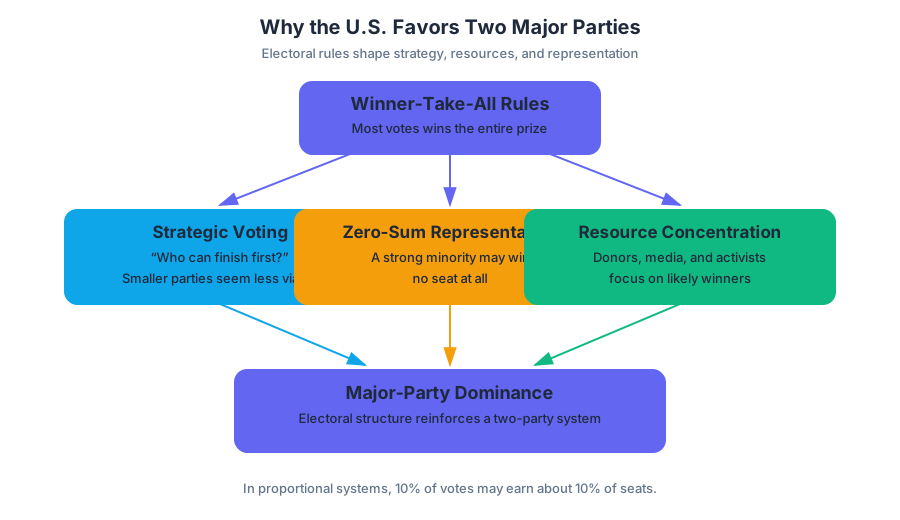
Essential Knowledge EK 5.5.A.1: In comparison to proportional systems, winner-take-all voting districts serve as a structural barrier to third-party and independent candidate success. Winner-take-all voting advantages the two-party system in the U.S.
A winner-take-all system awards the available electoral prize to the candidate who receives the most votes, even if that candidate does not receive a majority. By contrast, a proportional system distributes representation roughly according to each party’s share of the vote. A party that earns $10%$ of the vote in a proportional system may receive about $10%$ of the seats; in a winner-take-all system, it may receive no seat at all.
In a winner-take-all system, voters often make a strategic calculation: Which candidate can actually finish first? Supporting a third-party candidate may express a genuine preference, but it may also seem unlikely to produce representation. This discourages voters from supporting smaller parties and makes donors, media organizations, and political activists more likely to concentrate on the two major parties.
Major-party dominance therefore results not only from voter preferences but also from electoral rules. Ballot-access requirements, debate standards, fundraising networks, and the distribution of electoral votes can reinforce the same pattern: the two major parties receive the greatest resources, while third-party and independent candidates must overcome larger organizational barriers.
Worked example: the spoiler effect
Imagine a winner-take-all presidential contest with three candidates:
| Candidate | Vote share |
|---|---|
| Major Party A | $46%$ |
| Major Party B | $44%$ |
| Third Party C | $10%$ |
Candidate A wins because $46%$ is the largest share. Now suppose Candidate C’s supporters were generally closer to Candidate B on the central issue. If Candidate C had not run, some of those $10%$ of voters might have supported Candidate B. Candidate B could then have received more than Candidate A and won the state’s entire winner-take-all electoral reward.
A spoiler effect occurs when a third-party candidate draws enough support from one major-party candidate’s likely voters to alter the election outcome. The third-party candidate does not need to win; splitting the vote can be enough. Vote splitting means that support for similar candidates is divided, allowing a different candidate with a larger single bloc of support to prevail.
The spoiler analysis must remain conditional. A third-party candidate’s presence does not automatically cause a major-party loss. To establish a spoiler effect, an analyst must connect the third-party vote to the margin between the major-party candidates and explain how a different distribution of those votes could change the result.
Influence without winning
Essential Knowledge EK 5.5.A.2: The incorporation of third-party agendas into platforms of major political parties serves as a barrier to third-party and independent candidate success.
Third parties can practice issue advocacy: using a campaign to bring public attention to an issue, even when winning office is unlikely. If a third-party candidate makes an issue electorally visible, a major party may later adopt part or all of that candidate’s position to attract those voters.
This creates a political paradox. A third party may succeed at changing the policy conversation, but that success can reduce its future electoral distinctiveness. Once a major party incorporates the third party’s agenda into its platform, voters may choose the major party because it appears more capable of winning. The third party’s ideas gain visibility while the third party itself loses some of its reason for existing as a separate electoral choice.
Misconception check
Misconception: “If a third-party candidate does not win, the campaign had no effect.” The candidate may influence the election by splitting votes, force major parties to address neglected issues, or encourage a major party to revise its platform. Electoral success and political influence are different outcomes.
Skill connection — Data Analysis 3.D: Explain what the data implies or illustrates about political principles, institutions, processes, policies, and behaviors.
For a data question, do more than identify that a third-party candidate received votes. Explain the political implication: a noticeable third-party vote in a close winner-take-all contest may illustrate a potential spoiler effect, while strong support in a noncompetitive contest may show issue advocacy without clear evidence that the third party changed the winner.
Retrieval check: In a winner-take-all election, Candidate A receives $48%$, Candidate B receives $45%$, and Candidate C receives $7%$. What additional evidence would be needed to argue that Candidate C acted as a spoiler, rather than merely participating in the election?

Source Materials
- AP U.S. Government and Politics Course and Exam Description
- Learn More (.pdf)
- AP U.S. Government and Politics Course Overview
- AP U.S. Government and Politics Course at a Glance
- AP United States Government and Politics Course at a Glance Poster
- AP United States Government and Politics
- AP United States Government and Politics
- United States Government and Politics Sample Syllabus 1