From the free course AP United States Government and Politics on Lykke
4.9 Ideology and Economic Policy
Economic policy asks a practical question with competing answers: How much should government shape the economy, and by what means? A proposal to raise the minimum wage, expand public health insurance, reduce business regulation, or cut taxes is never only a technical decision; it reflects beliefs about equality,…
4.9 Ideology and Economic Policy
Economic policy asks a practical question with competing answers: How much should government shape the economy, and by what means? A proposal to raise the minimum wage, expand public health insurance, reduce business regulation, or cut taxes is never only a technical decision; it reflects beliefs about equality, individual responsibility, economic freedom, and the proper role of government.
4.9.A — Explain how ideologies of Democrats and Republicans influence economic policies.
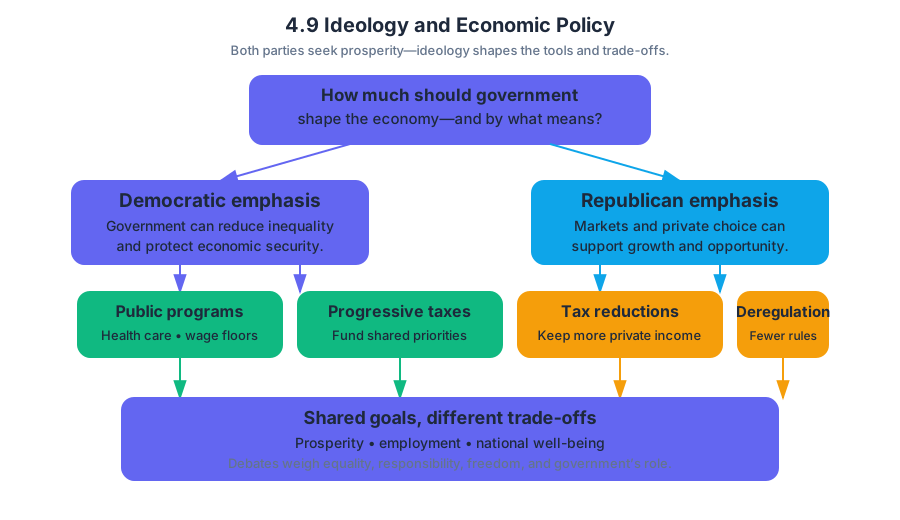
The central distinction is not that one party supports “the economy” and the other does not. Both major parties claim to promote prosperity, employment, and national well-being. They usually differ over the tools government should use, the amount of government involvement considered legitimate, and which economic costs or inequalities are most acceptable.
The ideological divide over the economy
Liberal economic ideology generally supports a more active government role in managing economic conditions and reducing inequality. Common liberal policy preferences include progressive taxation, public spending on social programs, stronger labor protections, consumer and environmental regulation, and government action intended to address unemployment or economic insecurity.
Conservative economic ideology generally places greater emphasis on free enterprise, private property, individual responsibility, and limited government intervention. Common conservative policy preferences include lower taxes, reduced regulation, restrained government spending, and policies intended to encourage private investment and market competition.
These are tendencies, not mathematical laws. Democrats and Republicans contain internal factions, and elected officials may change positions in response to voters, economic conditions, interest groups, party coalitions, or regional concerns. The labels describe broad ideological patterns rather than guarantees about every individual politician.
| Economic question | Liberal tendency | Conservative tendency |
|---|---|---|
| Taxation | More progressive taxation; higher-income individuals may pay a larger share | Lower overall tax burdens; concern that high taxes may reduce investment |
| Regulation | Stronger rules for workers, consumers, financial institutions, and the environment | Fewer or less costly regulations; concern about effects on business activity |
| Social welfare | Larger public programs to reduce poverty and economic insecurity | More limited programs, often emphasizing work, private charity, or state responsibility |
| Government spending | Public investment may be used to address needs or stimulate demand | Spending restraint and reduced deficits are emphasized |
| Economic freedom | Freedom is balanced against unequal resources and market power | Freedom is closely associated with voluntary exchange and limited government |
| Inequality | Government should more actively reduce major economic disparities | Differences in outcomes may be acceptable if opportunities and rules are fair |
The comparison is best understood as a debate over trade-offs. A regulation may protect workers or consumers but increase costs for businesses. A tax cut may encourage investment or leave the government with less revenue for public services. A welfare program may reduce hardship but also raise questions about cost, eligibility, and incentives to work.
Worked example: choosing an economic response
Imagine that a state faces rising housing costs and stagnant wages. One proposal would create a publicly funded housing-assistance program financed through higher taxes on high-income households. Another would reduce regulations on housing construction and offer tax credits to private developers.
The first proposal reflects a more liberal approach: government directly addresses economic insecurity, uses progressive taxation, and treats unequal access to housing as a problem requiring public intervention. The second reflects a more conservative approach: government attempts to expand supply through market incentives and fewer restrictions, while avoiding a large new public program.
Neither ideological description alone proves which policy will work best. An AP response should connect the policy instrument to the ideology: higher taxes and direct assistance indicate a preference for active government redistribution; deregulation and private-sector incentives indicate a preference for market-based solutions.
Why economic conditions can shift policy preferences
Ideological commitments interact with economic indicators. Policymakers may debate how to respond to unemployment, inflation, economic growth, poverty, or income inequality. For example, increased public spending may be defended as a way to support demand during a downturn, while critics may argue that spending increases inflation or expands the national debt.
The same policy can therefore be evaluated through different ideological priorities. A progressive tax may be viewed as a method of funding public goods and reducing inequality, or as a burden that discourages investment. Government regulation may be viewed as necessary protection against unsafe practices, or as an obstacle to innovation and competition.
Common misconception check
Misconception: “Democrats always support higher taxes and Republicans always oppose them.” The more accurate claim is that Democrats are generally more likely to support progressive taxation and government-funded programs, while Republicans are generally more likely to favor lower taxes and limited spending. Specific proposals, fiscal conditions, and party factions can produce exceptions.
AP skill connection
This topic most directly develops Skill 1: Concept Application, especially 1.A, applying economic-ideology concepts to a new policy scenario. It also uses Skill 3: Data Analysis, particularly 3.A and 3.B, when students identify economic trends and explain what a graph or table suggests; Skill 4: Source Analysis, especially 4.A and 4.B, when interpreting a party platform or political statement; and Skill 5: Argumentation, including 5.A and 5.B, when making and supporting a defensible claim about how ideology shaped a policy choice. Skill 2: SCOTUS Application is less central here unless an economic-policy dispute requires applying a relevant constitutional principle or Supreme Court decision.
Retrieval check
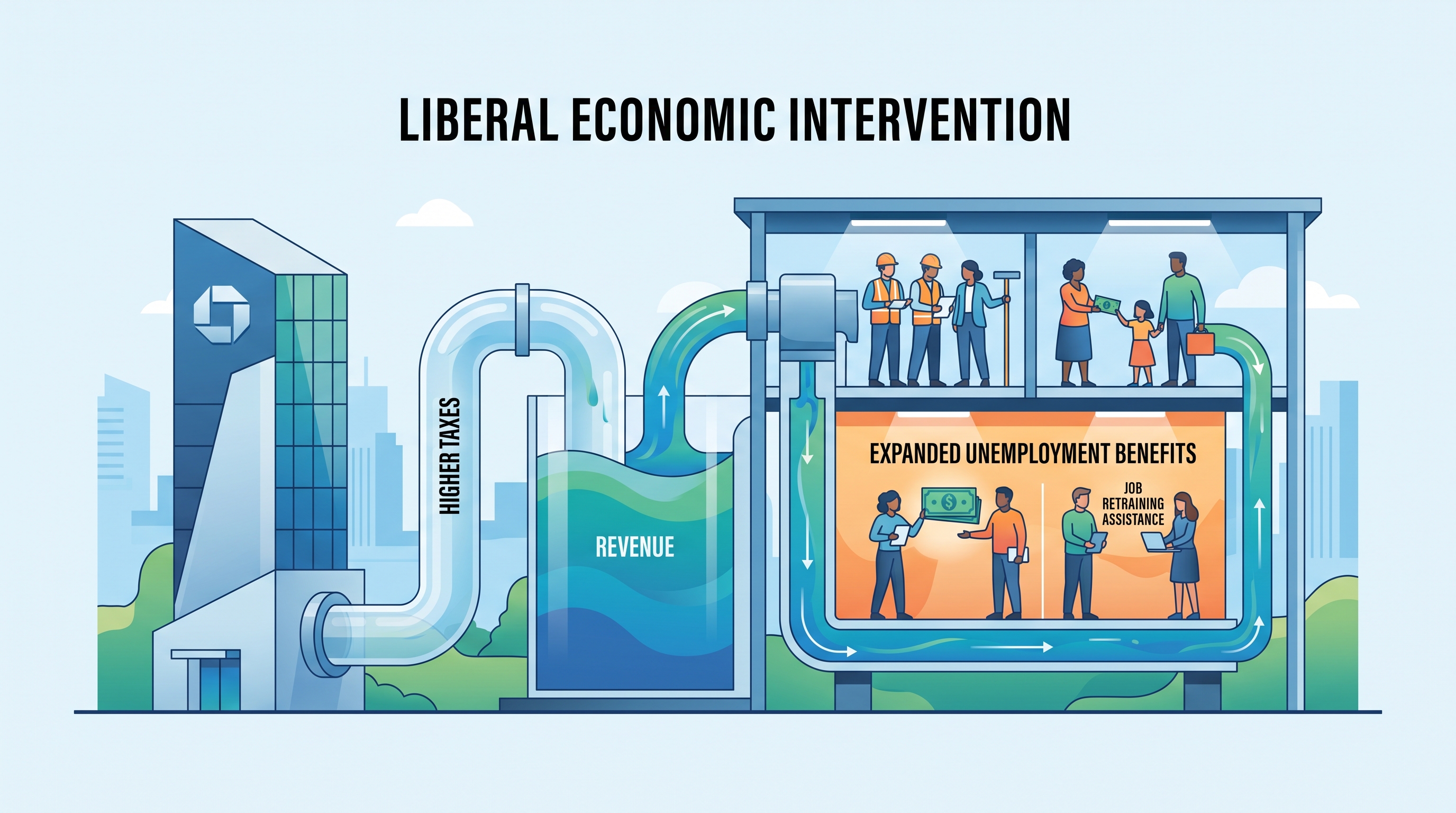
A government proposes a higher tax on corporations and uses the revenue to expand unemployment benefits. Which ideological position does the proposal most closely reflect, and what two policy features support your answer?
Answer: It most closely reflects a liberal economic approach because it combines greater government involvement through expanded social welfare with increased taxation to fund that intervention.
Source Materials
- AP U.S. Government and Politics Course and Exam Description
- Learn More (.pdf)
- AP U.S. Government and Politics Course Overview
- AP U.S. Government and Politics Course at a Glance
- AP United States Government and Politics Course at a Glance Poster
- AP United States Government and Politics
- AP United States Government and Politics
- United States Government and Politics Sample Syllabus 1