From the free course AP United States Government and Politics on Lykke
1.9 Federalism in Action
Key concepts: legitimacy · the accused · policy
Federalism turns public policy into a shared job: the national government may set broad goals, while state and local governments often decide how those goals operate in daily life.
1.9 Federalism in Action
Federalism turns public policy into a shared job: the national government may set broad goals, while state and local governments often decide how those goals operate in daily life. That arrangement can make policy more responsive—but it can also produce unequal results, political conflict, and questions about legitimacy, meaning whether people view governmental authority and its decisions as rightful, lawful, and worthy of acceptance.
Learning Objective 1.9.A — Explain how federalism affects public policy.
Essential Knowledge 1.9.A.1: Federalism divides governmental authority among the national, state, and local governments, allowing each level to participate in policymaking and implementation.
Essential Knowledge 1.9.A.2: The national government influences state policy through tools such as grants, mandates, and conditions attached to federal funding.
Essential Knowledge 1.9.A.3: States can act as policy laboratories by testing different approaches to shared problems.
From constitutional structure to actual policy
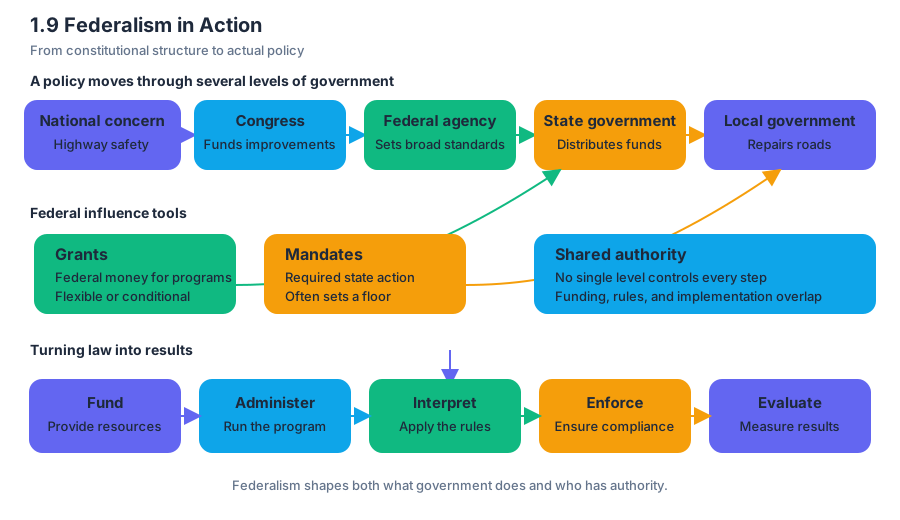
A policy is not simply an idea written into law. It must be funded, administered, interpreted, enforced, and evaluated. In a federal system, those tasks may be distributed across several levels of government.
For example, Congress might identify a national concern such as highway safety and provide money for improvements. A federal agency could establish broad standards, a state transportation department could distribute funds, and counties or cities could repair roads or redesign dangerous intersections. Federalism therefore affects both what government does and who has authority over each step.
The national government can influence state policy in several ways:
- Grants provide federal money for state or local programs. A grant may be relatively flexible, or it may require recipients to meet specific conditions.
- Mandates require state or local governments to take an action. An unfunded mandate can create tension when the national government orders a policy but supplies little or no money to carry it out.
- Preemption occurs when valid federal law displaces conflicting state law. In that situation, a state cannot use its own policy to override national authority within the federal government’s constitutional power.
Worked example: a coordinated safety policy
Imagine that Congress creates a program to reduce pedestrian deaths. The federal government offers transportation grants to states that adopt minimum road-design standards, collect crash data, and publish annual safety reports. State governments choose which roads receive priority, while local governments carry out construction and enforcement.
The arrangement may produce different results. State A uses the money to install raised crosswalks near schools; State B expands lighting and traffic-calming measures downtown; State C spends most of the grant on data collection before construction begins. These differences illustrate state experimentation, but they may also create unequal safety protections for residents in different states.
Now apply legitimacy. The policy is more likely to be viewed as legitimate when authority is transparent—people understand which government made which decision; implementation is accountable—officials can be questioned about delays or spending; treatment is reasonably equal—similar communities are not arbitrarily denied protection; and the policy is publicly accepted because residents see a lawful process and credible evidence behind it. Legitimacy weakens if federal officials impose unclear conditions, state agencies distribute funds secretly, or local leaders enforce standards selectively.
Policy laboratories: innovation with a trade-off
Federalism allows states to function as policy laboratories: governments can test different solutions before a broader adoption. One state may expand a public-health service, another may rely on tax incentives, and a third may combine private and public providers. Policymakers can compare outcomes and revise ineffective approaches.
The laboratory metaphor has a limit. Residents are not experimental subjects who can freely relocate whenever a policy fails. State-by-state variation may encourage innovation, but it can also mean that access to safety, education, health care, or legal protections depends heavily on geography. Federal standards and funding can reduce those disparities; state autonomy can preserve local choice.
Skill connection: reasoning from a policy dispute
This topic is especially suited to Concept Application (SP1): identify the federalism principle in a new policy scenario and connect it to a concrete governmental action. It also uses Source Analysis (SP4) when a passage describes a grant, mandate, or conflict among governments, and Argumentation (SP5) when evaluating whether federal involvement improves policy outcomes or legitimacy. If a prompt presents a relevant Supreme Court dispute, SCOTUS Application (SP2) requires connecting the case’s constitutional principle to the new facts rather than merely naming the case.
Misconception check — “Federalism means the national government and states must work separately.” Federalism does not require isolation. Much modern policy uses cooperative federalism, in which national, state, and local officials share responsibility. The important question is not whether governments cooperate, but how constitutional authority, funding, implementation, and accountability are distributed.
Retrieval check: A federal safety grant requires every state to publish spending records, but states may choose different road-safety projects. Identify one way the grant influences state policy, one federalism benefit, and one possible legitimacy concern. A strong answer identifies the funding condition, explains experimentation or local responsiveness, and notes that opaque spending or unequal implementation could reduce public acceptance.
Source Materials
- AP U.S. Government and Politics Course and Exam Description
- Learn More (.pdf)
- AP U.S. Government and Politics Course Overview
- AP U.S. Government and Politics Course at a Glance
- AP United States Government and Politics Course at a Glance Poster
- AP United States Government and Politics
- AP United States Government and Politics
- United States Government and Politics Sample Syllabus 1