From the free course AP United States Government and Politics on Lykke
3.13 Affirmative Action
Affirmative action consists of policies intended to address the effects of past discrimination and expand opportunities for groups that have historically faced exclusion. The central constitutional question is not simply whether inequality exists, but whether—and how—the government may respond to it without…
3.13 Affirmative Action
Affirmative action consists of policies intended to address the effects of past discrimination and expand opportunities for groups that have historically faced exclusion. The central constitutional question is not simply whether inequality exists, but whether—and how—the government may respond to it without creating a new form of unequal treatment.
Investigative question: When does treating people differently promote equal opportunity, and when does it violate the Equal Protection Clause?
What affirmative action is designed to do
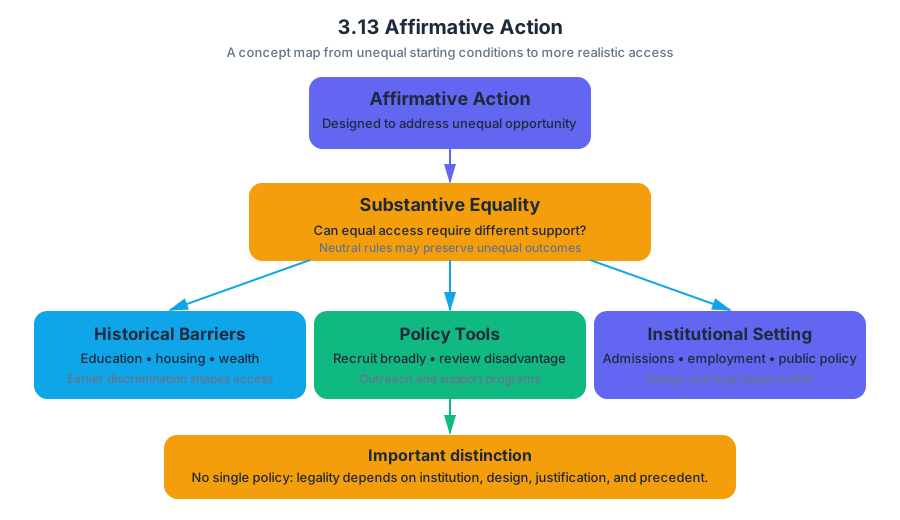
Formal equality means applying the same rule to everyone. Substantive equality asks whether people who begin from unequal historical conditions can realistically access the same opportunities. Affirmative action developed from the second concern: neutral rules may preserve unequal outcomes when earlier discrimination shaped access to education, employment, housing, wealth, or political influence.
A university, for example, might discover that its admissions process consistently excludes applicants from groups historically denied equal educational opportunities. An affirmative-action policy could respond by recruiting more broadly, reviewing socioeconomic disadvantage, supporting outreach programs, or—under earlier constitutional rules—considering race as one factor within an individualized admissions process.
Important distinction: affirmative action is not one single policy. Its legal status depends on the government institution, the policy’s design, the constitutional justification offered, and the relevant Supreme Court precedent.
Constitutional foundation: Equal Protection
The Fourteenth Amendment’s Equal Protection Clause requires states to provide equal protection of the laws. Through selective incorporation and constitutional interpretation, equal-protection principles also shape how governmental classifications are evaluated. A policy that treats people differently because of race receives especially demanding judicial review, commonly called strict scrutiny.
Under strict scrutiny, the government generally must show that a racial classification serves a compelling governmental interest and is narrowly tailored to achieve that interest.
This creates a constitutional tension. The government may argue that an affirmative-action policy remedies the continuing effects of discrimination or advances educational diversity. Opponents may argue that using racial classifications disadvantages individuals based on their racial identity and conflicts with the principle that government should treat citizens as individuals rather than as members of racial categories.
Supreme Court development
The Supreme Court’s affirmative-action decisions illustrate how constitutional interpretation changes as cases present different facts and legal arguments.
| Case | Constitutional significance |
|---|---|
| Regents of the University of California v. Bakke (1978) | The Court rejected a rigid racial quota in university admissions but allowed race to be considered as one factor in an individualized process. |
| Grutter v. Bollinger (2003) | The Court upheld a law-school admissions system that considered race in a holistic process designed to produce educational diversity, while rejecting mechanical point systems or fixed racial targets. |
| Fisher v. University of Texas (2016) | The Court applied demanding review to a race-conscious admissions policy and required the university to demonstrate that its approach was necessary to achieve its diversity objective. |
| Students for Fair Admissions v. Harvard (2023) | The Court held that the admissions programs challenged in the case violated the Equal Protection Clause, sharply limiting the use of race in college admissions. |
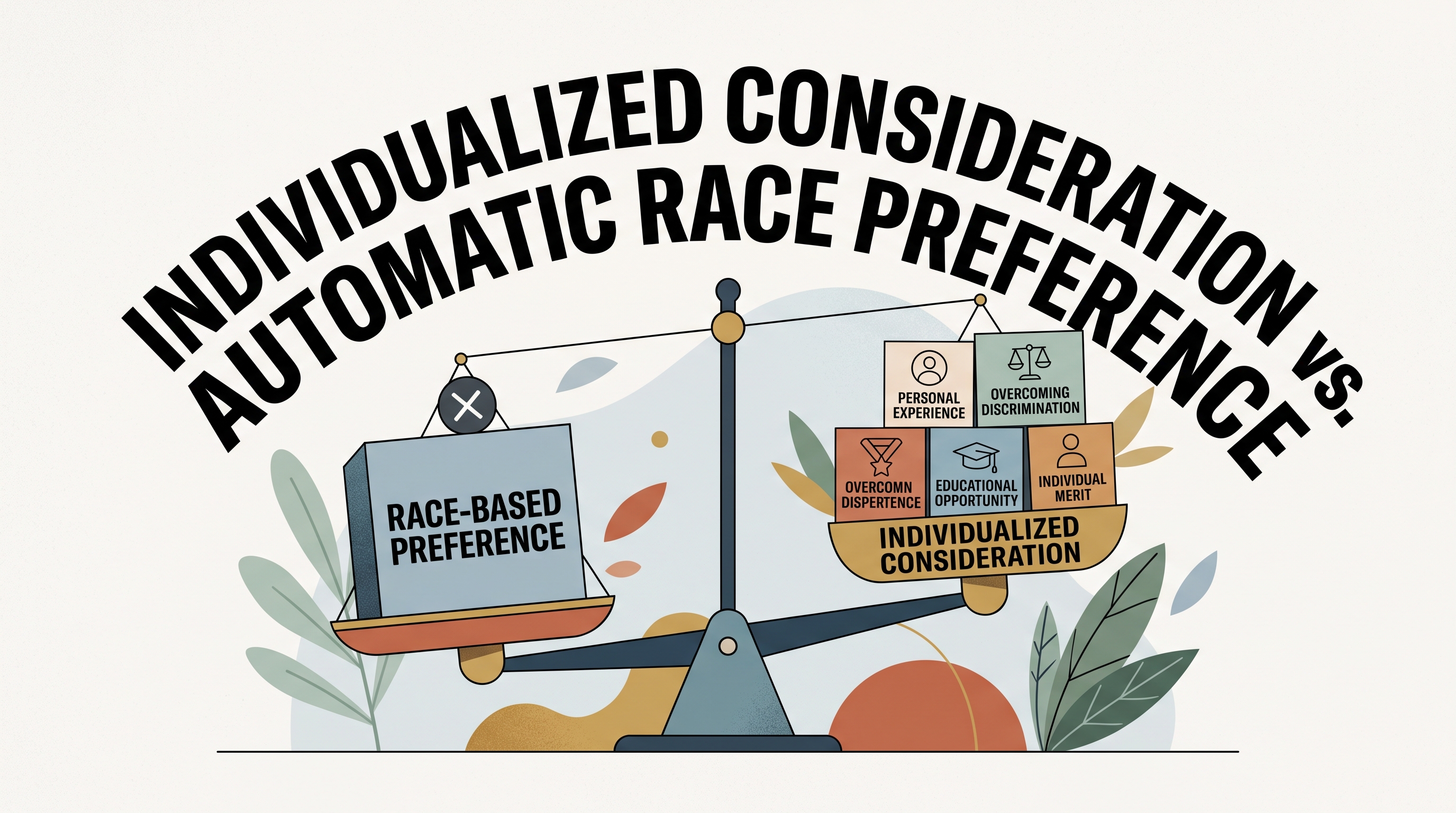
The practical lesson is that the Court has distinguished between individualized consideration and automatic racial formulas. More recent doctrine makes clear that colleges may not use race in the earlier broad manner approved by cases such as Grutter. Admissions officials may still consider an applicant’s experiences—including how race affected that person’s life—but they may not treat race itself as a positive or negative admissions factor.
Worked contextual example: evaluating an admissions policy
Suppose State University adopts this policy: “Applicants from Group A automatically receive ten additional admission points, and applicants from Group B automatically lose ten points.” The university says the policy will correct historical inequality.
Step 1: Identify the constitutional classification. The policy explicitly uses race, so it creates a racial classification.
Step 2: Identify the standard of review. Because race is a suspect classification, a court applies strict scrutiny rather than merely asking whether the policy is rational.
Step 3: Examine the policy’s structure. Automatic points treat applicants as members of racial groups rather than evaluating them individually. That design resembles a mechanical racial preference, not a narrowly tailored process.
Step 4: State the likely conclusion. The policy would face serious constitutional problems because its fixed points make race determinative and do not provide individualized review. A policy examining academic preparation, family income, neighborhood resources, educational obstacles, and personal experiences would use race-neutral criteria; a policy considering an applicant’s account of race-related experiences would need to avoid converting race into an automatic admissions advantage.
Misconception check
Misconception: “Affirmative action means lowering standards or admitting unqualified applicants.” That is not the constitutional definition. Affirmative-action disputes concern the criteria and procedures used to pursue equal opportunity, not an automatic assumption that beneficiaries lack merit.
Misconception: “Any policy designed to help a historically disadvantaged group is automatically constitutional.” Government purpose alone is insufficient. Courts examine the classification, governmental interest, evidence, and fit between the policy and its objective.
AP skill connection
Skill 1: Concept Application is central to Topic 3.13 Affirmative Action. To apply the concept, identify the policy’s governmental actor, the group classification, the constitutional principle involved, and the relevant Supreme Court standard. Then connect those features to a concrete conclusion rather than merely defining affirmative action.
A strong application might say: “Because the state university assigns automatic points based on race, the policy uses an explicit racial classification. Under Equal Protection analysis, that classification receives strict scrutiny, and the mechanical point system is unlikely to be narrowly tailored.” The answer earns strength from the chain fact → constitutional concept → legal standard → conclusion.
Retrieval check
A public university considers applicants individually and allows them to explain how racial discrimination affected their educational opportunities, but it does not award automatic points for racial identity. What constitutional distinction is the university attempting to preserve, and why did Students for Fair Admissions v. Harvard make that distinction especially important?
Answer: It is attempting to distinguish individualized consideration of an applicant’s experiences from treating race itself as an automatic admissions preference. Students for Fair Admissions v. Harvard sharply limited race-conscious admissions, making that distinction central to current Equal Protection analysis.
Source Materials
- AP U.S. Government and Politics Course and Exam Description
- Learn More (.pdf)
- AP U.S. Government and Politics Course Overview
- AP U.S. Government and Politics Course at a Glance
- AP United States Government and Politics Course at a Glance Poster
- AP United States Government and Politics
- AP United States Government and Politics
- United States Government and Politics Sample Syllabus 1