From the free course AP United States Government and Politics on Lykke
5.1 Voting Rights and Models of Voting Behavior
Voting is both a legal opportunity and a political decision: the Constitution and voting-rights legislation determine who may participate, while individual voters decide how to use that opportunity.
5.1 Voting Rights and Models of Voting Behavior
Voting is both a legal opportunity and a political decision: the Constitution and voting-rights legislation determine who may participate, while individual voters decide how to use that opportunity. LO 5.1.A asks you to explain how political participation is protected; LO 5.1.B asks you to describe models that explain voting behavior.
The legal expansion of voting rights
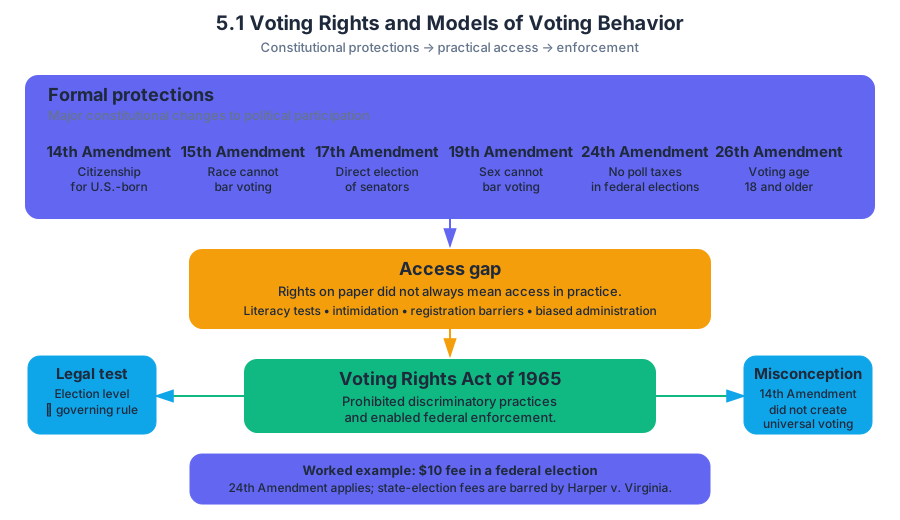
The American electorate expanded through constitutional amendments and federal legislation. EK 5.1.A.1 identifies the major constitutional protections:
| Amendment | Voting-rights significance |
|---|---|
| 14th Amendment | Granted citizenship to all persons born or naturalized in the United States, including formerly enslaved people. |
| 15th Amendment | Prohibited denying African American men the right to vote on the basis of race. |
| 17th Amendment | Established direct election of U.S. senators by the people rather than selection by state legislatures. |
| 19th Amendment | Prohibited denying women the right to vote on the basis of sex. |
| 24th Amendment | Eliminated poll taxes in federal elections. |
| 26th Amendment | Lowered the voting age to 18. |
These amendments changed the formal rules of political participation, but constitutional language alone did not always guarantee practical access. States and local governments used devices such as literacy tests, intimidation, registration barriers, and discriminatory administration to exclude eligible voters.
The Voting Rights Act of 1965 addressed this gap. It prohibited discriminatory voting practices and authorized federal enforcement to protect access to the ballot. In practical terms, the law gave the national government tools to challenge systems that appeared formally neutral but operated to deny minority citizens meaningful participation.
Worked legal example: Suppose a county requires a $10 fee before a citizen may vote in a federal election. That requirement conflicts with the 24th Amendment, which prohibits poll taxes in federal elections. If the same fee is imposed in a state election, the 24th Amendment does not directly govern that election; however, Harper v. Virginia Board of Elections held that poll taxes in state elections violate equal-protection principles. The key reasoning is to identify both the election level and the constitutional rule that applies.
Misconception check: The 14th Amendment did not itself create a universal voting right for every adult. It established citizenship and equal-protection principles. The voting-rights amendments address particular barriers, and legislation such as the Voting Rights Act strengthens enforcement.
Models of voting behavior
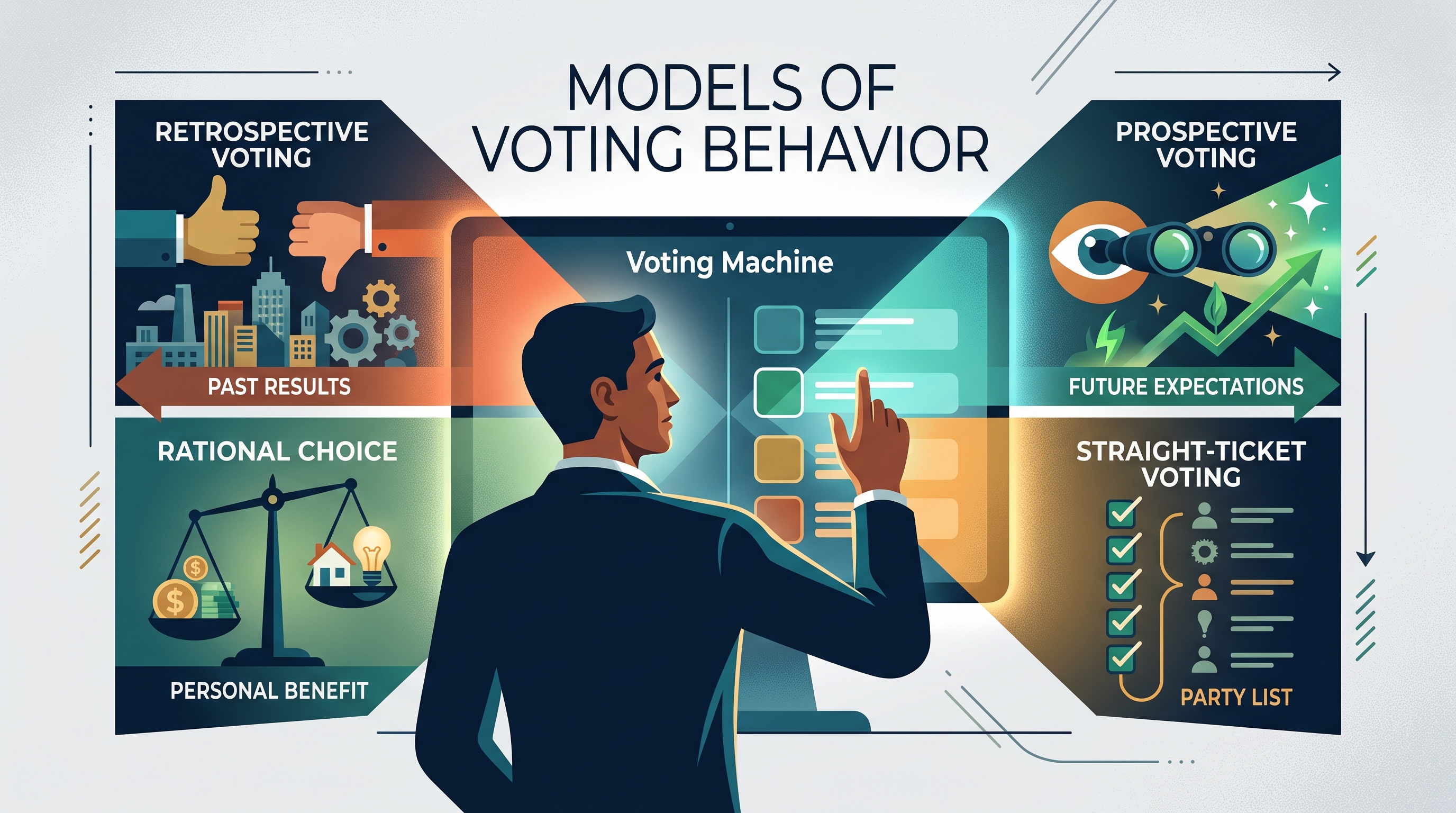
Legal eligibility answers who may vote. Voting models answer a different question: what considerations shape a voter’s choice? EK 5.1.B.1 identifies four models.
- Rational choice voting: Individuals choose the option they perceive as serving their best interest. A voter might support a candidate who promises lower transportation costs because that policy would directly benefit the voter’s household.
- Retrospective voting: Individuals judge a party or candidate in power by looking at the recent past. A voter may support reelection after observing strong economic performance or reject the incumbent after experiencing poor governmental results.
- Prospective voting: Individuals predict how a party or candidate will perform in the future. A voter may choose a challenger because the challenger’s proposed energy plan seems more likely to reduce future costs.
- Straight-ticket voting: Individuals vote for every candidate from one political party on the ballot.
These models can overlap. A voter might use retrospective reasoning to evaluate the incumbent’s record, prospective reasoning to compare future promises, and rational-choice reasoning to select whichever option appears most beneficial. Straight-ticket voting describes the pattern of choices across offices; it does not necessarily reveal whether the voter relied on past performance, future expectations, party loyalty, or perceived self-interest.
Worked scenario: identifying the model
Imagine that Jordan is voting in an election. Jordan says, “The current mayor failed to improve bus service, so I will not support the mayor’s party.” That is retrospective voting because Jordan evaluates recent past performance. Jordan then adds, “The challenger’s transportation proposal seems more realistic, so I expect better service next year.” That is prospective voting because the judgment rests on a prediction about future performance. If Jordan votes for every candidate from the challenger’s party, the ballot also demonstrates straight-ticket voting.
The strongest AP response names the model and connects it to the evidence. Merely saying “Jordan is voting based on transportation” is incomplete; the decisive clue is whether Jordan is evaluating the past, predicting the future, choosing perceived personal benefit, or selecting one party across the ballot.
Skill connection — Concept Application (1.D): When a scenario describes a voter, first locate the behavior in context. Then match the evidence to the precise model: past results indicate retrospective voting, future expectations indicate prospective voting, perceived personal advantage indicates rational choice voting, and voting for every candidate of one party indicates straight-ticket voting.
Retrieval check: A voter says, “My family’s taxes will be lower under Candidate A, so I support A,” and votes for Candidate A’s party in every contest. Which two models are illustrated, and what specific evidence supports each? The answer is rational choice voting because the voter emphasizes perceived personal benefit, and straight-ticket voting because the voter selects the same party across contests.
Source Materials
- AP U.S. Government and Politics Course and Exam Description
- Learn More (.pdf)
- AP U.S. Government and Politics Course Overview
- AP U.S. Government and Politics Course at a Glance
- AP United States Government and Politics Course at a Glance Poster
- AP United States Government and Politics
- AP United States Government and Politics
- United States Government and Politics Sample Syllabus 1
- AP US Gov Past Exam Questions — AP Central
- Khan Academy — AP US Government and Politics
- YouTube — Heimler's History
- YouTube — Jocz Productions