From the free course AP United States Government and Politics on Lykke
3.7 Selective Incorporation
Key concepts: Selective incorporation
The Bill of Rights originally restricted only the national government, but today most of its protections also limit state and local governments through the Fourteenth Amendment.
3.7 Selective Incorporation
The Bill of Rights originally restricted only the national government, but today most of its protections also limit state and local governments through the Fourteenth Amendment. The constitutional process that extended these protections one right at a time is called selective incorporation.
Selective incorporation is the gradual application of specific protections in the Bill of Rights to the states through the Fourteenth Amendment’s Due Process Clause.
The constitutional problem: two levels of government
The original Bill of Rights begins with restrictions directed at the federal government: Congress may not establish a religion, violate freedom of speech, conduct unreasonable searches, or deny other listed protections. For much of the nineteenth century, however, a state could violate those freedoms under its own laws unless its state constitution offered protection.
The Supreme Court made this distinction clear in Barron v. Baltimore (1833). John Barron argued that Baltimore had taken property without providing just compensation, violating the Fifth Amendment. The Court ruled that the Bill of Rights limited only the national government, not the states.
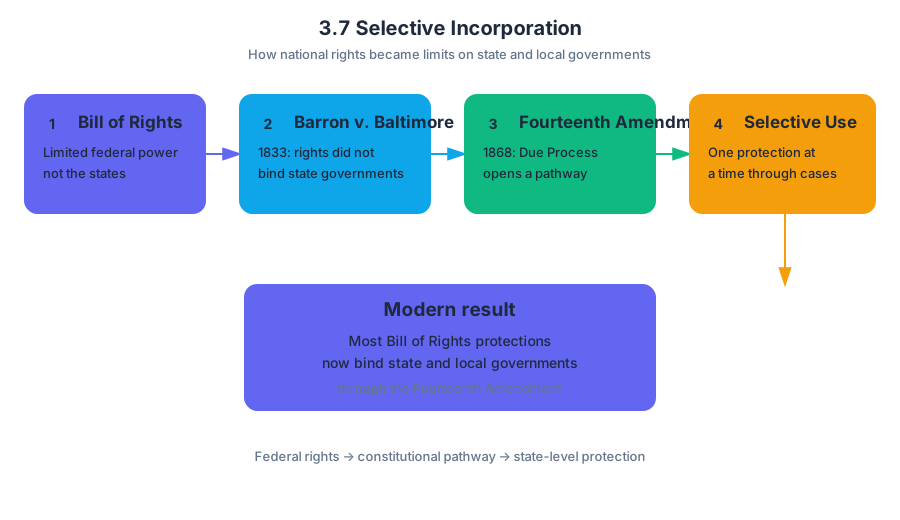
Visual sequence:
Bill of Rights → originally limited federal government only
Fourteenth Amendment, 1868 → Due Process Clause becomes a constitutional pathway
Supreme Court decisions → individual rights applied to states one protection at a time
Modern result → most Bill of Rights protections bind state and local governments
The Fourteenth Amendment changes the pathway
The Fourteenth Amendment prohibits states from depriving any person of life, liberty, or property without due process of law. The Supreme Court interpreted “liberty” to include certain fundamental freedoms protected by the Bill of Rights. When the Court determines that a particular freedom is fundamental and applies it to the states, that right has been incorporated.
The process is selective because the Court did not apply the entire Bill of Rights to the states in one decision. Instead, incorporation developed incrementally through individual cases. The First Amendment’s protection of speech, for example, was applied to the states in Gitlow v. New York (1925), while other rights were incorporated in later decisions.
Worked example: McDonald v. Chicago
Suppose Chicago prohibits residents from possessing handguns in their homes for self-defense. A resident argues that the restriction violates the Second Amendment, which the Supreme Court had interpreted in District of Columbia v. Heller (2008) as protecting an individual right to possess a firearm for lawful purposes such as self-defense in the home.
In McDonald v. Chicago (2010), the Supreme Court held that the Second Amendment right recognized in Heller applies to state and local governments through the Fourteenth Amendment. The reasoning has two steps:
- The Second Amendment protects an individual constitutional liberty.
- The Fourteenth Amendment’s Due Process Clause makes that fundamental liberty enforceable against the states.
The decision did not mean that every firearm regulation is unconstitutional. Incorporation answers the question which level of government must respect the right; it does not automatically answer whether a particular law is a permissible regulation of that right.
Incorporation is not total application
Most, but not all, protections in the Bill of Rights have been incorporated. Some provisions remain applicable only to the federal government, and some protections have been incorporated only partially. For example, incorporation of a right does not necessarily require states to use every federal procedure or remedy in exactly the same way.
| Question | What selective incorporation answers |
|---|---|
| Who must respect the right? | State and local governments, as well as the federal government |
| How does the right reach the states? | Through the Fourteenth Amendment |
| Does incorporation erase all regulation? | No. Courts may still permit reasonable constitutional limits |
| Did incorporation happen all at once? | No. Rights were applied through separate Supreme Court decisions |
Common misconception check
Misconception: “The Fourteenth Amendment automatically applied the entire Bill of Rights to the states.”
Correction: The Fourteenth Amendment supplied the constitutional basis for incorporation, but the Supreme Court decided the status of individual rights case by case. Barron represents the earlier nonincorporation rule; Gitlow and McDonald illustrate the later selective-incorporation approach.
AP skill connection
This topic most directly develops SCOTUS Application 2.A: Describe or explain the reasoning, decision, or significance of a Supreme Court case and SCOTUS Application 2.B: Explain how a Supreme Court decision relates to a political concept or issue. A strong response identifies the relevant constitutional provision, states what the Court decided, and connects that decision to selective incorporation rather than merely naming the case.
It also supports Concept Application 1.A: Define and explain political concepts and processes. In an argument, the key causal chain is: the Fourteenth Amendment’s Due Process Clause provides the route, the Supreme Court identifies a fundamental liberty, and the protection becomes enforceable against state and local governments.
Retrieval check
A state law restricts a freedom protected by the First Amendment. Which constitutional development allows a person to challenge that state law in federal court, and why is the process called selective incorporation?
Answer: The Fourteenth Amendment’s Due Process Clause allows the challenge because the Supreme Court has applied fundamental Bill of Rights protections to the states. It is called selective because the Court incorporated rights individually over time rather than applying every protection simultaneously.

Source Materials
- AP U.S. Government and Politics Course and Exam Description
- Learn More (.pdf)
- AP U.S. Government and Politics Course Overview
- AP U.S. Government and Politics Course at a Glance
- AP United States Government and Politics Course at a Glance Poster
- AP United States Government and Politics
- AP United States Government and Politics
- United States Government and Politics Sample Syllabus 1