From the free course AP United States Government and Politics on Lykke
AP Practice 6
A strong AP Government argument does not merely announce an opinion; it makes a defensible claim, supports that claim with precise evidence, and explains why the evidence proves the claim.
AP Practice 6
A strong AP Government argument does not merely announce an opinion; it makes a defensible claim, supports that claim with precise evidence, and explains why the evidence proves the claim. AP Practice 6 focuses on the free-response Argument Essay, the exam task that most directly measures Skill 5: Argumentation.
Argumentation means constructing a logical political argument in essay form using a defensible claim, relevant evidence, and reasoning that connects the evidence to the claim.
The argument essay at a glance
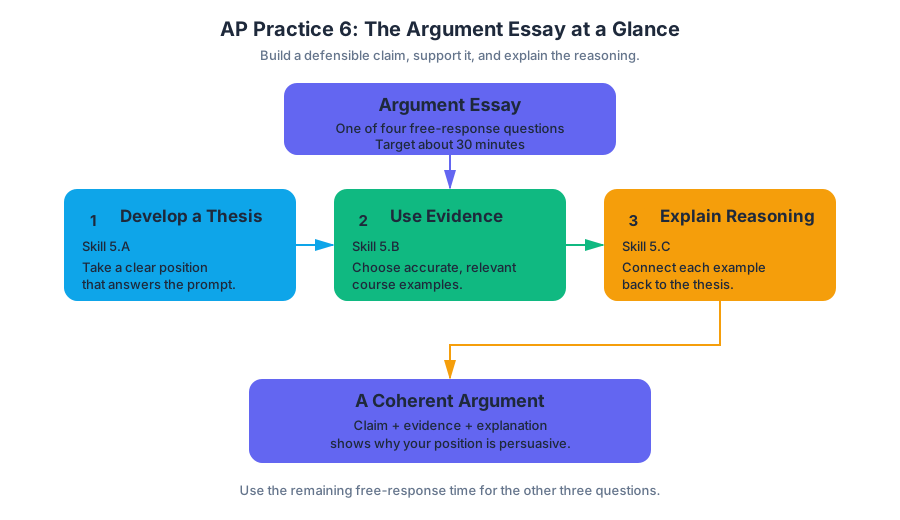
The Argument Essay is one of four free-response questions. The free-response section contains four questions and is completed in approximately $1$ hour and $40$ minutes. A practical target is about $30$ minutes for this task, leaving time for the other three questions.
| Required move | What the reader must see |
|---|---|
| Skill 5.A: Develop a thesis/claim | A clear position that directly answers the prompt |
| Skill 5.B: Support the argument using specific and relevant evidence | Accurate evidence from required foundational documents, required Supreme Court cases, course concepts, or political examples |
| Skill 5.C: Use reasoning to organize an argument and explain why evidence supports a claim | Explicit explanation connecting each piece of evidence to the thesis |
Original practice prompt
Prompt:
Some political scientists argue that divided government—the condition in which different political parties control the presidency and at least one chamber of Congress—protects democratic liberty. Others argue that divided government makes it harder for elected officials to respond to public problems.
Develop an argument that evaluates the extent to which divided government protects democratic liberty.
In your response:
- Present a defensible claim or thesis.
- Use at least two pieces of specific and relevant evidence.
- Use at least one required foundational document as evidence.
- Explain how your evidence supports your claim.
Step 1: Build a defensible thesis
A defensible thesis must do more than repeat the question. It should take a position and establish a line of reasoning. A useful structure is:
$$\text{Although } X,\ \text{divided government } Y\ \text{because } A \text{ and } B.$$
Worked thesis:
Although divided government can delay responses to national problems, it generally protects democratic liberty because competing institutions can check executive power and force public debate over major policy changes.
This thesis earns the argument’s central claim because it answers how far divided government protects liberty and identifies two reasons: checking executive power and forcing public debate. The concession strengthens the claim because it recognizes a legitimate counterargument without abandoning the position.
Step 2: Select evidence that does actual work
The best evidence is specific and connected to the reasoning. Possible evidence includes:
- Federalist No. 51: The Constitution divides power among institutions so that “ambition” can counteract ambition.
- Federalist No. 70: The executive needs energy, but that energy must operate within constitutional limits.
- Youngstown Sheet & Tube Co. v. Sawyer (1952): The Supreme Court rejected presidential seizure of private steel mills when the president lacked constitutional or statutory authority.
- Congressional oversight, appropriations restrictions, confirmation power, and the Senate’s role in approving treaties and executive appointments.
A response should not simply name Federalist No. 51. It must use the document’s idea. For example: Federalist No. 51 supports divided government because it explains that institutional ambition can restrain institutional ambition. When Congress is controlled by a different party, legislators have stronger incentives to investigate executive actions and limit presidential initiatives, making it more difficult for one branch to accumulate unchecked power.
Step 3: Explain the connection
The reasoning chain should be visible:
$$ \text{Divided party control} \rightarrow \text{greater institutional oversight} \rightarrow \text{fewer unchecked executive actions} \rightarrow \text{stronger protection for liberty} $$
For example, if a president attempts to use executive authority to implement a controversial policy, a Congress controlled by the opposition party may conduct hearings, restrict funding, refuse confirmation of nominees, or pass legislation limiting the policy. These actions do not automatically produce good policy, but they illustrate the constitutional principle that liberty is safer when power is divided and monitored.
A compact high-scoring outline
- Thesis: Divided government generally protects liberty by checking executive power, although it may slow policymaking.
- Evidence 1: Federalist No. 51—separated institutions restrain one another.
- Reasoning: Opposition-controlled Congress has incentives and tools to investigate and limit presidential action.
- Evidence 2: Youngstown Sheet & Tube Co. v. Sawyer—presidential power is limited when Congress has not authorized the action.
- Reasoning: Judicial and legislative checks prevent executive claims from becoming unlimited authority.
- Qualification: Gridlock can delay responses to emergencies, so divided government protects liberty more reliably than it promotes efficient policymaking.
Misconception check: “More checks always mean better government”
Misconception: Divided government automatically improves democracy.
Correction: Divided government can strengthen accountability and protect liberty, but it can also produce gridlock. The strongest argument distinguishes liberty from efficiency: a system may protect citizens from concentrated power while making policy change slower.
Timing and error review
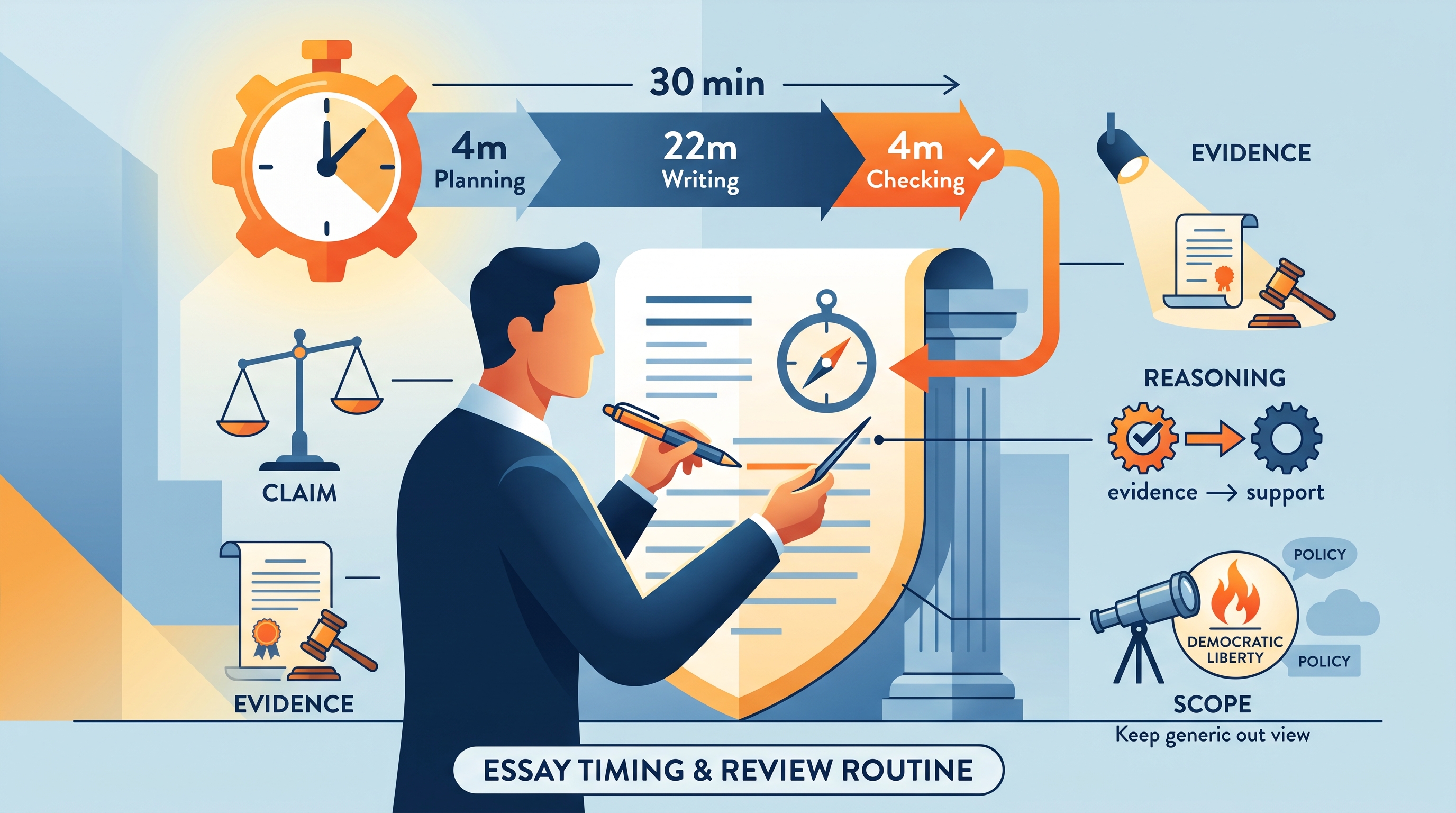
Spend about $4$ minutes planning, $22$ minutes writing, and $4$ minutes checking. During the final check, underline the thesis, circle each specific piece of evidence, and draw an arrow from each evidence sentence to the explanation showing why it supports the claim.
A useful error-review routine is:
- Claim error: Did I take a position rather than summarize both sides?
- Evidence error: Did I identify a specific document, case, institution, or political process?
- Reasoning error: Did I explain the causal or constitutional connection?
- Scope error: Did I answer the question about democratic liberty rather than drifting into general policy efficiency?
Retrieval check: If an essay names Federalist No. 51 but never explains how separated institutions protect liberty, which argumentation requirement is missing? The answer is Skill 5.C: Use reasoning to organize an argument and explain why evidence supports a claim.
Source Materials
- AP U.S. Government and Politics Course and Exam Description
- Learn More (.pdf)
- AP U.S. Government and Politics Course Overview
- AP U.S. Government and Politics Course at a Glance
- AP United States Government and Politics Course at a Glance Poster
- AP United States Government and Politics
- AP United States Government and Politics
- United States Government and Politics Sample Syllabus 1
- AP US Gov Past Exam Questions — AP Central
- Khan Academy — AP US Government and Politics
- YouTube — Heimler's History
- YouTube — Jocz Productions