From the free course AP United States Government and Politics on Lykke
1.2 Types of Democracy
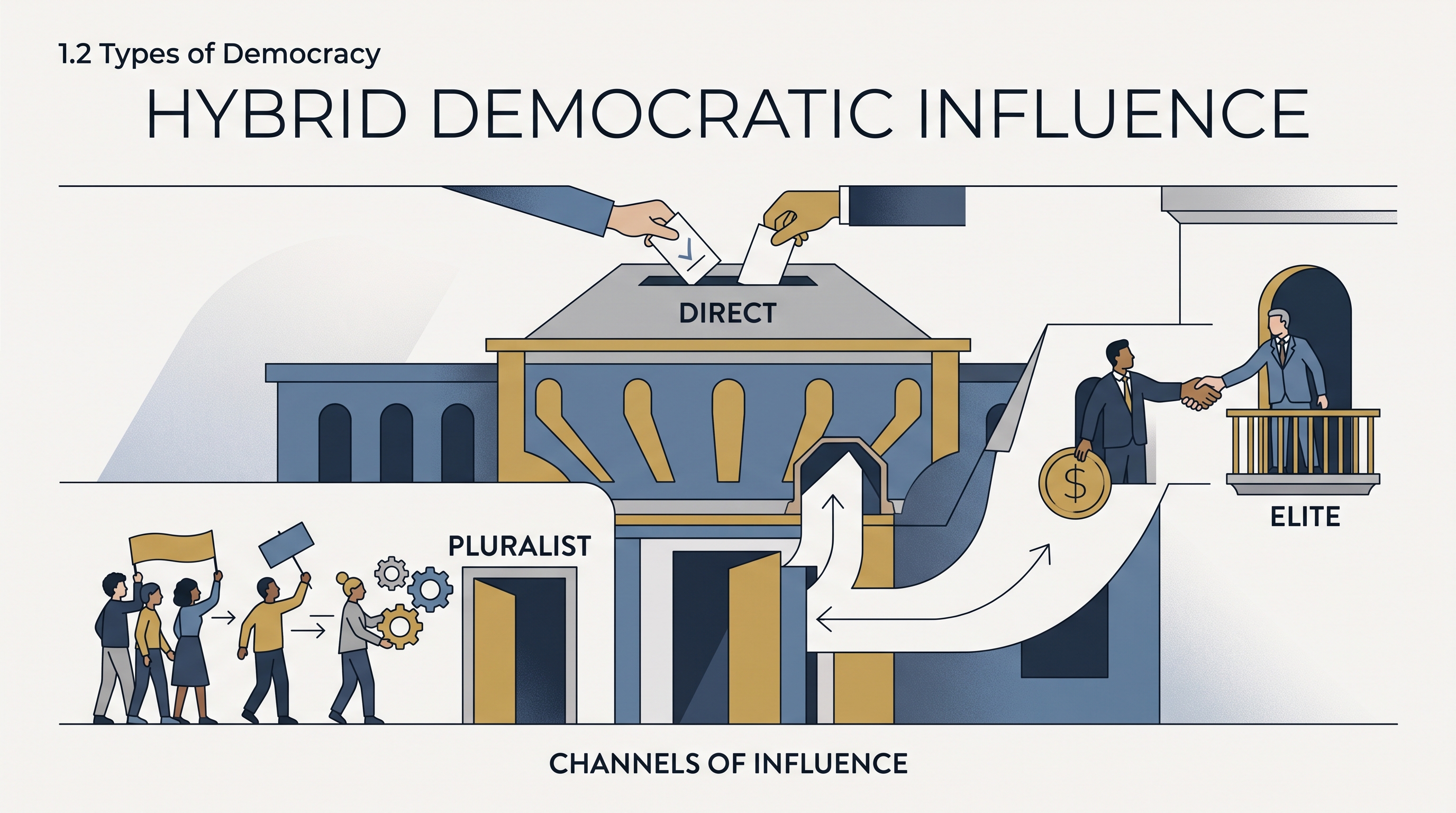
A democracy can ask citizens to govern in different ways: directly, through organized groups, or mainly through elected and influential leaders. The United States uses a representative democracy, but its institutions and political debates reflect three competing models: participatory democracy, pluralist democracy,…
1.2 Types of Democracy
A democracy can ask citizens to govern in different ways: directly, through organized groups, or mainly through elected and influential leaders. The United States uses a representative democracy, but its institutions and political debates reflect three competing models: participatory democracy, pluralist democracy, and elite democracy.
Investigative question: When citizens do not vote on every policy themselves, how can the government still be democratic?
The basic distinction: direct and representative democracy
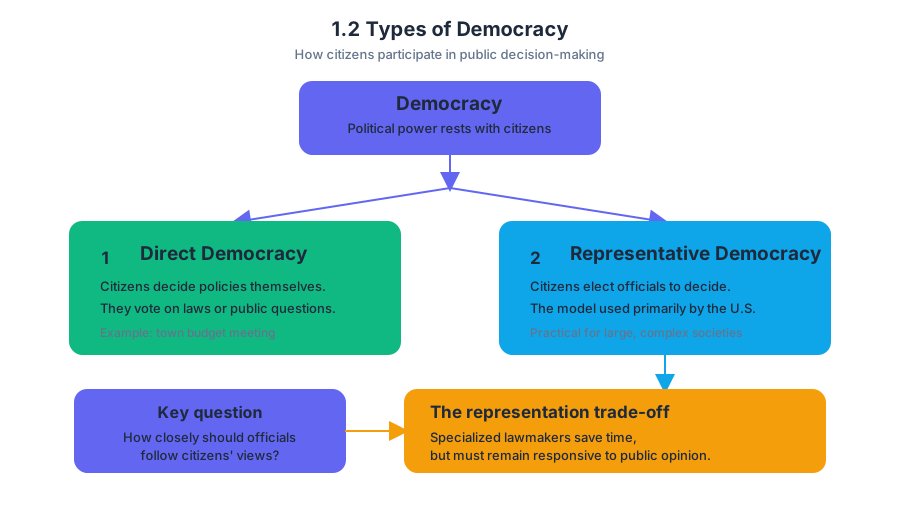
In a direct democracy, citizens make policy decisions themselves, usually by voting on laws or public questions. A small town using a meeting in which residents vote directly on a local budget is a limited example.
In a representative democracy, citizens choose officials who make public decisions on their behalf. The United States relies primarily on this model because its large population, geographic size, and complex policy agenda make direct decision-making on every issue impractical.
Representation creates a useful trade-off. Citizens gain officials with the time and specialized knowledge to write laws, but citizens must also decide how closely representatives should follow public opinion. That tension produces different models of representative democracy.
Three models of representative democracy
The models are not three separate constitutional systems. They are perspectives for explaining who participates, whose preferences receive attention, and how political decisions are made.
| Model | Central idea | Political activity it emphasizes | Illustrative example |
|---|---|---|---|
| Participatory democracy | Broad citizen involvement strengthens democratic government. | Voting, town halls, public meetings, petitions, protests, and civic organizing. | Residents organize and testify at a city meeting about a proposed development. |
| Pluralist democracy | Policy results from competition among many organized interests. | Interest-group advocacy, coalition building, lobbying, and bargaining. | Environmental, business, labor, and neighborhood groups compete to shape a regulation. |
| Elite democracy | A relatively small group of leaders and economically or politically powerful actors exercises disproportionate influence. | Leadership by elected officials, experts, major donors, executives, and other influential actors. | A policy debate is formally open to the public, but well-funded organizations have far greater access and policy expertise. |
Participatory democracy
Participatory democracy treats citizen involvement as valuable beyond simply selecting leaders. Participation can include voting, contacting representatives, attending public meetings, joining campaigns, organizing demonstrations, and discussing public issues with other citizens.
Its strength is political engagement: participation can make government more responsive and help citizens develop the knowledge and confidence needed for self-government. Its limitation is unequal participation. Public meetings and campaigns may attract citizens with more time, money, transportation, or specialized knowledge than the broader population.
Pluralist democracy
Pluralist democracy emphasizes organized groups rather than isolated individuals. Interest groups allow people with shared concerns—such as workers, businesses, patients, gun owners, environmental advocates, or professional associations—to combine resources and present their preferences to policymakers.
Pluralism can prevent one viewpoint from controlling every decision. However, groups do not possess equal resources. A large organization with professional lobbyists may communicate with policymakers more frequently than a loosely organized group whose members lack funding or access.
Elite democracy
Elite democracy focuses on the disproportionate influence of a small number of actors. “Elite” does not necessarily mean a secret conspiracy; it can refer to elected leaders, government officials, wealthy donors, corporate executives, policy experts, or organized interests with unusual access and resources.
This model draws attention to a central question: Does formal political equality produce equal political influence? Every citizen may have one vote, while some actors may have far greater ability to fund campaigns, hire experts, shape media attention, or obtain meetings with decision-makers.
Worked contextual example: a proposed transit policy
Imagine that a city is considering a new rail line. Under the participatory model, the key evidence would be residents attending hearings, submitting comments, voting in a referendum, and organizing neighborhood support or opposition.
Under the pluralist model, the analysis would track competition among groups: transit advocates, automobile associations, construction firms, neighborhood organizations, environmental groups, and taxpayers’ associations. The final policy would reflect bargaining among these organized interests.
Under the elite model, the analysis would ask whether major developers, wealthy donors, transportation consultants, or senior officials shaped the proposal more strongly than ordinary residents. The same event can therefore support different interpretations depending on which model is being applied.
Named misconception check
Misconception: “The United States is either participatory, pluralist, or elite.”
Correction: The models describe different ways of analyzing democratic politics. The United States is a representative democracy that contains participatory practices, pluralist competition, and unequal influence associated with elite democracy.
AP skill connection: Skill 4.A — Source Analysis
Topic 1.2 Types of Democracy is associated with Skill 4.A — Source Analysis. This skill requires identifying and interpreting an argument in a source rather than merely locating a familiar word.
For example, if a source argues that democracy works best when citizens organize in associations, connect that claim to pluralist democracy. If it argues that ordinary citizens must participate directly in public decisions, connect it to participatory democracy. If it emphasizes the power of wealthy or highly connected actors, connect it to elite democracy. The strongest response names the model and explains the source’s reasoning.
Retrieval check
A state allows voters to approve laws directly, several advocacy organizations lobby the legislature, and major donors receive frequent meetings with policymakers. Which model is illustrated by each feature, and why can all three exist within one representative democracy?
Source Materials
- AP U.S. Government and Politics Course and Exam Description
- Learn More (.pdf)
- AP U.S. Government and Politics Course Overview
- AP U.S. Government and Politics Course at a Glance
- AP United States Government and Politics Course at a Glance Poster
- AP United States Government and Politics
- AP United States Government and Politics
- United States Government and Politics Sample Syllabus 1