From the free course AP United States Government and Politics on Lykke
3.9 Amendments: Due Process and the Right to Privacy
Key concepts: Substantive due process · Procedural due process · The constitutional right to privacy · The Ninth Amendment and unenumerated rights · The Fourteenth Amendment’s Due Process and Equal Protection Clauses · Fourth Amendment protections against unreasonable searches and seizures · The exclusionary rule · Privacy in the digital age · Individual rights and government limits
Substantive due process asks whether the government has violated a fundamental liberty through an unjustified or arbitrary law, even when the government has followed formally correct procedures.
3.9 Amendments: Due Process and the Right to Privacy
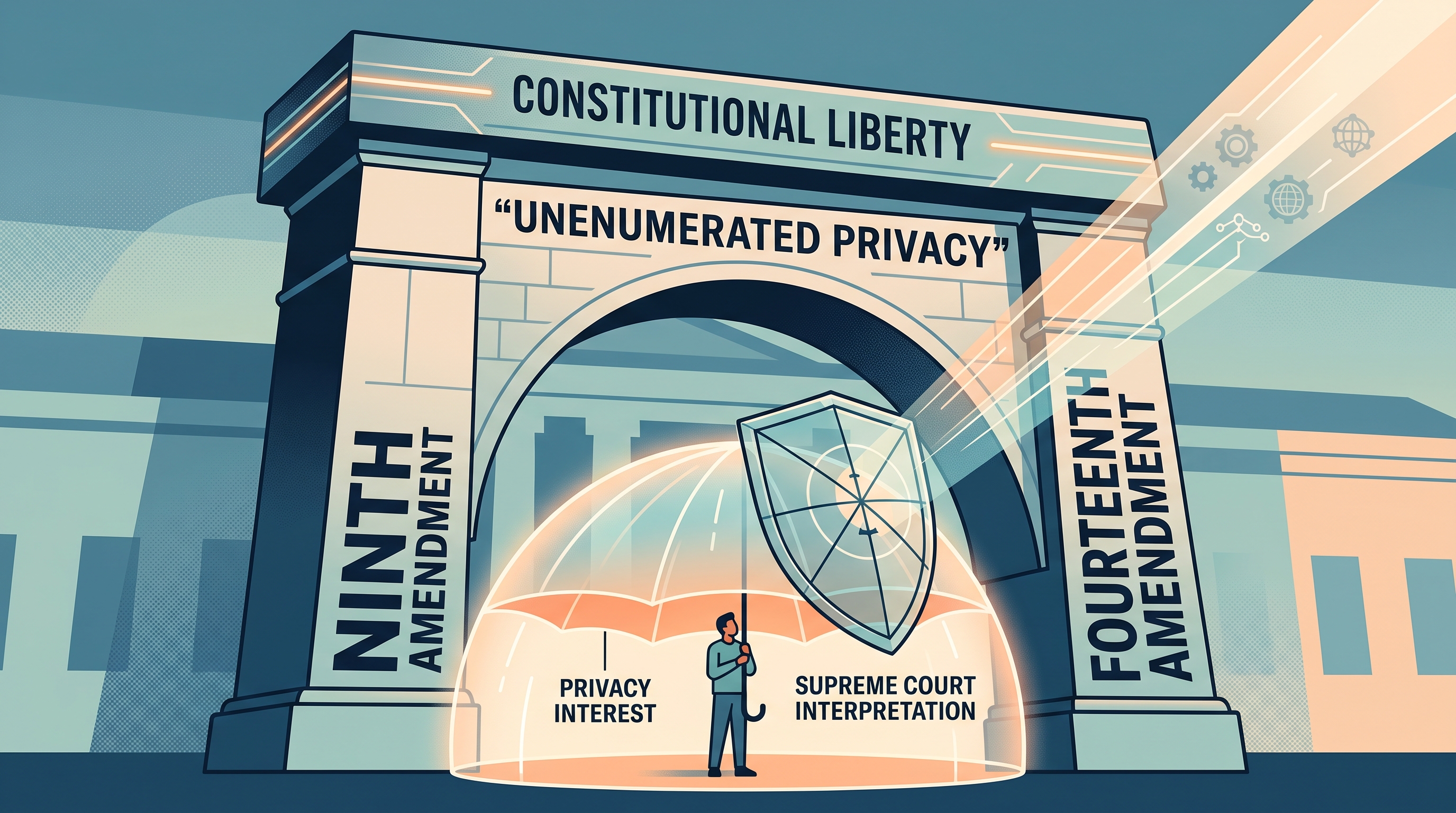
Substantive due process asks whether the government has violated a fundamental liberty through an unjustified or arbitrary law, even when the government has followed formally correct procedures. The central puzzle is that the Constitution does not explicitly use the phrase right to privacy, yet the Supreme Court has recognized privacy as a constitutionally protected interest.
LO 3.9.A: Explain the extent to which substantive due process limits the government from infringing upon individual rights.
EK 3.9.A.1: The Supreme Court has recognized unenumerated rights—rights not specifically listed in the Constitution—including a right to privacy. The Ninth Amendment supports this reasoning by stating that listing certain rights does not mean that people lack other rights retained by the people.
Two meanings of due process
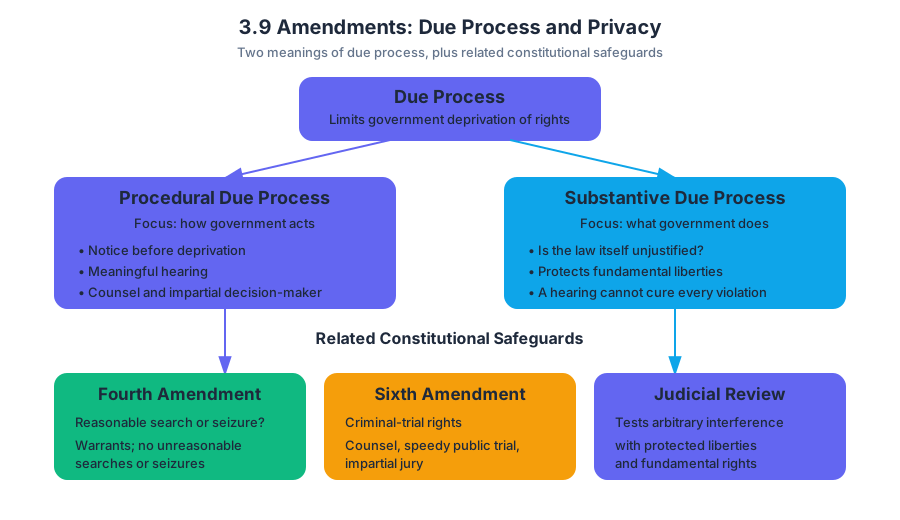
Procedural due process concerns the fairness of the government’s method: Did the government provide appropriate notice, a meaningful opportunity to be heard, access to counsel when required, and a fair or impartial decision-maker before taking away life, liberty, or property? These safeguards regulate how government acts.
Substantive due process concerns the substance of the government’s action: Is the law itself an unjustified infringement on a protected liberty? A government cannot necessarily make an unconstitutional deprivation acceptable merely by providing a hearing first.
| Question | Constitutional focus | Typical protections |
|---|---|---|
| Procedural due process | Was the government’s process fair? | Notice, hearing, counsel where required, impartial decision-maker |
| Substantive due process | Is the government’s interference with a protected liberty itself unjustified? | Judicial review of arbitrary infringements on fundamental rights |
| Fourth Amendment | Was a search or seizure reasonable? | Warrants and protection against unreasonable searches and seizures |
| Sixth Amendment | Were criminal-trial rights protected? | Counsel, speedy and public trial, impartial jury |
Important distinction: an impartial jury is a Sixth Amendment protection, and protection against unreasonable searches and seizures is a Fourth Amendment protection. Both may matter in a criminal case, but neither should be casually labeled as a generic example of procedural due process.
The constitutional right to privacy
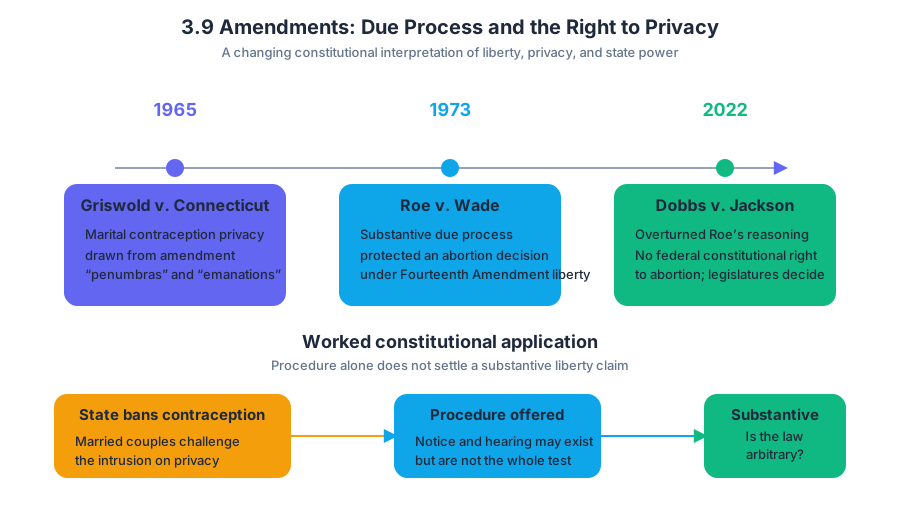
The Supreme Court developed the constitutional right to privacy through interpretation rather than through one express constitutional sentence. In Griswold v. Connecticut (1965), the Court recognized a privacy right involving marital decisions about contraception. The reasoning drew on protections located in several amendments—the Constitution’s “penumbras” and “emanations”—as well as the broader principle that individual liberty is not limited to rights printed in a single list.
In Roe v. Wade (1973), the Court used substantive due process to recognize a constitutional privacy right protecting a pregnant woman’s decision regarding abortion. The decision treated the liberty protected by the Fourteenth Amendment’s Due Process Clause as extending to that decision, thereby limiting state authority to regulate abortion.
In Dobbs v. Jackson Women’s Health Organization (2022), the Court overturned Roe. The decision held that the Constitution does not confer a federal constitutional right to abortion under the reasoning used by Roe, returning primary authority over abortion regulation to elected legislatures. The broader debates over privacy, liberty, and substantive due process therefore continue.
Worked constitutional application: Suppose a state prohibits married couples from obtaining contraception. The government might provide notice and a hearing, satisfying a procedural requirement, but the law could still be challenged substantively because it intrudes on a recognized liberty interest. Under Griswold, the government’s formal procedure would not answer the deeper question: whether the law itself arbitrarily invades protected privacy.
Privacy, equality, and the Fourteenth Amendment
The Fourteenth Amendment’s Due Process Clause applies constitutional liberty protections against the states and provides the foundation for substantive due process analysis. Its Equal Protection Clause addresses a related but distinct problem: whether government has treated similarly situated people differently without sufficient constitutional justification. Topic 3.9 centers on due process and privacy; equal protection becomes especially important when the classification of people, rather than the intrusion on liberty alone, is the constitutional issue.
Digital privacy and the Fourth Amendment
The Fourth Amendment protects people against unreasonable searches and seizures. Courts have applied that protection to modern technology because digital records can expose far more than a single physical search.
In Carpenter v. United States (2018), the Supreme Court held that obtaining historical cell-site location information generally requires a warrant. Cell-site records can reveal an extensive record of a person’s movements, so the government cannot treat access to that information as equivalent to observing a few isolated public actions.
The exclusionary rule is an enforcement mechanism: evidence obtained through an unconstitutional search or seizure is generally barred from use against the accused in a criminal prosecution. It does not mean every procedural mistake automatically ends a case; the key question is whether the evidence was obtained through a constitutional violation and whether an applicable exception affects its admissibility.
National-security surveillance also illustrates the tension between liberty and security. The Patriot Act expanded government surveillance authority after the September 11 attacks, while the USA Freedom Act placed limitations on the bulk collection of telecommunications metadata. These laws show that privacy protections are shaped not only by court decisions but also by legislation responding to changing technologies and security concerns.
Misconception check
Misconception: “Privacy is protected only when the word appears in the Constitution.” The Ninth Amendment supports recognition of unenumerated rights, and the Supreme Court has interpreted the Fourteenth Amendment’s liberty protection to include certain privacy interests. However, recognizing a privacy interest does not make every private decision immune from regulation; the constitutional question is the extent of the protected liberty and whether the government’s infringement is justified.
Suggested AP skill — SCOTUS Application 2.C: Explain the implications of a Supreme Court decision. Apply it by identifying the constitutional principle in Carpenter, then explaining its consequence: government access to historical cell-site location information generally requires a warrant because the data creates an extensive movement record.
Retrieval check: A state gives a person notice, a hearing, and an impartial decision-maker before imposing a restriction, but the restriction directly invades a recognized fundamental liberty. Which concept allows a court to examine the restriction itself rather than only the fairness of the procedure—and which Supreme Court case illustrates the privacy principle involved?
Source Materials
- AP U.S. Government and Politics Course and Exam Description
- Learn More (.pdf)
- AP U.S. Government and Politics Course Overview
- AP U.S. Government and Politics Course at a Glance
- AP United States Government and Politics Course at a Glance Poster
- AP United States Government and Politics
- AP United States Government and Politics
- United States Government and Politics Sample Syllabus 1