From the free course AP United States Government and Politics on Lykke
1.1 Ideals of Democracy
Key concepts: Ideals of democracy · Republicanism · Social movements · Constitutional principles · Supreme Court decisions · Refutation or rebuttal · Argumentation: claim, evidence, and reasoning · Democratic representation
A democracy rests on the idea that government is legitimate only when it reflects the rights, consent, and political will of the people.
1.1 Ideals of Democracy
A democracy rests on the idea that government is legitimate only when it reflects the rights, consent, and political will of the people.
Investigative question: How can a government claim to represent “the people” while still acting unconstitutionally or excluding some people from meaningful representation?
Democratic ideals as standards for government
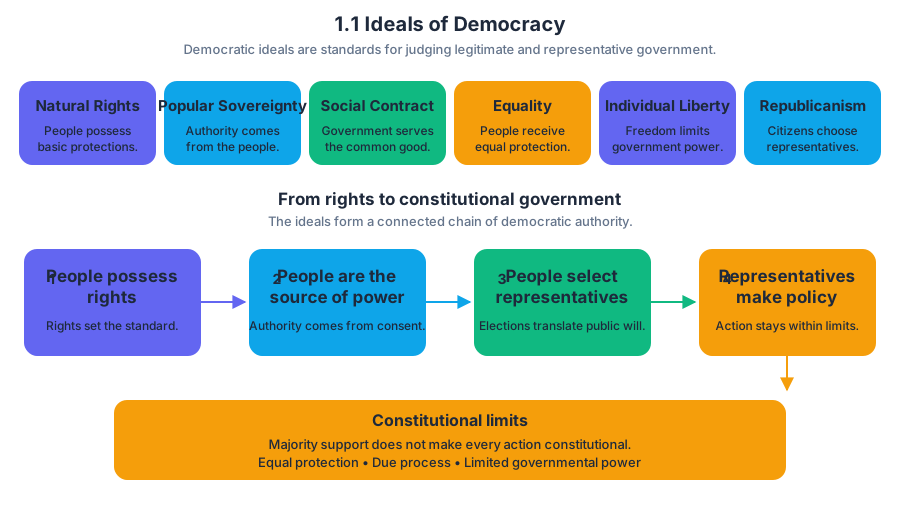
Democratic ideals are principles used to judge whether government is legitimate and representative. Important ideals include natural rights, popular sovereignty, social contract, equality, individual liberty, and republicanism. These ideals do not merely describe how government operates; they establish standards against which government action can be evaluated.
Republicanism means that citizens have a fair opportunity to select representatives who express their will in government. In a republic, citizens usually govern indirectly through elected officials rather than voting personally on every policy. Republicanism therefore requires more than holding elections: districts, voting rules, and governmental institutions must allow citizens’ preferences to be translated fairly into representation.
The connection among ideals can be pictured as a chain:
People possess rights → people are the source of governmental authority → people select representatives → representatives make policy within constitutional limits
The final step matters. Popular support does not automatically make an action constitutional. A majority may favor a policy, but government officials must still follow constitutional protections such as equal protection, due process, and limits on governmental power.
Bush v. Vera: republicanism and constitutional limits
In Bush v. Vera (1996), the Supreme Court considered Texas congressional districts drawn with race as the predominant factor. The Court held that the districts violated the Equal Protection Clause of the Fourteenth Amendment because racial classification had controlled the design of the districts without satisfying the demanding constitutional standard required for such classifications.
The case demonstrates a two-part relationship between constitutional principles and democratic ideals:
| Question | Constitutional principle | Democratic meaning |
|---|---|---|
| May government classify voters primarily by race when drawing districts? | Equal protection limits racial classifications | Government cannot treat citizens as political categories in a way that undermines equal citizenship |
| What should redistricting pursue? | Constituency-based representation rather than racial categorization | Citizens should have a fair opportunity to choose representatives who express their political will |
The decision connects to republicanism because representative government depends on fair opportunities for citizens to choose officials. A district designed primarily around racial categories may appear to increase representation for a racial group, but the Court’s reasoning insisted that representation must remain constitutionally equal and connected to constituencies and the people’s political will.
Named misconception — “A policy is democratic if it helps a historically disadvantaged group.”
Not necessarily. A policy may pursue a democratic goal yet use unconstitutional means. In Bush v. Vera, the relevant question was not simply whether minority representation mattered; it was whether the government’s use of race as the predominant districting factor complied with the Constitution.
Social movements and national policy
Social movements are organized efforts by citizens to change public attitudes, laws, or government institutions. They can begin locally but produce national policies that apply across all states. Protest, speech, litigation, organizing, voting, and public persuasion can transform a movement’s demands into constitutional amendments, federal statutes, or Supreme Court decisions.
For example, civil rights activists used demonstrations, legal challenges, public arguments, and organizing to pressure the national government to address racial inequality. The broader democratic connection is that participation allows citizens to influence the definition and enforcement of political ideals. A movement does not need to win every immediate election to change national policy; sustained collective action can alter what government institutions consider legitimate and necessary.
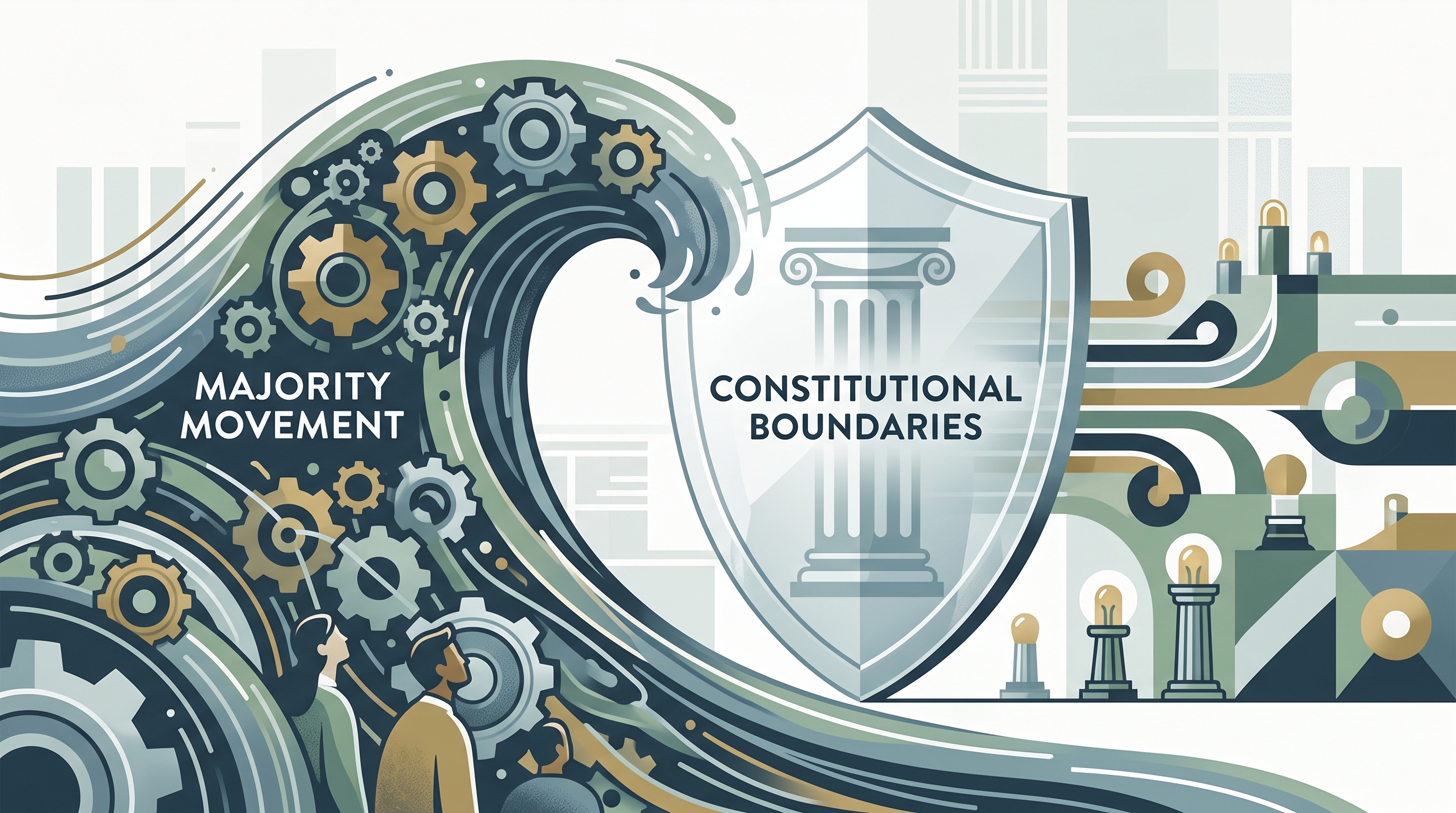
At the same time, social movements operate within constitutional boundaries. Some actions may violate the Constitution even when supporters believe the goal is beneficial. The constitutional question concerns both the objective and the government’s method: who acted, what power was used, which constitutional provision applies, and whether the action unjustifiably burdens protected rights or equal citizenship.
AP reasoning: turning ideals into an argument
This topic is assessed through SP1: Concept Application, SP2: SCOTUS Application, SP4: Source Analysis, and SP5: Argumentation. These skills require more than naming republicanism or Bush v. Vera; they require explaining how a specific fact produces a constitutional or democratic consequence.
A strong argument follows this structure:
- Thesis/claim: State a defensible position that answers the question.
- Evidence: Use specific facts, constitutional provisions, cases, documents, or examples.
- Reasoning: Explain why each piece of evidence supports the claim.
- Alternative perspective: Identify a competing view and refute or rebut it.
Worked example: Claim: Bush v. Vera supports republicanism because the Court protected the principle that citizens should receive fair opportunities for representation rather than being assigned political identities solely through racial classifications. Evidence: Texas used race as the predominant factor in drawing congressional districts, and the Court found that practice unconstitutional under equal protection. Reasoning: If district boundaries classify citizens primarily by race, the design of representation may replace citizens’ political will with a government-imposed category. Rebuttal: Although race-conscious districting may seek to improve minority representation, that purpose does not eliminate the constitutional requirement that racial classifications satisfy equal protection.
Retrieval check: A social movement persuades Congress to pass a law applying nationwide, but the law restricts a constitutional right. Which democratic ideal explains the movement’s influence, and what additional question must be asked? Answer: Civic participation explains how the movement influenced national policy; the additional question is whether the law itself complies with the Constitution.
Source Materials
- AP U.S. Government and Politics Course and Exam Description
- Learn More (.pdf)
- AP U.S. Government and Politics Course Overview
- AP U.S. Government and Politics Course at a Glance
- AP United States Government and Politics Course at a Glance Poster
- AP United States Government and Politics
- AP United States Government and Politics
- United States Government and Politics Sample Syllabus 1
- AP US Gov Past Exam Questions — AP Central
- Khan Academy — AP US Government and Politics
- YouTube — Heimler's History
- YouTube — Jocz Productions