From the free course AP United States Government and Politics on Lykke
3.6 Amendments: Balancing Individual Freedom with Public Order and Safety
Key concepts: Balancing individual freedom with public order and safety · Supreme Court decisions · Constitutional rights · Public safety · Individual rights · Civil liberties and civil rights · Unit 3: Civil Liberties and Civil Rights · Learning Objective 3.6.A · Essential Knowledge 3.6.A.1 · Suggested Skill 5.B
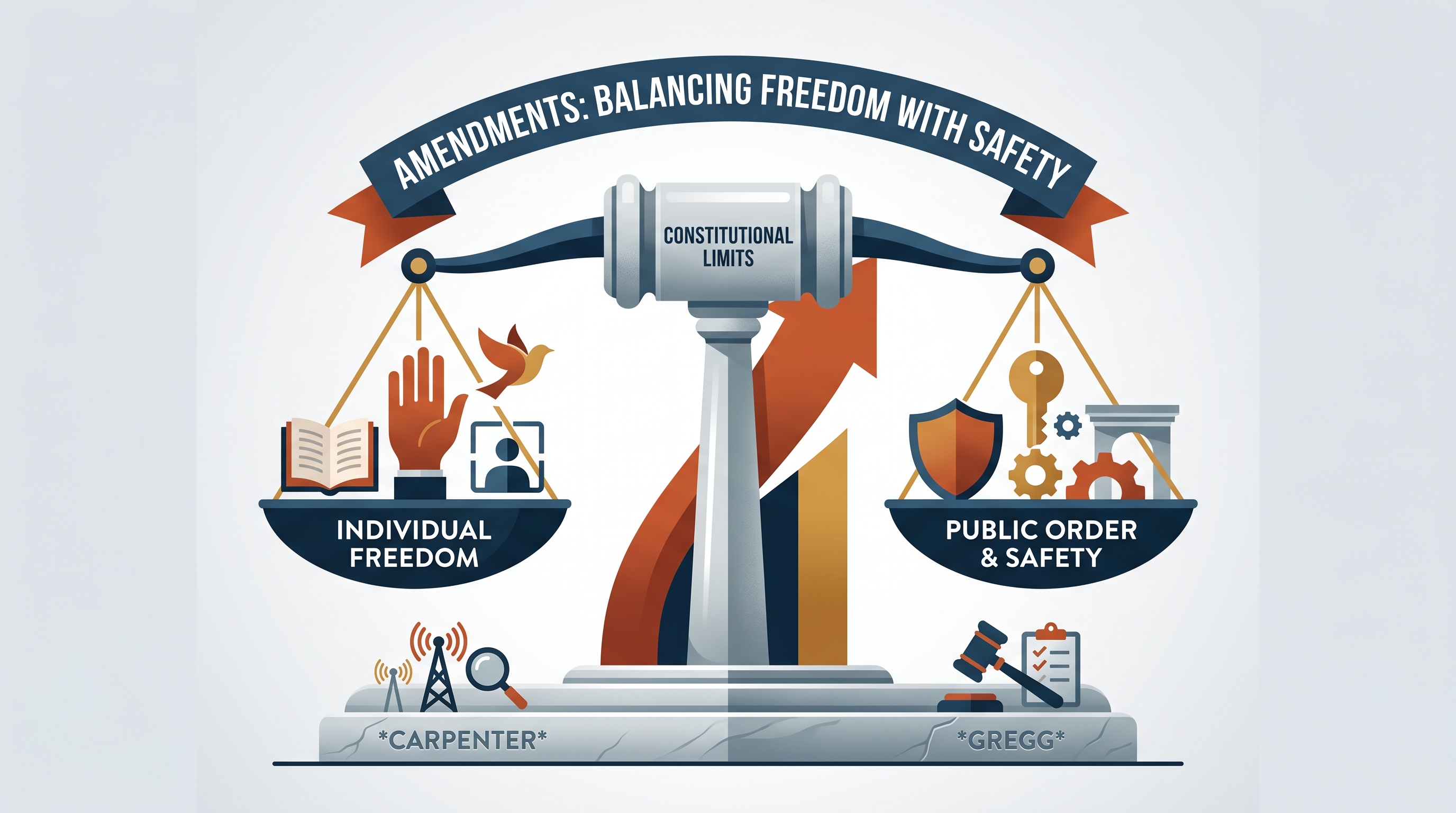
A constitutional right is rarely absolute: the Supreme Court must decide how far individual freedom extends when government argues that a restriction is necessary to protect public order and safety.
3.6 Amendments: Balancing Individual Freedom with Public Order and Safety
A constitutional right is rarely absolute: the Supreme Court must decide how far individual freedom extends when government argues that a restriction is necessary to protect public order and safety. That recurring conflict is the core of 3.6 Amendments: Balancing Individual Freedom with Public Order and Safety.
In Unit 3, civil liberties are protections from government action, while civil rights concern equal treatment and protection under the law. Topic 3.6 focuses primarily on civil liberties, especially the problem of deciding when government enforcement procedures become an unacceptable intrusion on individual freedom.
The constitutional balancing problem
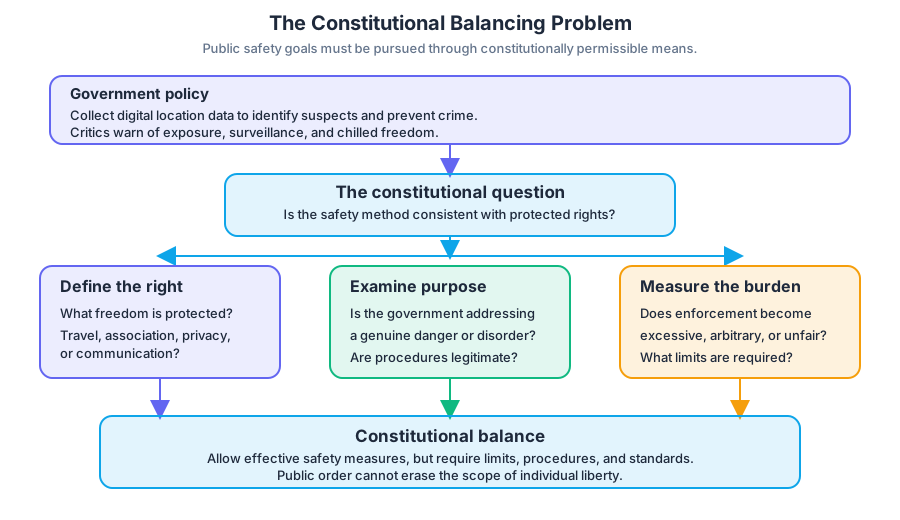
Imagine a city defending a policy that allows police to collect large amounts of digital location data. Officials argue that the information helps identify dangerous suspects and prevent crime. Critics respond that constant government access to personal information can expose innocent people and chill their freedom to associate, travel, or communicate.
The constitutional question is not simply “Is public safety important?” It is whether the government has protected safety through means consistent with constitutional rights. The Court therefore interprets constitutional text, examines the government’s purpose and procedures, and evaluates the burden placed on individual liberty.
| Government’s claim | Individual-rights concern | Supreme Court’s task |
|---|---|---|
| A restriction prevents danger or disorder. | The restriction may punish, search, or control people unfairly. | Define the right and determine whether the government’s method is constitutionally permissible. |
| Enforcement must be effective. | Enforcement may become excessive or arbitrary. | Require limits, procedures, or standards that protect liberty. |
| The public benefits from regulation. | Individuals may bear the constitutional cost. | Balance public order and safety against the scope of the protected freedom. |
Learning Objective 3.6.A
Learning Objective 3.6.A: Explain how the Supreme Court has attempted to balance claims of individual freedom with laws and enforcement procedures that promote public order and safety.
The verb explain requires more than naming an amendment or case. A strong explanation identifies the government’s safety objective, identifies the constitutional liberty at stake, describes the Court’s interpretation, and shows whether the decision strengthened, limited, or reshaped either side of the balance.
Cruel and unusual punishment: the Eighth Amendment
Essential Knowledge 3.6.A.1: Court decisions defining cruel and unusual punishment involve interpretation of the Eighth Amendment and its application to death penalty statutes.
The Eighth Amendment prohibits “cruel and unusual punishments.” The Supreme Court has treated this language as requiring interpretation rather than applying a fixed list of forbidden punishments. The central tension is visible in death-penalty cases: the government seeks a severe punishment for especially serious crimes, while the accused claims that the punishment is excessive, arbitrary, or constitutionally unacceptable.
In Furman v. Georgia (1972), the Court invalidated existing death-penalty procedures because their discretionary application could produce arbitrary results. The decision did not permanently abolish capital punishment; it required states to revise their statutes. In Gregg v. Georgia (1976), the Court upheld a redesigned death-penalty system that included procedures intended to guide discretion and produce more consistent decisions.
Worked example: A state argues that capital punishment deters crime and expresses society’s condemnation of murder. A defendant argues that juries receive too little guidance, so similar defendants may receive different punishments. Under the reasoning associated with Furman, the problem is not merely whether the death penalty promotes safety; it is whether the procedure imposes the punishment arbitrarily. A later statute with structured procedures may survive under Gregg because it addresses that constitutional defect.
Firearms, metadata, and public safety
Essential Knowledge 3.6.A.2: The debate about the Second and Fourth Amendments involves concerns about public safety and whether government regulation of firearms or collection of digital metadata promotes or interferes with public safety and individual rights.
The Second Amendment debate asks whether firearm regulation reduces violence or improperly burdens the right to keep and bear arms. The Fourth Amendment debate asks whether government searches or surveillance protect people from crime and terrorism or intrude on the right to be secure against unreasonable searches.
In District of Columbia v. Heller (2008), the Court recognized an individual Second Amendment right to possess a firearm for lawful purposes such as self-defense, while also indicating that the right is not unlimited. This illustrates how a decision can protect individual liberty while leaving room for some public-safety regulation.
Digital metadata—information about communications or activity, such as when a phone connects to a location network—can reveal highly personal patterns even when it does not contain the message’s words. In Carpenter v. United States (2018), the Court held that the government generally needs a warrant supported by probable cause to obtain extended historical cell-site location information. The ruling treated the government’s investigative interest as important but concluded that the privacy intrusion required stronger constitutional protection.
Supreme Court decisions: promoting or interfering with safety and rights
A decision may promote public safety by permitting carefully designed enforcement, limiting dangerous conduct, or allowing officials to gather evidence under lawful procedures. The same decision may also interfere with safety from the government’s perspective if constitutional safeguards make investigations slower or restrict available enforcement tools.
Conversely, a decision may promote individual rights by preventing arbitrary punishment, requiring warrants, or recognizing a protected sphere of personal autonomy. Critics may argue that the ruling interferes with safety if it removes a law-enforcement tool or makes regulation more difficult. AP analysis should identify whose claim is being advanced rather than treating “safety” or “freedom” as self-proving conclusions.
Skill focus: 5.B — Support an argument or claim/thesis using relevant evidence
The suggested analytical skill is 5.B: Support an argument or claim/thesis using relevant evidence. Evidence is relevant when it directly supports the claim being made. A case name alone is not evidence; the reasoning and constitutional effect of the decision must be connected to the argument.
Argument example: “Supreme Court decisions can promote individual rights without completely rejecting public safety concerns.” Relevant evidence includes Gregg, because the Court allowed a death-penalty system with procedural safeguards, and Carpenter, because the Court required a warrant for sensitive location data while leaving lawful investigations possible.
Misconception check — “Balancing” means splitting the difference. The Court does not automatically compromise by giving each side half of what it wants. It may invalidate an entire procedure, uphold a restriction, require a warrant, or recognize a right while permitting limited regulation. The constitutional result depends on the text, precedent, facts, and procedures involved.
Retrieval check: A state claims that a new surveillance system will improve public safety, but it collects detailed location histories from millions of people without individualized judicial approval. Identify the relevant amendment, state the individual-rights concern, and use Carpenter as evidence for one defensible claim about why the procedure might be constitutionally limited.
Source Materials
- AP U.S. Government and Politics Course and Exam Description
- Learn More (.pdf)
- AP U.S. Government and Politics Course Overview
- AP U.S. Government and Politics Course at a Glance
- AP United States Government and Politics Course at a Glance Poster
- AP United States Government and Politics
- AP United States Government and Politics
- United States Government and Politics Sample Syllabus 1