From the free course AP United States Government and Politics on Lykke
3.10 Social Movements and Equal Protection
Key concepts: Equal Protection Clause of the Fourteenth Amendment · Civil rights and protection from discrimination · Social movements · Participatory model of democracy · Civil Rights Act of 1964 · Title VII and workplace equality · LGBTQ rights advocacy · Women’s participation and equal opportunity · Racial gerrymandering and voting rights · Civil disobedience and the Letter from Birmingham Jail
The Equal Protection Clause of the Fourteenth Amendment turns a demand for equal treatment into a constitutional claim: government may not deny any person the equal protection of the laws.
3.10 Social Movements and Equal Protection
The Equal Protection Clause of the Fourteenth Amendment turns a demand for equal treatment into a constitutional claim: government may not deny any person the equal protection of the laws. That principle has not operated only inside courtrooms; it has also helped organize people into social movements demanding that constitutional equality become real in daily life.
Learning Objective 3.10.A: Explain how constitutional provisions have supported and motivated social movements.
Equal protection and civil rights
Civil rights are protections against discrimination—unjust treatment based on characteristics such as race, national origin, religion, and sex. These protections arise from the Constitution’s due process and equal protection guarantees and from laws enacted by Congress.
The constitutional principle and the political movement reinforce one another:
| Constitutional or legal protection | Problem addressed | Movement or political demand |
|---|---|---|
| Fourteenth Amendment Equal Protection Clause | Unequal treatment by government | Civil rights and equal-rights campaigns |
| Civil Rights Act of 1964, Title II | Discrimination in public accommodations | Integration of public places and facilities |
| Civil Rights Act of 1964, Title VII | Employment discrimination | Equal employment opportunities |
| Title IX | Unequal opportunities in education and athletics | Women’s equality |
| Equal-protection litigation | Discriminatory laws or governmental classifications | Strategic court challenges |
The Civil Rights Act of 1964 translated constitutional equality into enforceable national policy. Title II prohibited discrimination in public accommodations, such as restaurants, hotels, and other public places, while the Act also supported the integration of schools and public facilities. Title VII prohibited employment discrimination and advanced equal employment opportunities for women and other protected groups.
Title VII: workplace equality
Title VII matters because discrimination at work can restrict political and economic participation even when a person formally possesses the right to vote. For example, if an employer refuses to hire qualified applicants because they are women, the legal issue is not merely personal unfairness; it is unequal access to employment opportunities based on sex.
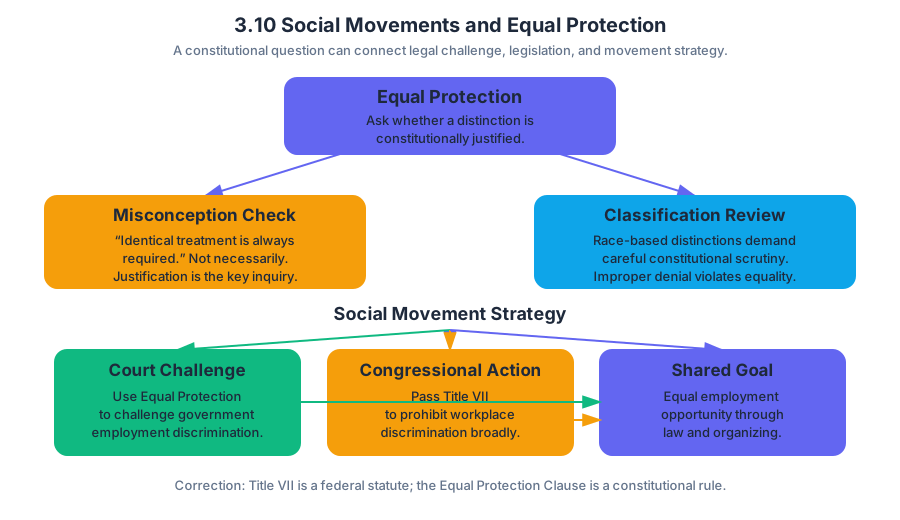
A useful distinction is that the Fourteenth Amendment directly constrains government action, whereas congressional civil-rights legislation can regulate discrimination in areas that Congress has constitutional authority to reach. On an AP response, identify both the constitutional principle and the statute’s concrete policy effect rather than treating them as interchangeable.
Social movements as participatory democracy
A social movement is a large-scale, organized effort to change public policy, laws, institutions, or social practices. Social movements illustrate the participatory model of democracy, in which citizens influence government through sustained political action—not only by voting, but also through protests, boycotts, litigation, petitions, organizing, public argument, and coalition building.
Consider a simplified chain of action:
- People experience or identify unequal treatment.
- They connect individual grievances to a constitutional principle such as equal protection.
- Organizations coordinate participation and communicate demands.
- Courts, Congress, political parties, and public officials face pressure to respond.
- A ruling or law changes the formal rules, which may generate further organizing to secure enforcement.
The civil rights movement of the 1960s, the women’s rights movement, and advocacy for LGBTQ rights show how constitutional language can motivate collective action. The National Organization for Women, for example, connected women’s claims about employment, education, and political equality to broader equal-protection principles. LGBTQ-rights advocacy similarly uses equality arguments to challenge discriminatory governmental policies and practices.
Civil disobedience and unjust laws
In Dr. Martin Luther King Jr.’s “Letter from Birmingham Jail,” civil disobedience means intentionally violating an unjust law in a public, nonviolent way in order to expose injustice and create pressure for reform. King does not argue that people may casually ignore every law; he distinguishes between just laws, which respect human dignity, and unjust laws, which degrade or deny equality.
Key insight: Civil disobedience can respect the general importance of law while rejecting laws that contradict justice.
This argument explains why marches, sit-ins, and boycotts can be understood as political participation rather than disorder alone. Participants make a constitutional claim, accept visibility and often legal consequences, and use public action to persuade institutions and the broader public.
Equal protection and electoral districts
Shaw v. Reno (1993) and Bush v. Vera (1996) applied the Fourteenth Amendment’s Equal Protection Clause to racial gerrymandering. Both cases addressed constitutional limits on using race when drawing electoral districts. Race may be relevant to protecting minority voting power, but making race the predominant factor in district design can trigger equal-protection scrutiny.
This creates a constitutional tension: government may need to recognize race to remedy racial discrimination and preserve fair representation, yet it may also violate equal protection if racial classifications dominate districting without sufficient constitutional justification. The cases therefore connect civil rights to representative democracy, not merely to personal treatment.
Misconception check
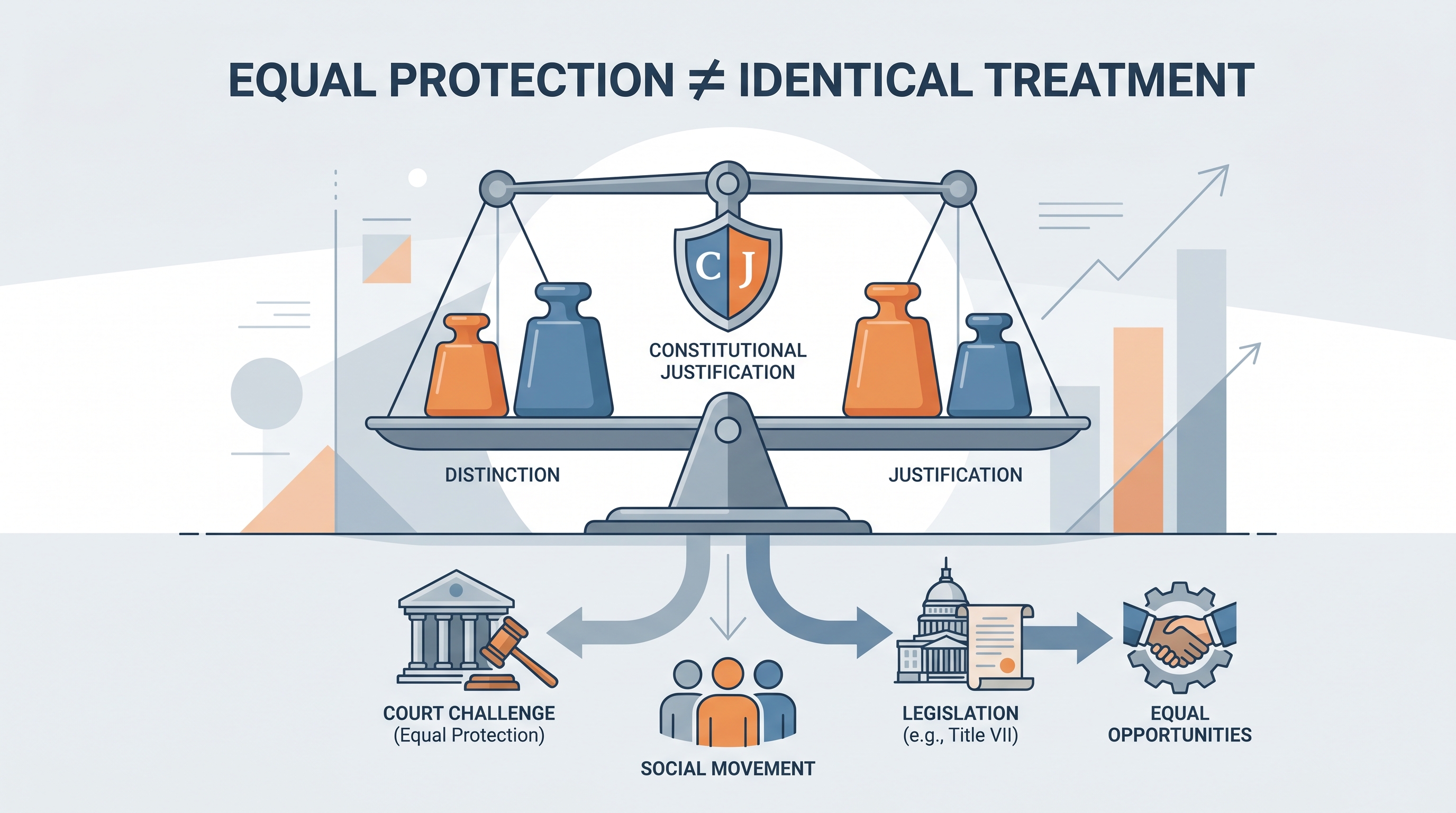
Misconception: “Equal protection requires identical treatment in every circumstance.” Equal protection does not mean that every classification is automatically unconstitutional. The key question is whether government’s distinction is constitutionally justified and whether the use of race or another classification improperly denies equal protection.
Retrieval check: A student says, “Title VII and the Equal Protection Clause are the same rule.” Correct the statement in one sentence, then explain how a social movement could use both a court challenge and congressional legislation to pursue equal employment opportunities.
Source Materials
- AP U.S. Government and Politics Course and Exam Description
- Learn More (.pdf)
- AP U.S. Government and Politics Course Overview
- AP U.S. Government and Politics Course at a Glance
- AP United States Government and Politics Course at a Glance Poster
- AP United States Government and Politics
- AP United States Government and Politics
- United States Government and Politics Sample Syllabus 1