From the free course AP United States Government and Politics on Lykke
1.5 Ratification of the U.S. Constitution
Key concepts: Ratification of the U.S. Constitution · Constitutional Convention compromises · Ratification debates · Federalists and Anti-Federalists · Agreement to add a Bill of Rights · Concerns of the Anti-Federalists · Debates about self-government · Balance between federal and state governments · Unresolved issues left by the ratification compromises · Federalist No. 10 and Brutus No. 1
The Constitution became effective only after a political bargain convinced enough states to accept a stronger national government while preserving meaningful state influence and individual protections.
1.5 Ratification of the U.S. Constitution
The Constitution became effective only after a political bargain convinced enough states to accept a stronger national government while preserving meaningful state influence and individual protections.
LO 1.5.A: Explain the impact of political negotiation and compromise at the Constitutional Convention on the development of the constitutional system.
Convention compromises: designing a government states could accept
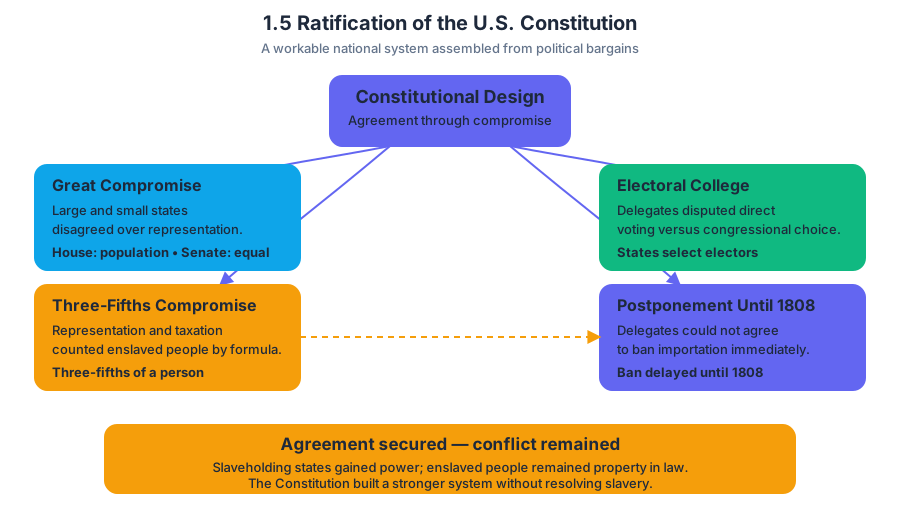
Delegates at the Constitutional Convention disagreed over representation, executive selection, slavery, and the distribution of power. The final document was not a perfect expression of one political theory; it was an architecture assembled from bargains.
| Compromise | Problem it addressed | Constitutional result |
|---|---|---|
| Great (Connecticut) Compromise | Large and small states disagreed over representation | A bicameral Congress: the House represents population, while the Senate gives each state equal representation |
| Electoral College | Delegates disputed whether the president should be chosen directly by voters or by Congress | Each state selects electors who formally choose the president |
| Three-Fifths Compromise | Delegates disputed how enslaved people would count for representation and taxation | A formula counted enslaved people as three-fifths of a person for those purposes |
| Postponement until 1808 | Delegates could not agree on banning the importation of enslaved persons | Congress could not prohibit the importation of enslaved persons until 1808 |
These arrangements secured agreement, but they also embedded unresolved conflicts. The Three-Fifths Compromise and the postponement of the importation ban protected the political power of slaveholding states while treating enslaved people as property in law. The Constitution therefore created a more workable national system without resolving the fundamental conflict over slavery.
Ratification: Federalists versus Anti-Federalists
After the Convention, the Constitution still required ratification by the states. Federalists supported ratification because they believed the proposed government needed enough authority to govern effectively. Anti-Federalists opposed or criticized ratification because they feared that a distant national government would threaten state authority, individual liberty, and self-government.
The dispute was not simply “strong government versus weak government.” It concerned who would control government and how citizens could protect themselves when government acted improperly. Federalists emphasized the need for an energetic national government and argued that a large republic could control factional conflict. Anti-Federalists worried that national officials would become detached from local communities and that the Constitution’s national powers were too broad.
Contrasting texts: Federalist No. 10 and Brutus No. 1
| Perspective | Central concern | Reasoning |
|---|---|---|
| Federalist No. 10 | Factions—organized groups pursuing their interests—are unavoidable | A large republic containing many competing interests makes it harder for one faction to dominate |
| Brutus No. 1 | A large republic may become too distant to remain genuinely self-governing | National officials could accumulate power, weaken the states, and govern a country too large for representatives to understand local concerns |
Read together, these documents reveal the central ratification question: does a larger republic protect liberty by multiplying competing interests, or endanger liberty by separating rulers from the people? A strong source-analysis response should identify each author’s claim, explain the reasoning supporting it, and connect the disagreement to federalism and self-government.
The Bill of Rights as a ratification bargain
The Bill of Rights was not a compromise made at the Constitutional Convention. The Constitution was signed without one. During ratification, Anti-Federalists objected that the new government lacked explicit protections for freedoms such as speech, religion, and fair legal procedures.
Federalists initially argued that listing specific rights was unnecessary because the national government possessed only the powers granted to it. Anti-Federalists responded that a government with broad powers might interpret its authority expansively unless individual rights were written down. The agreement to pursue amendments addressing these concerns helped secure ratification.
The first ten amendments were ultimately adopted in 1791. The sequence matters:
$$ \text{Constitution signed in 1787} \rightarrow \text{ratification debates} \rightarrow \text{promise to add protections} \rightarrow \text{Bill of Rights adopted in 1791} $$
Misconception check: The Bill of Rights did not appear in the original Constitution and was not one of the Convention’s structural compromises. It was a later response to Anti-Federalist concerns and part of the political bargain surrounding ratification.
Article V: self-government built into constitutional change
The ratification debates also influenced the amendment process. If self-government means that the people and states must be able to correct their governing system, the Constitution could not be permanently frozen. Article V therefore created a demanding but possible method of amendment.
An amendment may be proposed by either:
- a two-thirds vote in both houses of Congress; or
- a convention called after applications from two-thirds of the state legislatures.
It becomes part of the Constitution only after ratification by three-fourths of the states. This design balances national and state authority: change cannot occur through one branch or one state, but neither can a small minority permanently block an amendment supported across the country.
What ratification did not settle
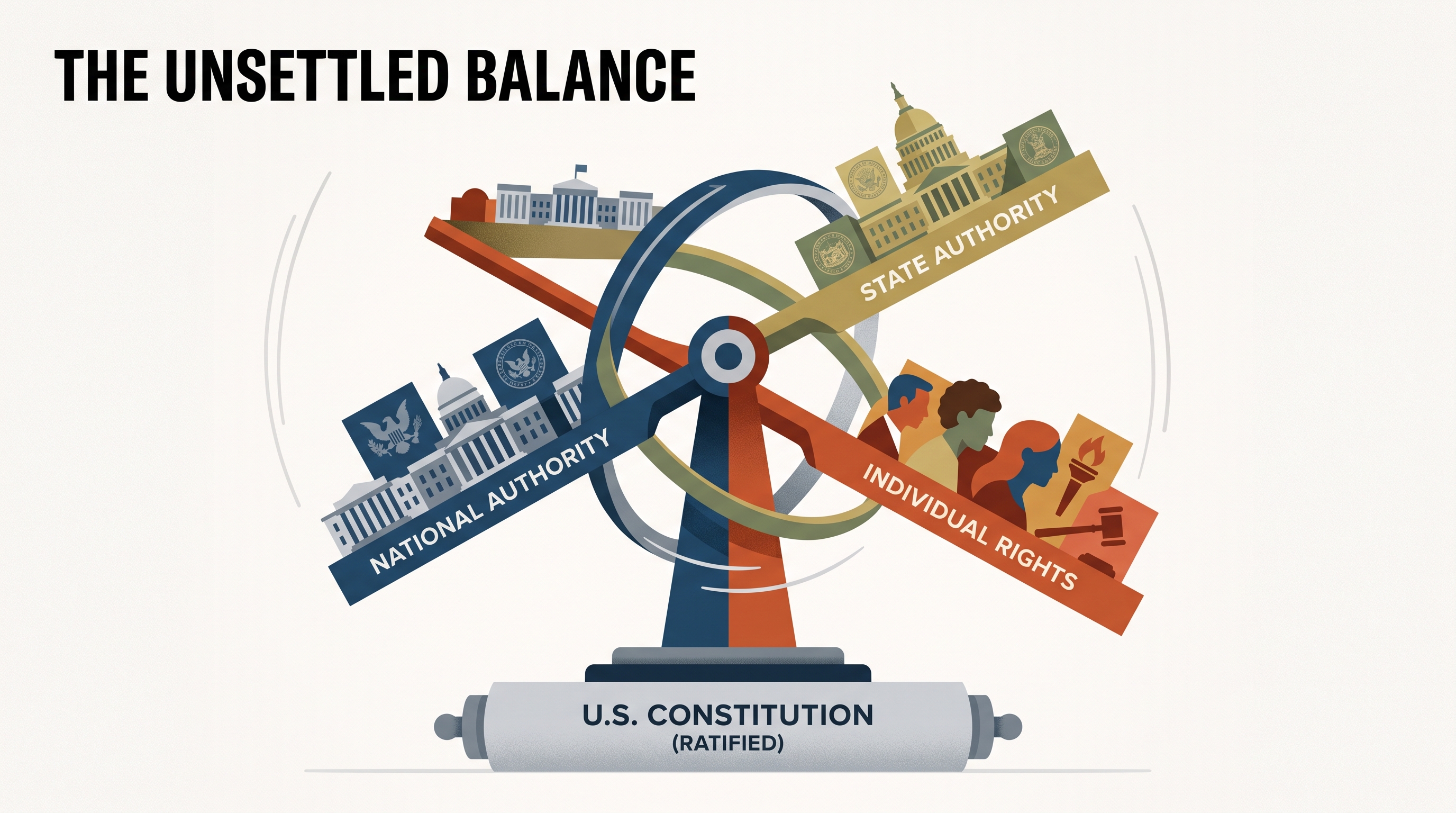
EK 1.5.A.3 emphasizes that the compromises necessary to secure ratification left matters unresolved. The role of the national government, the powers of state governments, and the rights of individuals remain subjects of constitutional debate. Modern disputes over federal surveillance following the 9/11 attacks and the government’s role in public-school education illustrate the continuing question of where governmental power should end.
EK 1.5.A.4 connects these disputes to the enduring balance among national authority, state authority, and individual rights. EK 1.5.A.2 identifies Article V as the constitutional mechanism created by debates about self-government.
Retrieval check: Why is the Bill of Rights best described as a ratification negotiation rather than a Convention compromise? In two sentences, contrast the reasoning of Federalist No. 10 with Brutus No. 1, then explain how Article V reflects both national and state participation in constitutional change.

Source Materials
- AP U.S. Government and Politics Course and Exam Description
- Learn More (.pdf)
- AP U.S. Government and Politics Course Overview
- AP U.S. Government and Politics Course at a Glance
- AP United States Government and Politics Course at a Glance Poster
- AP United States Government and Politics
- AP United States Government and Politics
- United States Government and Politics Sample Syllabus 1
- About the Advanced Placement Program ® (AP ®)
- Information about many constitutional issues can be found on the National Constitution Center’s website. This same information is also available for download for e-readers, tablets, and other mobile d