From the free course AP United States Government and Politics on Lykke
3.4 First Amendment: Freedom of the Press
Key concepts: First Amendment protection of freedom of the press · Supreme Court interpretation of individual liberty · Prior restraint · National security and press freedom · New York Times Co. v. United States (1971) · Heavy presumption against prior restraint · Wisconsin v. Yoder (1972) · Free Exercise Clause · SCOTUS application skill
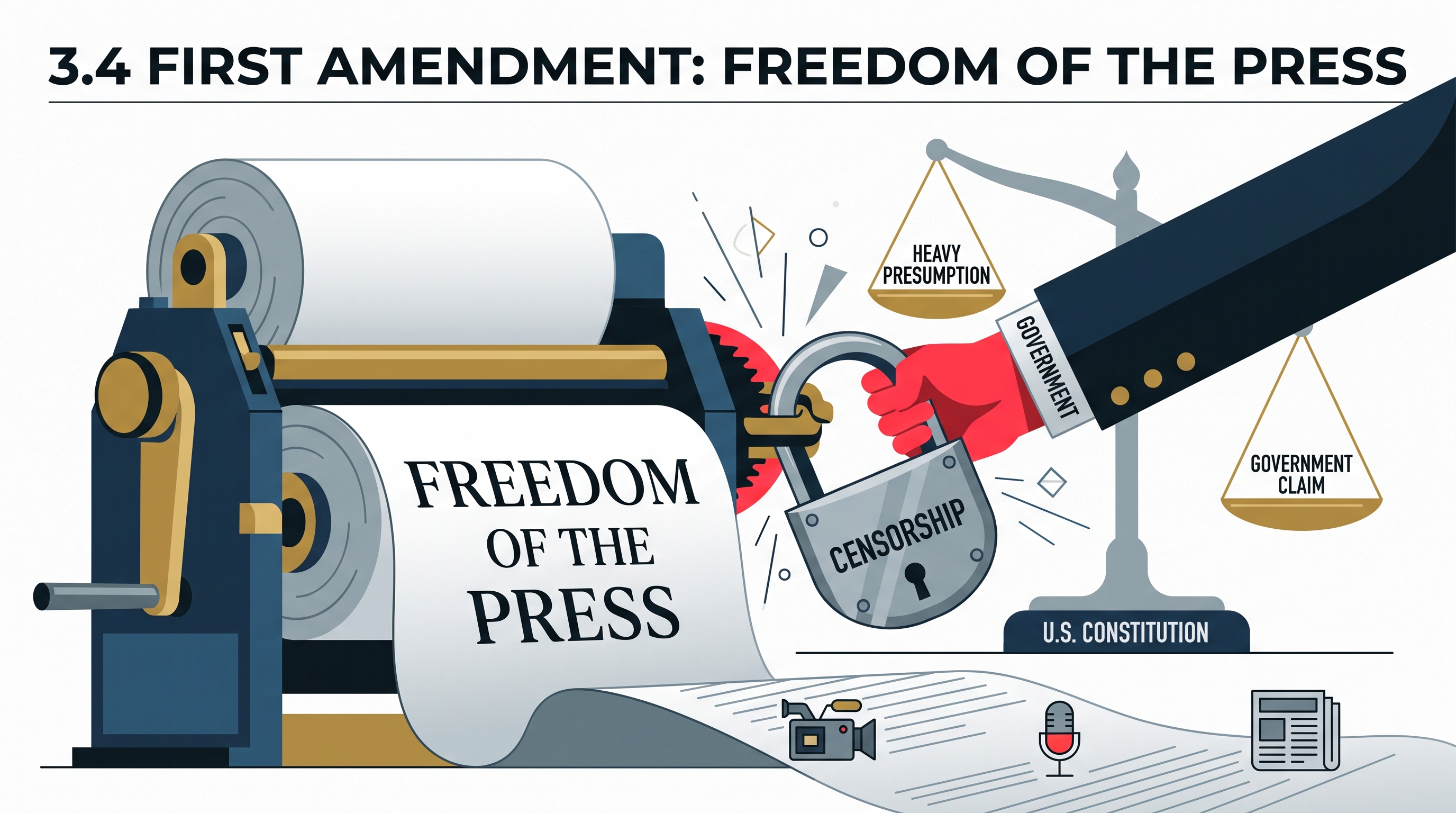
A government order that stops a newspaper from publishing information before publication is called prior restraint, and the Supreme Court has treated it as one of the most serious threats to individual liberty.
3.4 First Amendment: Freedom of the Press
A government order that stops a newspaper from publishing information before publication is called prior restraint, and the Supreme Court has treated it as one of the most serious threats to individual liberty.
Investigative question
How should a democracy respond when officials claim that publishing information could endanger national security?
The constitutional tension is immediate:
| Government’s concern | Press-freedom concern |
|---|---|
| Publication could reveal military or diplomatic information. | Officials might invoke “security” to hide errors, misconduct, or embarrassing facts. |
| Preventing publication may appear safer than punishing publication later. | Censorship before publication prevents the public from receiving information and prevents the press from performing its watchdog role. |
The constitutional principle: liberty before censorship
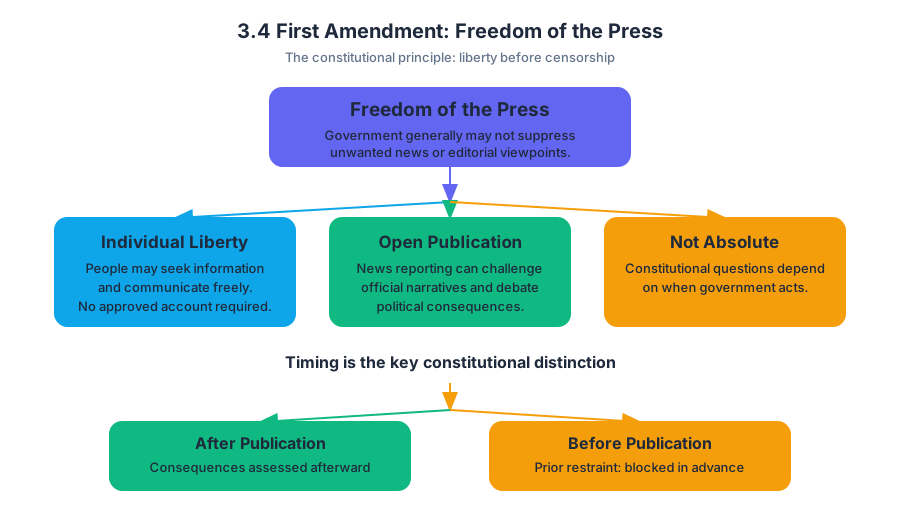
The First Amendment protects freedom of the press, meaning that government generally may not suppress news reporting or editorial publication simply because officials dislike the information or fear its political consequences. This protection reflects a commitment to individual liberty: people must retain the freedom to seek, receive, and communicate information rather than depend entirely on government-approved accounts.
The protection is not absolute. The key constitutional distinction is when the government acts. A law that imposes consequences after publication raises one set of constitutional questions; an order that blocks publication in advance is prior restraint.
New York Times Co. v. United States (1971)
In New York Times Co. v. United States (1971), the federal government attempted to prevent newspapers from publishing classified material concerning the Vietnam War. The government argued that publication threatened national security. The newspapers argued that the First Amendment protected their ability to publish information important to public debate.
The Supreme Court rejected the government’s attempt to impose prior restraint and bolstered First Amendment freedom-of-the-press protections. The decision established a heavy presumption against prior restraint, meaning that the government faces an exceptionally difficult burden when it seeks to stop publication before it occurs.
Heavy presumption against prior restraint: Courts begin with a strong constitutional assumption that government censorship before publication is invalid, even when the government invokes national security.
The word heavy matters. The Court did not declare that national security can never justify limiting publication. Instead, it required an extraordinarily strong justification before allowing the government to silence the press in advance. National security is therefore relevant, but it does not automatically override press freedom.
Worked constitutional application
Imagine that a federal agency asks a court to stop a newspaper from publishing a report based on leaked documents. The agency claims that publication could harm national security.
- Identify the constitutional protection. The First Amendment protects freedom of the press.
- Identify the government action. The court order would prevent publication before it occurs, so it is prior restraint.
- Apply the precedent. Under New York Times Co. v. United States (1971), there is a heavy presumption against such an order, even in a national-security case.
- Explain the principle. Allowing officials to block publication merely by asserting national security would give the government excessive control over public information. The Court’s interpretation protects individual liberty by preserving the press’s ability to inform citizens and support democratic accountability.
Exam-ready conclusion: The order is constitutionally suspect because it is a prior restraint, and New York Times Co. v. United States established a heavy presumption against prior restraint even when national security is cited.
Connecting press freedom to religious liberty
Wisconsin v. Yoder (1972) illustrates the same broader constitutional commitment to individual liberty in a different First Amendment setting. The Court held that compelling Amish students to attend school beyond the eighth grade violated the Free Exercise Clause.
The cases do not concern the same freedom: New York Times concerns freedom of the press, while Yoder concerns free exercise of religion. Their connection is analytical: in both cases, the Court examined whether government could impose a generally asserted public goal at the expense of a constitutionally protected individual liberty.
Do not conflate the holdings: New York Times Co. v. United States concerns prior restraint and freedom of the press; Wisconsin v. Yoder concerns religious exercise and compulsory education.
Common misconception check
Misconception: “The First Amendment prevents the government from ever regulating the press.”
Correction: The principle is more precise. The First Amendment creates strong protection against government censorship, and New York Times established a heavy presumption against prior restraint. That presumption makes advance censorship exceptionally difficult, but it does not mean every conceivable regulation or consequence involving published material is automatically unconstitutional.
CED and AP skill alignment
Learning Objective LO 3.4.A: Explain the extent to which the Supreme Court’s interpretation of the First Amendment reflects a commitment to individual liberty.
Essential Knowledge: The required case principle is New York Times Co. v. United States (1971): freedom-of-the-press protections were strengthened through a heavy presumption against prior restraint, including in cases involving national security.
This topic is especially assessed through SCOTUS Application (SCOTUS-1): identify the holding, apply it to a new constitutional scenario, and connect the Court’s reasoning to individual liberty. It also uses Concept Application (CON-1) when a prompt asks you to apply prior restraint, press freedom, or liberty to a contextual situation.
Retrieval check
A court is asked to block publication of a newspaper investigation because officials claim the article may damage national security. What two features make the case resemble New York Times Co. v. United States (1971), and what constitutional presumption applies?
Answer: The case involves freedom of the press and government censorship before publication, making it prior restraint. The court must apply a heavy presumption against prior restraint, even though the government invokes national security.
Source Materials
- AP U.S. Government and Politics Course and Exam Description
- Learn More (.pdf)
- AP U.S. Government and Politics Course Overview
- AP U.S. Government and Politics Course at a Glance
- AP United States Government and Politics Course at a Glance Poster
- AP United States Government and Politics
- AP United States Government and Politics
- United States Government and Politics Sample Syllabus 1
- 5 92,022 23.7