From the free course AP United States Government and Politics on Lykke
5.13 Changing Media
A political message can now travel from a candidate’s phone to millions of voters before a newspaper editor, television producer, or government official has time to respond.
5.13 Changing Media
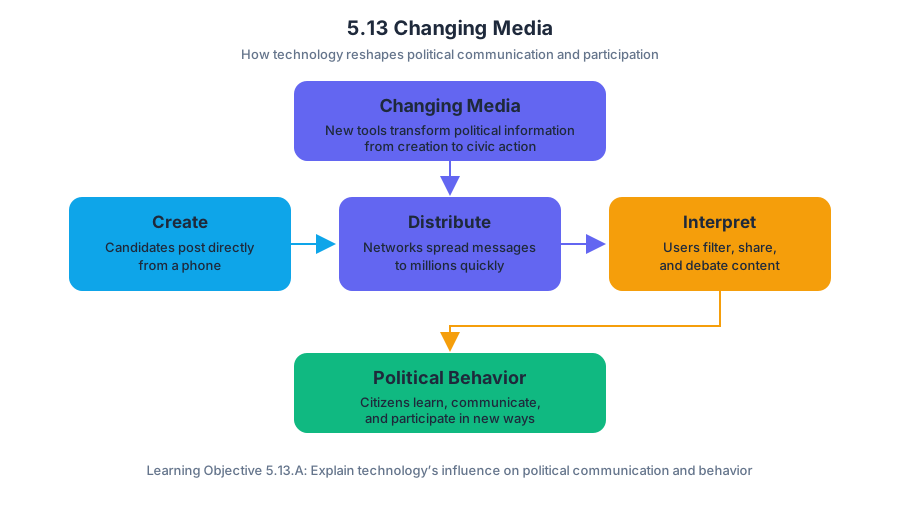
A political message can now travel from a candidate’s phone to millions of voters before a newspaper editor, television producer, or government official has time to respond. Changing media refers to the way new communication technologies reshape how political information is created, distributed, interpreted, and used for participation.
Learning Objective 5.13.A: Explain how changes in technology influence political communication and behavior.
Essential Knowledge 5.13.A.1: Changes in technology influence the ways in which citizens learn about politics. Essential Knowledge 5.13.A.2: Changes in technology influence the ways in which citizens communicate and participate in politics.
From gatekeepers to personalized political environments
Older media systems relied heavily on gatekeepers—editors, producers, publishers, and journalists who selected which events and arguments would reach a large audience. Digital media reduce the number of institutional gatekeepers. A candidate, advocacy group, or ordinary citizen can publish directly through a website, video platform, podcast, or social-media account.
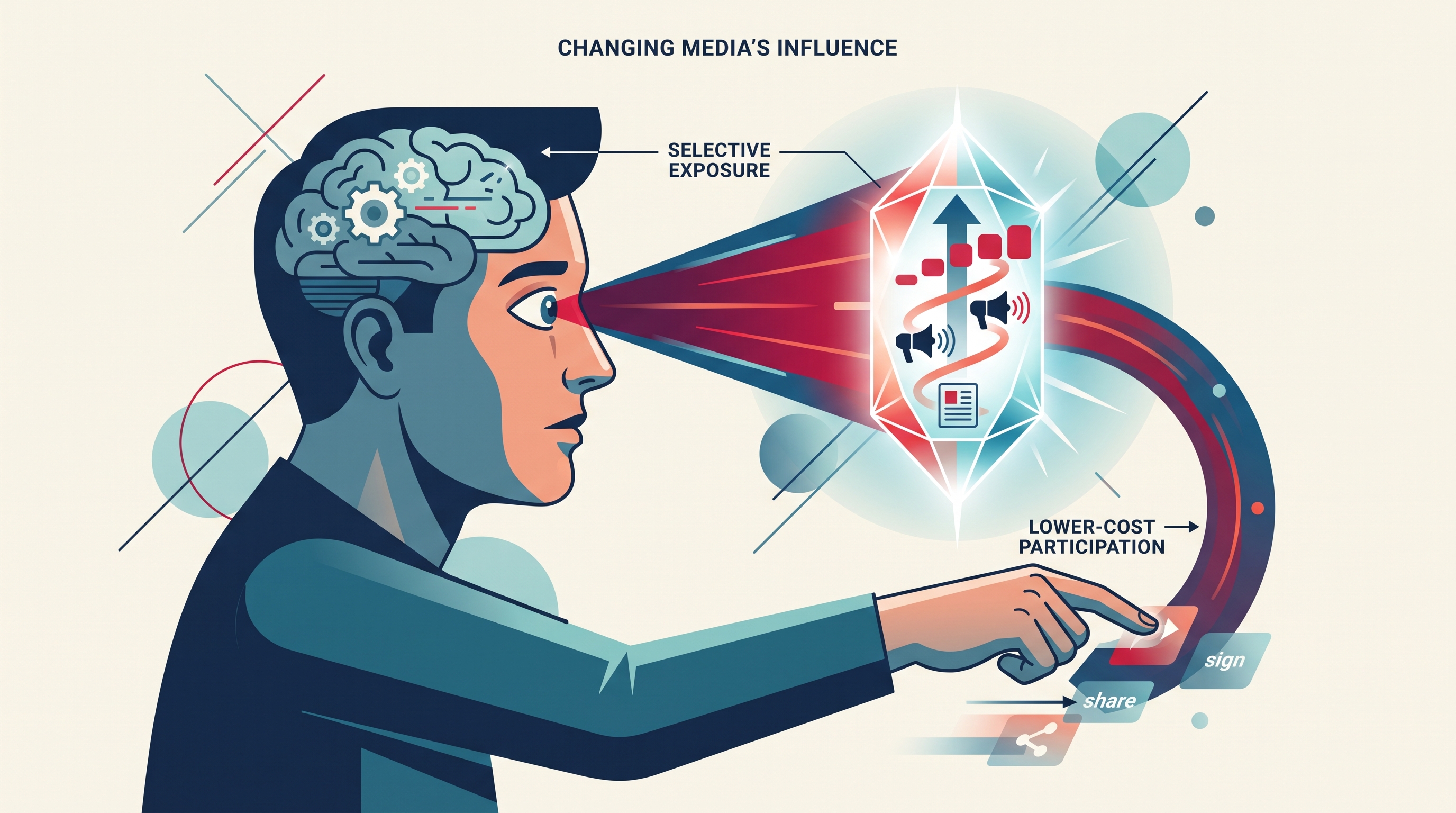
That change expands access to political communication, but it also makes information environments more personalized. Selective exposure is the tendency to seek information that agrees with one’s existing beliefs. Narrowcasting is the delivery of messages to a small, targeted audience rather than to the general public. Together, these processes can strengthen political polarization: people encounter more arguments that confirm their views and fewer that challenge them.
The key distinction is not simply “old media versus new media.” Digital technology changes the pathway of communication:
| Communication feature | More traditional pattern | Changing-media pattern |
|---|---|---|
| Distribution | A few organizations reach a mass audience | Many actors publish directly |
| Audience | Broad and relatively shared | Segmented and personalized |
| Feedback | Mostly one-way | Immediate comments, sharing, and responses |
| Political targeting | General demographic appeals | Data-informed messages to specific groups |
| Information control | Editors filter content | Platforms, algorithms, users, and networks filter content |
Worked example: one issue, three information environments
Imagine that a city is considering a major transit expansion. A local newspaper publishes one article describing the cost and another describing expected environmental benefits. A transportation advocacy group posts short videos emphasizing reduced traffic. A neighborhood account posts images of construction risks and directs followers to an online petition.
A resident who follows the advocacy group may repeatedly see pro-expansion messages. Another resident who follows neighborhood activists may see mostly opposition arguments. Both residents can communicate directly with officials, organize supporters, and circulate evidence without joining a traditional organization. Technology has therefore influenced both political communication—how messages move—and political behavior—how citizens participate.
However, repeated exposure does not prove that one side possesses the complete truth. A persuasive post may simplify evidence, omit context, or contain false information. The political consequence depends on how citizens evaluate sources, compare perspectives, and decide whether to act.
Why changing media can increase participation—and distortion
Digital communication lowers the cost of participation. A person can sign a petition, donate, contact a representative, attend a virtual meeting, or share a political message almost instantly. These tools can bring previously less-visible voices into public debate and help groups coordinate collective action.
The same speed can amplify rumors and misinformation, meaning inaccurate information shared regardless of whether the sender intended to deceive. A related concern is confirmation bias, the tendency to notice and accept information that supports existing beliefs more readily than information that challenges them. The lesson is not that all online information is false; it is that abundance and speed do not automatically produce accuracy.
A useful evaluation routine is:
- Identify who created and funded the message.
- Separate factual claims from emotional framing.
- Compare the claim with coverage from ideologically different sources.
- Check whether the evidence is current, complete, and independently supported.
- Determine what action the message is trying to produce.
Applying Skill 2.D: Explain how a required Supreme Court case relates to a political concept or issue
Topic 5.13 is assessed through Skill 2.D: Explain how a required Supreme Court case relates to a political concept or issue. The required case Citizens United v. Federal Election Commission (2010) connects changing media to political communication because independent political spending can finance messages distributed through television, websites, videos, targeted advertisements, and other communication networks.
The reasoning must show the connection rather than merely name the case. For example: Citizens United protected corporate and union independent expenditures because the Court treated political spending used for advocacy as protected political expression. As digital platforms make it cheaper to distribute targeted messages, that constitutional protection can operate through many new media channels, although the decision does not guarantee that audiences will receive accurate or balanced information.
High-value explanation: A case name is evidence only when the answer explains its constitutional principle and connects that principle to the issue in the prompt.
Misconception check
Misconception: “Social media creates political polarization by itself.” Technology creates opportunities and incentives, but polarization also reflects political identities, organized interests, partisan media, social networks, and individual choices. A strong explanation identifies the mechanism—such as selective exposure or narrowcasting—rather than treating technology as an automatic cause.
Retrieval check
A video platform recommends increasingly one-sided political content to a user, who then shares those videos and signs an online petition. Identify one way changing media influenced political communication and one way it influenced political behavior. For an AP-quality response, name the mechanism: the recommendation system may contribute to selective exposure or narrowcasting, while sharing and petition-signing illustrate lower-cost political participation.
Source Materials
- AP U.S. Government and Politics Course and Exam Description
- Learn More (.pdf)
- AP U.S. Government and Politics Course Overview
- AP U.S. Government and Politics Course at a Glance
- AP United States Government and Politics Course at a Glance Poster
- AP United States Government and Politics
- AP United States Government and Politics
- United States Government and Politics Sample Syllabus 1