From the free course AP United States Government and Politics on Lykke
2.6 Expansion of Presidential Power
A president can expand the practical reach of the office without changing the constitutional text: the central question is whether presidential leadership is a necessary tool for effective government or a threat to limited government.
2.6 Expansion of Presidential Power
A president can expand the practical reach of the office without changing the constitutional text: the central question is whether presidential leadership is a necessary tool for effective government or a threat to limited government. Expansion of presidential power refers to the broader interpretation and use of presidential authority through both formal powers, which come from the Constitution or laws, and informal powers, which arise from political practice, public expectations, persuasion, and claims of executive responsibility.
LO 2.6.A: Explain how presidents have interpreted and justified their use of formal and informal powers.
The argument for a strong executive
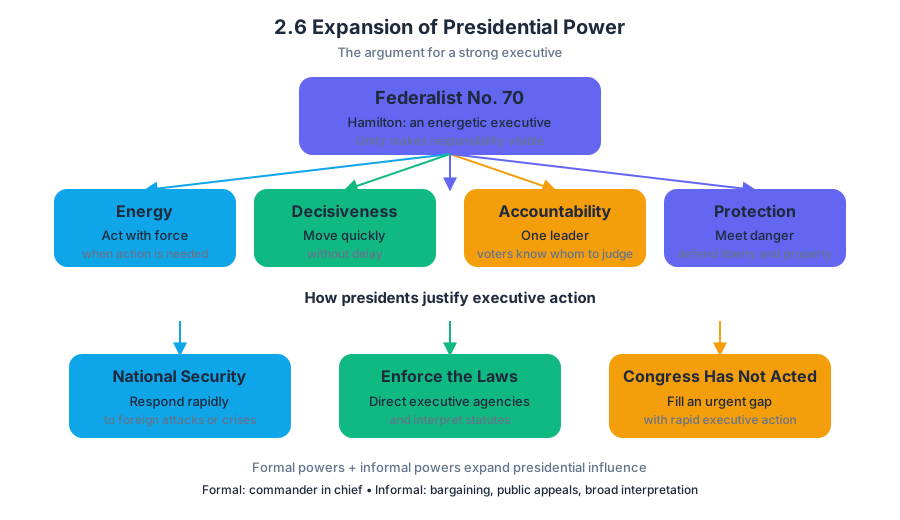
The classic justification for an energetic presidency appears in Federalist No. 70. Alexander Hamilton argues that a single executive is valuable because a unified leader can provide energy, decisiveness, accountability, and protection in moments of danger. The argument is not simply that presidents should be powerful; it is that a sufficiently strong executive is “essential to the protection of the country against foreign attacks, to the steady administration of the laws, to the protection of property, and to the security of liberty” (EK 2.6.A.1).
This reasoning treats executive power like a command center during an emergency: one person can act more quickly than a large legislature, and voters can identify who is responsible for the decision. Presidents may therefore justify executive action by pointing to national security, enforcement of the laws, or the need to respond rapidly when Congress has not acted.
A president might use a formal power, such as directing executive agencies or serving as commander in chief, while also relying on informal powers, such as negotiating privately with legislators, appealing directly to the public, or interpreting broad statutory language. The legal source of the action and the political method used to carry it out are different questions.
Why expansion creates constitutional tension
The same flexibility that allows a president to respond quickly can weaken the principle of limited government. If presidents increasingly claim that broad national interests authorize unilateral action, Congress may have less influence over policymaking, and the separation of powers may shift toward the executive branch. The constitutional debate is therefore not simply “strong president versus weak president”; it is a disagreement about how much initiative the office requires and where legitimate authority ends.
The Twenty-Second Amendment, which established presidential term limits, demonstrates concern about the expansion of presidential power (EK 2.6.A.2). Its adoption reflected anxiety that a president who remains in office for too long could accumulate excessive influence over agencies, public opinion, appointments, and national policy. Term limits constrain the office even when a president remains popular and politically effective.
Competing presidential perspectives
Different presidents and political thinkers have defended different versions of the presidential role. William Howard Taft’s Our Chief Magistrate and His Powers represents a more limited interpretation: the president should exercise authority grounded in the Constitution or in legislation. Theodore Roosevelt’s An Autobiography is associated with a more expansive view, in which the president may take action for the national interest unless the Constitution or law clearly forbids it. Franklin Delano Roosevelt’s 1941 State of the Union Address provides another context for examining how national crisis can support a broader understanding of presidential responsibility.
These perspectives remain relevant when presidents respond to contemporary events. A president who orders an action during an international crisis may argue that speed and national security require executive initiative. Critics may answer that congressional authorization is necessary, especially when the action creates long-term obligations or affects individual rights. The disagreement illustrates EK 2.6.A.3: perspectives on the presidential role range from limited to expansive interpretations and continue to be debated.
Worked contextual example: analyzing a presidential action
Imagine that a president directs executive agencies to begin a national emergency program after Congress has delayed legislation. The president claims that existing law gives the executive branch discretion to act; opponents argue that the president is creating new policy without legislative authorization.
Apply Suggested Skill 4.A, Source Analysis: Describe the argument, perspective, evidence, and reasoning presented in the source. First identify the president’s argument: immediate executive action is necessary to address the emergency. Next identify the perspective: an expansive view of presidential responsibility. Then locate the evidence: the president points to existing statutory language and the urgency of the crisis. Finally explain the reasoning: because the law grants administrative discretion and delay threatens the public interest, executive action is presented as legitimate.
A complete analysis must also identify the opposing perspective. Critics may argue that the president is using informal initiative to accomplish what requires new legislation. The key issue is not whether the president acted decisively, but whether the action is justified by an existing formal power or represents an unsupported expansion of executive authority.
Misconception check
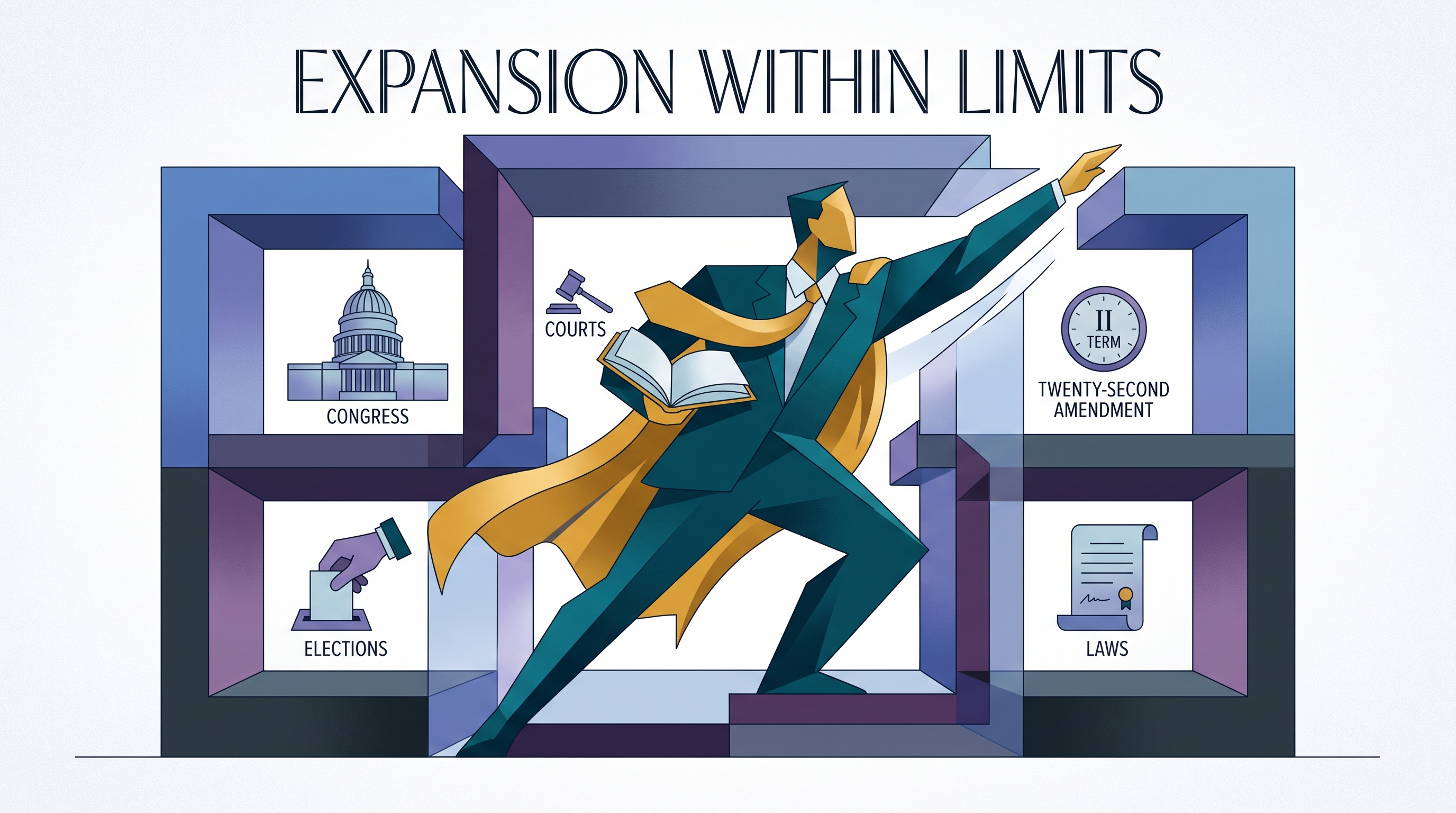
Misconception: “Expansion of presidential power means the president has unlimited power.” Expansion means that presidents interpret or use existing formal and informal powers more broadly; it does not erase constitutional limits. Congress, the courts, laws, elections, term limits, and public scrutiny can still constrain presidential action, even though the balance among branches may change over time.
Retrieval check: Why does Federalist No. 70 support a strong executive, and why does the Twenty-Second Amendment suggest concern about executive power? In one sentence, connect each document or constitutional provision to the competing debate between energetic leadership and limited government.
Source Materials
- AP U.S. Government and Politics Course and Exam Description
- Learn More (.pdf)
- AP U.S. Government and Politics Course Overview
- AP U.S. Government and Politics Course at a Glance
- AP United States Government and Politics Course at a Glance Poster
- AP United States Government and Politics
- AP United States Government and Politics
- United States Government and Politics Sample Syllabus 1